
Omaha Immigration Court packs more than 100 deportation cases in a day
Court handles most detained and all nondetained Iowa immigration cases
By 8:30 a.m., four days after the nation’s 250th anniversary, the line outside the Omaha Immigration Court stretched 36 people deep. Adults stood beneath umbrellas against the summer sun and clutched accordion folders of paperwork.
A baby cried in a stroller. Two children sat on the sidewalk, plucking at the grass. A toddler in a pink dress stumbled on the edge of the sidewalk, catching herself with her hands as a pacifier clipped to her dress swung against the concrete.
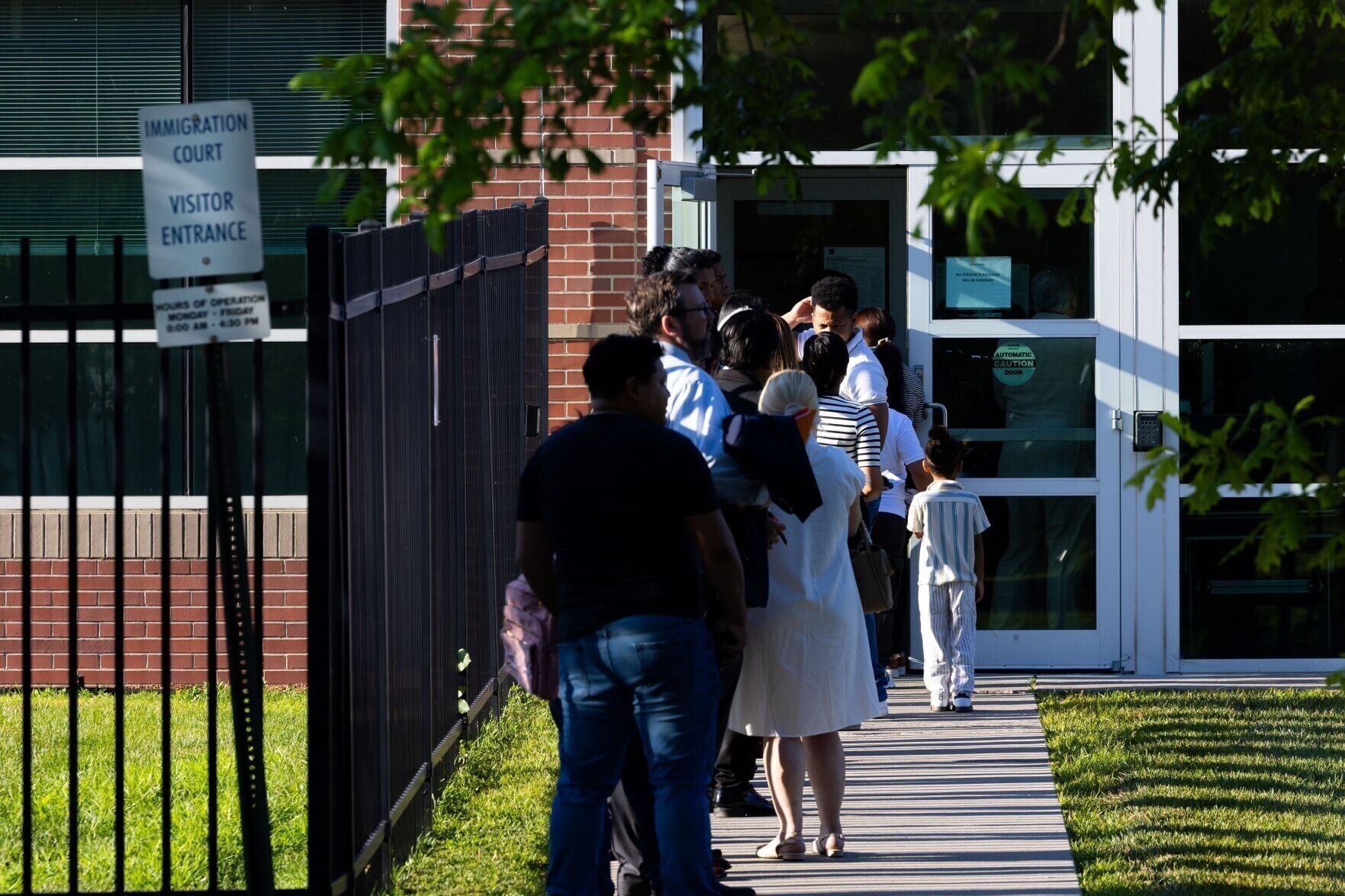
The line extends out the door for the visitors' entrance, where non-detained people enter for immigration court hearings, at the Omaha Immigration Court at 1717 Ave. H East in Omaha on July 14.
Inside, the courtroom’s three rows of benches were already full. In the hallway waiting area, every chair was taken, court officials told an attorney waiting with a client. People crowded between the entryway’s two sets of doors.
Immigration Judge Matthew Morrissey had 118 cases on his docket that day — roughly triple the 30 to 40 cases he heard during a typical master calendar session. Migrant advocates and court officials call these larger sessions "mega master calendar hearings."
Regular master calendar sessions resemble a county court arraignment, with rows of people waiting their turn before a judge. In those preliminary appearances, judges explain the civil charges and respondents' rights, take pleas, set filing deadlines and schedule future court appearances.
Mega master hearings can place more than 100 immigration cases a day before a single judge in the local court, compared with the previous norm of up to 50 cases per judge. The larger hearings now happen three times a week.
Attorneys across the country began reporting supersized dockets in mid-May, according to the National Immigration Project, a national network of immigration attorneys and advocates.
The Omaha court held its first mega master hearing June 9, according to Roxana Cortes-Mills, legal director for the Center for Immigrant and Refugee Advancement, a Nebraska nonprofit that provides legal, resettlement and social services to immigrants and refugees in Nebraska and Iowa.
Nebraska's only immigration court handles most detained and all non-detained immigration cases in Nebraska and Iowa.
Cortes-Mills said the court is now moving up hearings that had originally been scheduled years into the future. The court often gives people no more than a month's notice. Some of CIRA’s clients received notices after the hearings had already taken place and they had been ordered deported for failing to appear.
Advocates say some migrants are receiving late notice about the hearings or none at all. An Omaha World-Herald analysis of data from the Executive Office for Immigration Review, the Justice Department agency that runs immigration courts, found a June spike in the number of people ordered removed after failing to appear for a hearing, the same month the mega hearings began.
Under federal law, an immigration judge can issue an in absentia removal order only after finding that the government gave a respondent proper notice of the hearing and proving that a person is removable.
The accelerated pace of hearings comes as the Trump administration has expanded immigration enforcement since President Donald Trump returned to office in January 2025 and sent more cases into the system that determines who can stay in the U.S.
A spokesperson for the Executive Office for Immigration Review said the office adjusts schedules as needed so cases don't languish and will keep doing so as it hires new judges with additional funding from Congress via the latest federal budget reconciliation bill.
The Secure America Act, which became law this summer, provides $70 billion for the Department of Homeland Security, U.S. Customs and Border Protection and U.S. Immigration and Customs Enforcement for personnel and technology. The 2025 One Big Beautiful Bill Act also increased funding for immigration courts.
“Unnecessary delay hurts both aliens with meritorious claims and the American public, who wish to see aliens with non-meritorious claims removed as quickly as possible,” the spokesperson said.
A court already strained
The rush is reshaping the immigration court’s Omaha outpost that was already under administrative and physical strain.
People with cases pending in the court wait an average of 1,169 days — or more than three years — for their cases to be heard. The Omaha Immigration Court has among the nation's longest waits, second only to the border court in El Paso, Texas, and well above the national average of 911 days. The local court's backlog, which peaked at more than 45,000 pending cases in 2024, has fallen by nearly 4,000 since.
But clearing cases through mega master hearings can come at the expense of due process and raises the risk of having to revisit the same cases weeks later, said Grant Friedman, an ACLU of Nebraska attorney who represents immigration detainees.
“The cases that they’re moving really fast on — some of them are the ones that I then spend hours upon hours litigating in federal court for them to be then ordered to have a bond hearing or ordered release,” Friedman said. “So then, what may have been a four-minute hearing in immigration court resulted in 100 hours of my time, the assistant U.S. attorney’s, the ICE agents that are having to write the affidavits in support of it and then the officials that are having to coordinate it at the court. … It’s just so much time that is being spent to correct one thing that happened in three minutes.”
Since Trump took office the second time, Omaha deportation cases resulting in removal orders have surged. In March 2026, 664 people were ordered deported in Omaha — the most in a single month in Omaha since at least 1998, when the oldest records from Syracuse University’s Transactional Records Access Clearinghouse begin.
According to a February 2024 report by ACLU Nebraska and the University of Nebraska-Lincoln’s Legal Decision-Making Lab, Omaha historically featured one of the lowest asylum-granting rates in the nation. In fiscal year 2023, it denied about 91% of asylum cases, compared with a national average of about 47%, according to the Syracuse-based center.
The 2024 report observed 534 master calendar hearings in Omaha and found the average lasted 3.9 minutes. In more than four out of five observed hearings, immigration court judges did not advise the people facing possible removal of their rights. Of the 18% whom judges did advise, the judges typically addressed the people waiting to access the court as a group instead of individually, the report said.
Friedman said the practice of advising people of their rights as a group “certainly got worse” with the larger, faster hearings.
“If they are getting the information in a way that is not tailored to how they can receive it, then you didn’t give them that information,” Friedman said.
In a statement, a Justice Department spokesperson said the department is hearing cases fairly and according to the law.
Immigration judges answer to a different authority than most judges, Friedman said. They are Justice Department employees, typically former ICE prosecutors, and unlike federal and state judges, they can be fired or reassigned like any other employee. Under the current administration, he said, judges seen as friendlier to migrants are being moved off dockets dealing with detainees.
“The problems that we are feeling in Omaha are not unique,” Friedman said. “They are being experienced across the country.”
The Justice Department has added new judges in Omaha and reshuffled the court’s original three, Friedman said.
The Executive Office for Immigration Review website lists eight Omaha immigration judges, including the assistant chief immigration judge whose jurisdiction also includes Minnesota and Missouri. One of the new judges was appointed in February as a temporary Omaha immigration judge. The two others were appointed in the spring.
Cortes-Mills, the Center for Immigrant and Refugee Advancement legal director, said the new judges arrived as the larger, faster hearings began. When updated numbers of backlogged cases come out, there will be no way to tell which change moved them.
Another problem with the mega hearings is physical space. While Omaha has new judges, Cortes-Mills said, it still has only three courtrooms.
“Our courtrooms do not hold 100 people,” Cortes-Mills said.
When Judge Morrissey had 118 cases on his docket July 8, the court did not allow the public or press to observe open court proceedings until the line of people headed to court had died down.
A week earlier, The World-Herald sat through a morning session when the court was a little less packed. Morrissey had 81 cases on his docket. Here’s what happened:
Represented
Just before 8:30 a.m., lawyers and immigrants entered the small administrative courtroom at 1717 Ave. H East, filling its three benches that seat about 30 people.
A little boy in a yellow polo gripped his mom’s fingers with one hand and a sippy cup in the other, following his older brother to a seat.
Judge Morrissey took his seat beneath the Justice Department seal and swore in a Spanish interpreter appearing by Webex. A Department of Homeland Security prosecutor sat behind a computer monitor at a table in front of the gallery.
The court reporter hadn't arrived, and Morrissey took his own notes.
"Everything's gonna be a little slower today," he told the courtroom crowd.
An immigration attorney brought the morning’s first client to the respondent table — an Iowa woman in glasses and a floral blouse. The government's charges against her were incorrect, the attorney told the judge: His client had entered the U.S. on a tourist visa in 1978. Morrissey reset her case for October, and the attorney stayed at the table as his next client stepped up.
That became the morning’s rhythm. Attorneys, rather than clients, were called and stayed at the table until all their cases were heard. Morrissey asked respondents which language they spoke and understood best, verified addresses, took pleadings and set new dates when he could.
Attorneys sought time to prepare, asked that relatives’ cases be consolidated and challenged government charges they said were incorrect. In one family’s case, the court could not find the father in its system. Another woman had been scheduled so her case could be joined with her sister’s, only to learn that the court had moved her sister’s hearing. Most cases were reset for October.
Throughout the day, a tense silence filled the space between Morrissey's statements and interpreter's translations, which lagged over the virtual connection. Confirming one family's address, he stopped her mid-sentence: "That wasn't what I said."
One man said the language he understood best was French. There was no French interpreter on Webex. Morrissey asked whether he spoke a little English and whether he would waive his right to interpretation. He did.
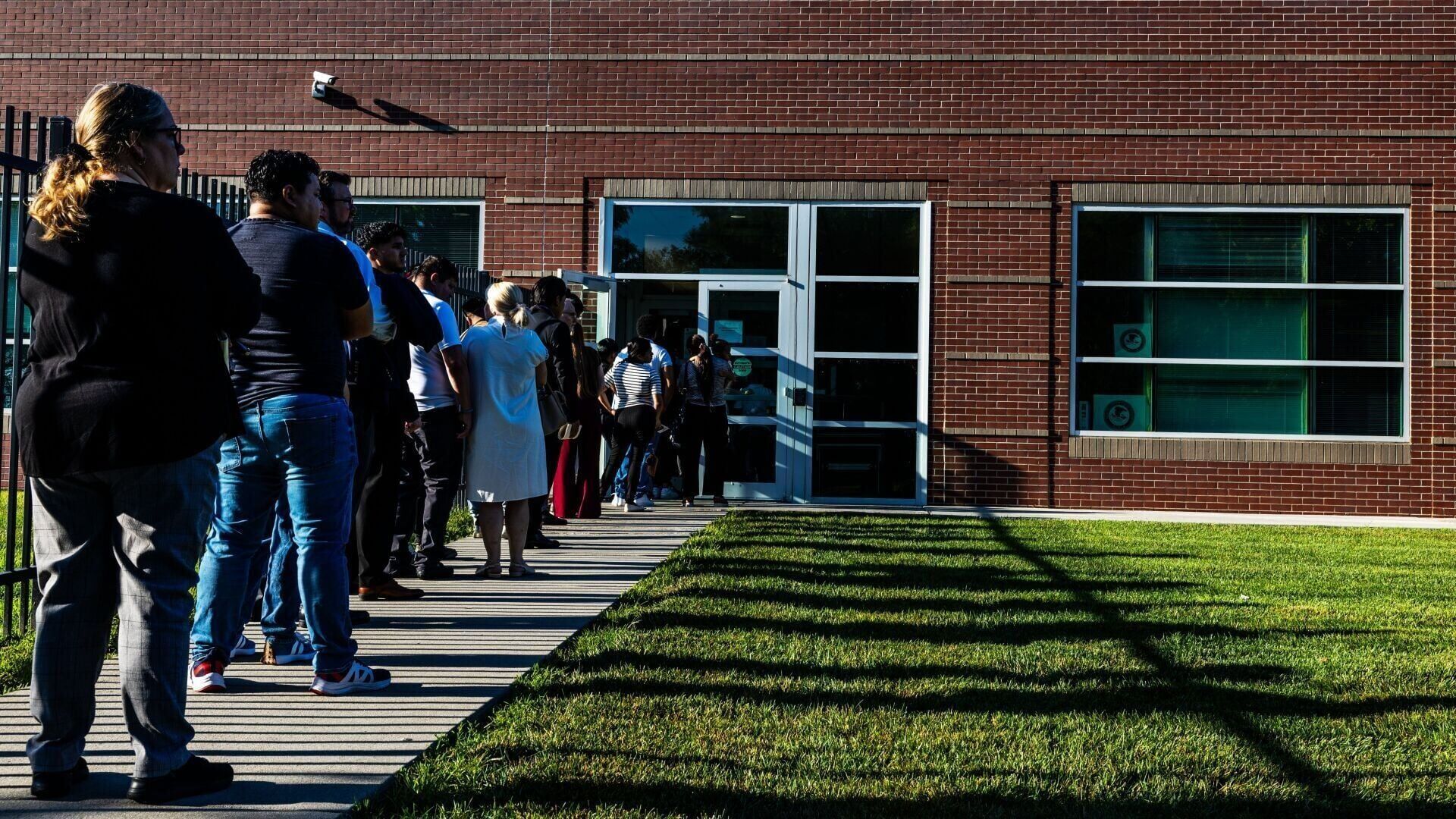
The line extends out the door for the visitors' entrance, where nondetained people enter for immigration court hearings, at the Omaha Immigration Court located at 1717 Ave. H East in Omaha, Tuesday, July 14, 2026.
As the man, from the Democratic Republic of Congo, left, Morrissey turned to the DHS attorney: "Don't just write Congo. That's not a country."
Next came an Omaha family from Venezuela, a husband, wife and son dressed in a suit. They were seeking asylum. They entered their pleas, and Morrissey told them their next hearing would be the trial on their asylum claim. He could not tell them when. The docket was being reorganized the following week. He said he was sorry.
"I think we should tell you when your next hearing is," Morrissey said. "But unfortunately someone else has made the decision not to do that."
The inability to schedule next hearings is new, Cortes-Mills said.
“What I think is happening now is that the administration has … put a limit on how far they can schedule trials,” she said.
At 10 a.m., Morrissey addressed the gallery and the Webex room: We're trying to get to your case. We just have a lot of cases this morning.
A boy in the front row wrapped his arm around his little brother, both dressed in white. The smaller boy’s feet didn’t reach the floor, and he swung them back and forth before leaning his head against the arm of the bench.
The last case with an attorney was a number and name until the attorney corrected the judge with a title: doctor. She told the court he is a hematologist and professor at the University of Iowa who was in the country legally on an H-1B visa. His Notice to Appear was dated May 27.
"I find this wholly ridiculous that he's even in removal proceedings," the attorney said.
Morrissey told the attorney to see whether she and DHS could come to an agreement. He set a new hearing for August.
On their own
By 10:16 a.m., the attorneys were gone, and the unrepresented respondents — the pro se cases — filed in.
Nationally, having a lawyer is one of the strongest predictors of how an immigration case ends. A national study on access to counsel, updated last year by researchers at the University of California, Los Angeles School of Law, found that nearly two-thirds of immigrants who found attorneys succeeded in avoiding deportation — and that people with them are far more likely to show up for their hearings.
Barely half find one. In immigration court, unlike criminal court, the government does not provide an attorney to those who cannot afford one on their own.
Morrissey asked the gallery to rearrange itself so that everyone with a case sat in the front two rows. The back row held family, friends and a World-Herald reporter. The family in white stayed seated.
The judge told the room he would be reading them their rights as a group, which he noted requires organization. First, he stressed that they must file a change of address form with the court every time they moved. He asked whether anyone already knew that they needed to do so.
Two raised their hands, and the court reporter handed them forms.
Notices for hearings go out by mail to the address the court has on file, Cortes-Mills said, but not everyone knows they have to update it when they move — or how. That’s a longstanding problem not unique to mega master hearings, she said. At the state's first such hearing, a CIRA attorney recalled watching person after person update their address in court.
Morrissey called out names and alien registration numbers, asking people through the Spanish interpreter to raise a hand when called. Then he asked them to raise their hand if they spoke and understood Spanish best. All did.
He played a video of himself advising them of their rights, each line translated into Spanish. At 10:33 a.m., he asked everyone who understood their rights to raise their hand.
Asking a room whether it understands Spanish, rather than asking each person what language they understand best, leads people to an answer, Friedman said.
Migrants in a high-stress environment, when they know the judge decides their fate, may interpret that question, “Raise your hand if you understand Spanish best,” as a binary with the alternative being that they speak English the best, and raise their hand because they understand more Spanish than English, even if neither is their primary language, Cortes-Mills said.
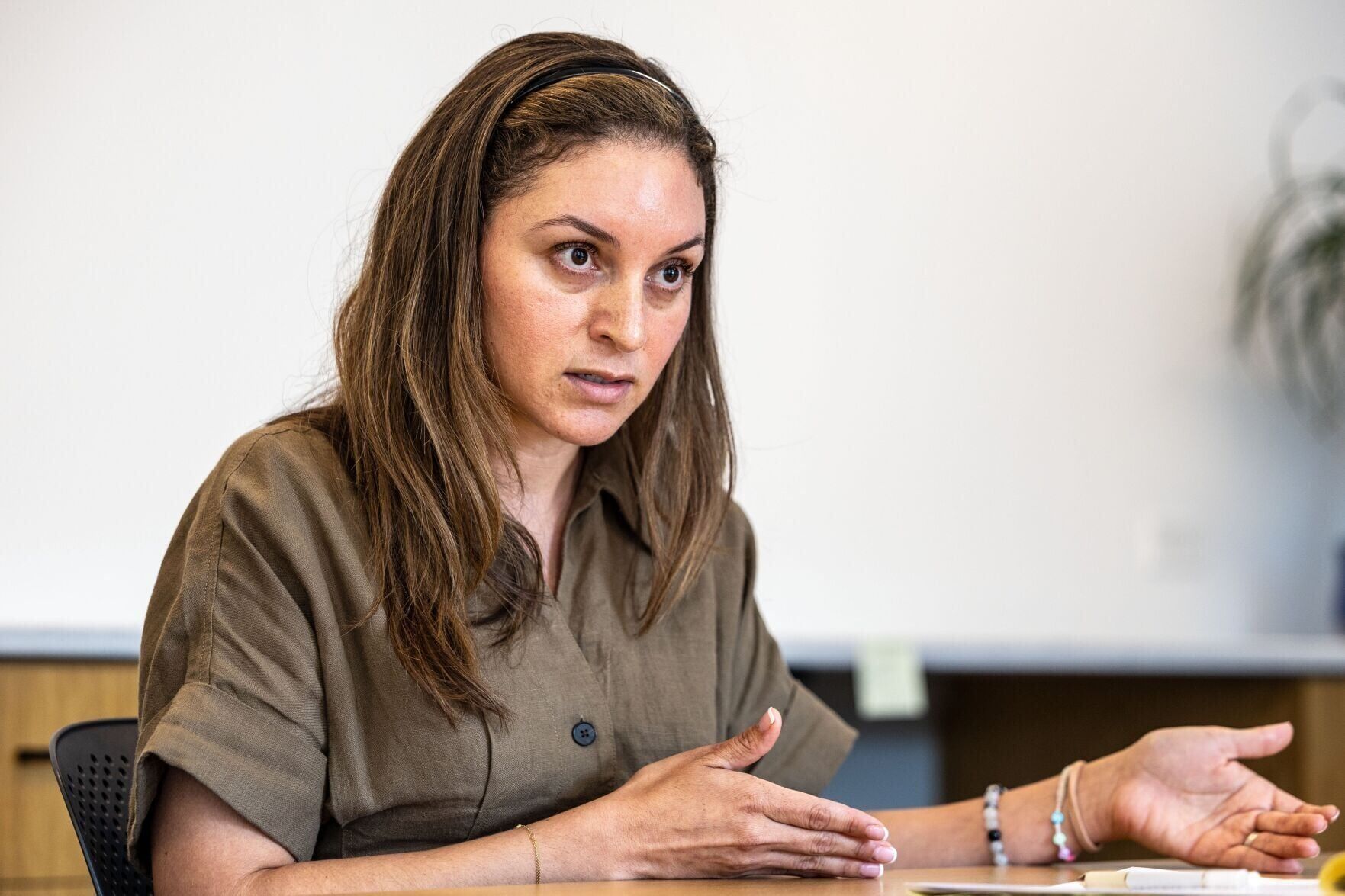
Roxana Cortes-Mills, legal director for the Center for Immigrant and Refugee Advancement, talks about "mega master" calendar hearings in the Omaha Immigration Court during an interview at the CIRA office in Omaha on July 10.
In a group that size, Cortes-Mills said, the odds that someone's primary language is neither English nor Spanish are pretty high. A court can put on the record that rights were read but not that they were understood, she said.
Then: Raise your hand if you already have a lawyer. An elderly man's hand went up. Morrissey informed him that the advocate he had walked in with was not an attorney.
Then: Raise your hand if you want time to find one. Most hands went up — including that of a little girl in a pink princess dress with pink bows in her hair, facing the back of the courtroom with her chin on her father's shoulder. When his hand rose, so did hers.
Two people didn't raise their hands. After some back and forth, seeming confused about what was happening, they did.
"I don't know why that was so hard the first time," Morrissey said when the last woman's hand went up. The interpreter did not translate the comment.
Morrissey explained the plan: He would verify each person's address and reset their hearings for Dec. 9, giving them time to find lawyers. He asked them to keep filling in the respondent table as each person finished, and for their help making things go fast, because there were a lot of them.
The elderly man went first. In less than a minute, Morrissey verified that he spoke Spanish, understood his rights, lived at the same address and wanted time to find an attorney. It took the man a moment to realize his hearing was over and he could leave.
"Good luck," Morrissey said at the end of case after case.
By the time her turn came, the girl in the princess dress was asleep against her father's chest. He carried her in one arm, with a plum-colored accordion binder of legal documents and papers that he did not need.
All pro se Cuban respondents were instructed to go last. When their time came, Morrissey told them they might have options to adjust their status under the Cuban Adjustment Act if they had been paroled into the country.
If they didn't know how, he said, they should try to get a lawyer. At 11 a.m., two and a half hours after the first case was called, Morrissey took a 10-minute break, his first of the day.
The next respondent asked for a Creole interpreter — the language understood best by his mother, who was seated in the gallery. Morrissey repeated that he could provide an interpreter only for the language the respondent himself understood best, which the young man had said was Spanish, and only for people whose cases were being heard that day.
Then the Homeland Security attorney, looking at his monitor, notified the judge that the respondent was 17 years old. Morrissey said he was trying to figure out why a child was representing himself in his courtroom.
"This is a tough day made worse by whoever files this stuff not putting families together," the judge said.
He found the boy's mother's case and rescheduled the boy's hearing to match hers — in 2027.
"When you're 17, you should be with your mom," Morrissey told him. The judge thanked him for coming to his hearing anyway.
He wasn't the first minor on a Nebraska mega master docket, according to Cortes-Mills. A CIRA attorney saw an unaccompanied child — a boy who appeared to be 5 or younger.
The judge noted on the record that the child belonged on the court's juvenile docket and continued his case to the next docket day for kids.
Then Morrissey let in a group of Haitians waiting in the hallway to represent themselves. He greeted them in Creole and dialed a number on Webex. A recorded voice offered language options. Morrissey pressed 6 for Creole.
Two girls in princess dresses — one green, one pink, their beaded hair in buns with bows — walked in smiling and sat in the back, the younger one on the older one's lap. Eventually they were running around, peeking their heads over the benches, and Morrissey asked one of the group members to take the children into the hall.
He read them their rights in English, and the interpreter on the phone translated them into Creole. The voice was loud but muffled, breaking up as it went. Some in the front rows looked around.
In an individualized hearing, a judge can pause, look up and realize when a person’s body language indicates that they don’t understand, Cortes-Mills said.
"That is an element of having a fair day in court — having your hearing and an opportunity to talk to the judge about your specific facts, including language necessities, so that you can understand your proceedings," she said.
She doesn't see a way to square that with advising rights to a full courtroom at once. She said the larger, faster hearings remind her of mass production assembly lines — quick, but lacking in quality assurance.
"I'm not saying that the judges are doing this because they want to do this," she said. "It's just a fact that it’s happening. … I don't see a way to not violate that area of due process unless we're giving people their individualized hearings (in) the way that we have been doing so far and prior to these mega masters."
Three hours later, at 11:40 a.m., Morrissey had worked through nearly 50 cases.
The no-shows
Not everyone with a case that day made it to the courtroom.
People who miss immigration hearings have always risked being ordered deported in their absence, Cortes-Mills said. What's new is the number of people not showing up and the likelihood that they didn't know they had a hearing.
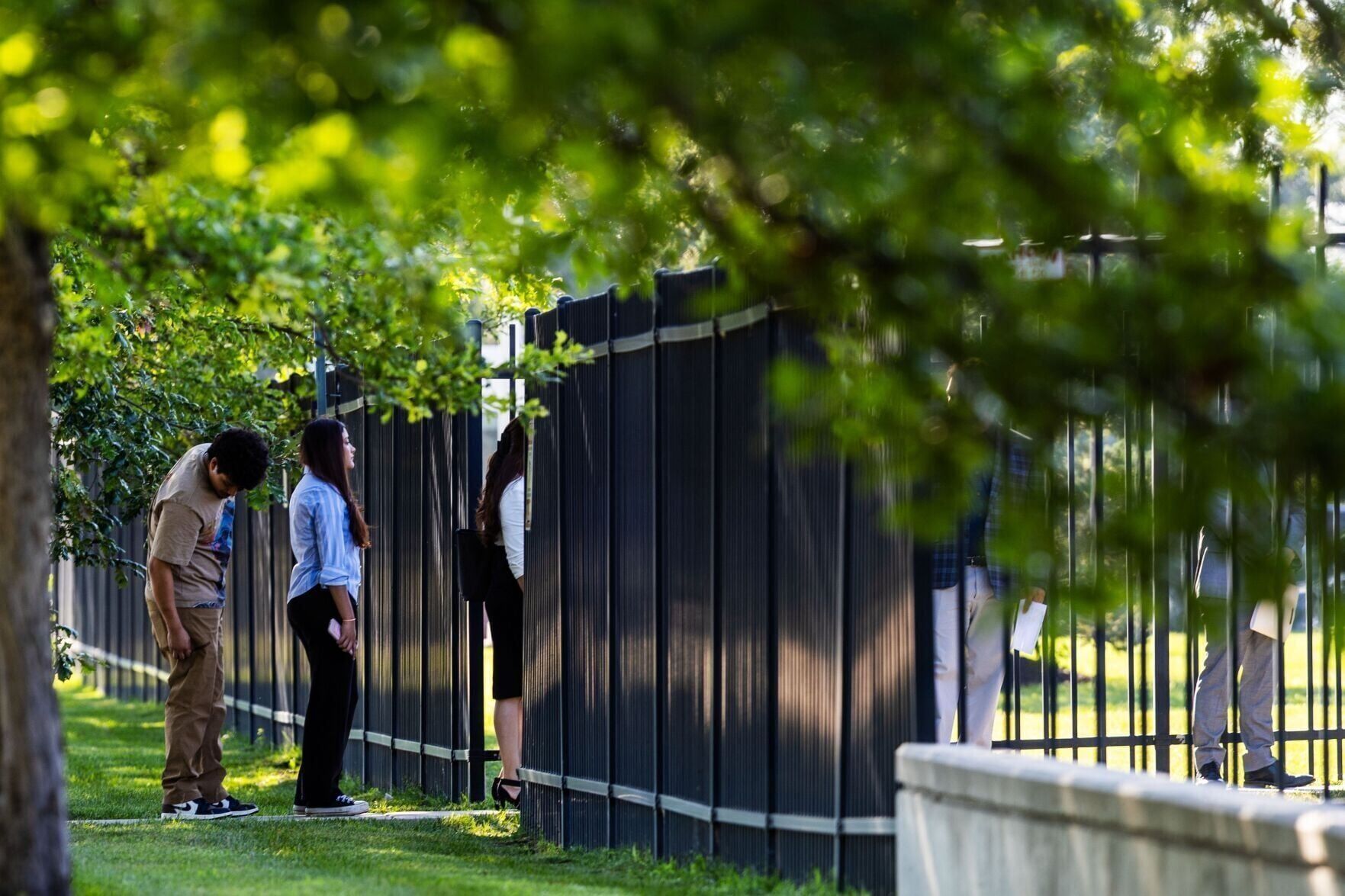
The line extends to the sidewalk for the visitors entrance, where non-detained people enter for immigration court hearings, at the Omaha Immigration Court on July 14, 2026. Attorneys across the country began reporting supersized dockets in mid-May, according to the National Immigration Project
With cases accelerated by a year or more, the most notice CIRA has seen anyone get is a month, she said. One woman brought a CIRA attorney a hearing notice she had just received in the mail. The hearing had happened days earlier, and she had been ordered deported in absentia.
"That begs the question: Are they not showing up because they don't want to show up, or are they not showing up because they're not getting the notice?" Cortes-Mills said.
Even people who do get notice may not be able to act on it, she said.
"The expense becomes insurmountable and not accessible to some people," she said.
Most mega master hearings start at 8:30 a.m. For someone living hours away from Omaha, that can mean finding — or paying — someone to drive them, a place to sleep, time off work, arrangements for children.
“It becomes a really complex situation,” she said. “When they have sufficient notice, they can plan for these things.”
Friedman offered a theory for why most of the hearings they've observed are merely reset for another day.
“I think genuinely that is just the … first round of filter to try to get folks that will not engage removed,” he said.
Undoing a deportation order issued in absentia requires persuading the court to reopen the case.
"It's a difficult process for us as attorneys to navigate," Cortes-Mills said. "It's definitely … a nearly impossible process for a pro se individual to navigate, and it is cost-prohibitive."
When the respondents had all left, Morrissey read out the “alien numbers” of every case that was scheduled but didn’t show: five families and two individuals, 21 people in all.
The Homeland Security attorney motioned for removal in absentia. It took 40 minutes to do so, between side conversations about their kids’ baseball and football teams. All were ordered deported.