
A cancer crisis decades in the making is bearing down on rural Iowa
This is the first in a series examining Iowa's cancer crisis and the lives caught in it. Funding from the USC Annenberg Center for Health Journalism's 2026 National Fellowship helped to support this series.
ATLANTIC — Three times, Lavonne Schroeder was sent home to die.
Twenty-three years after cancer first upended her life, she was settled into one of the recliners at Cass County's only cancer center, a blue cap covering her head as another round of chemotherapy flowed into her veins.
"I never imagined I'd be 72," she said.
Schroeder has a stage 4 granulosa cell tumor, a rare ovarian cancer that has forced her through surgery after surgery, chemotherapy, sepsis and cardiac arrest. Three years ago, while still fighting her own cancer, she cared for her husband at their farmhouse until he passed away from spinal cord cancer.
Now she is tired.
"I'm not doing very well. This is one of my lower points," Schroeder said, her voice faltering. "I never expected to live this long anyway, so whatever they tell me, I'm at peace. Whatever is going to happen in the next year, I'm at peace."
Tears welled in every corner of the room as Schroeder spoke. The steep toll cancer has taken on her life and family would be staggering almost anywhere. But in Cass County, and across Iowa, stories like hers are becoming unnervingly familiar.
"Living here, it has always felt like it was not a matter of if you were going to get cancer. It was a matter of when and where that cancer was going to be," said Sarah Strohman, director of public health for Palo Alto County.
Cass County only recently overtook Palo Alto County for the highest cancer incidence rate in Iowa, according to data from the National Cancer Institute. The two heavily agricultural counties, though, are hardly outliers: Nearly half of Iowa's 99 counties now have cancer rates higher than Louisiana's "Cancer Alley," a heavily industrialized stretch long infamous for its extraordinary cancer risk.
Iowa ranks second among states for cancer incidence and is one of only three states where rates are still rising. Some 21,700 will be diagnosed this year, according to the Iowa Cancer Registry. About 6,400 Iowans with cancer will die.
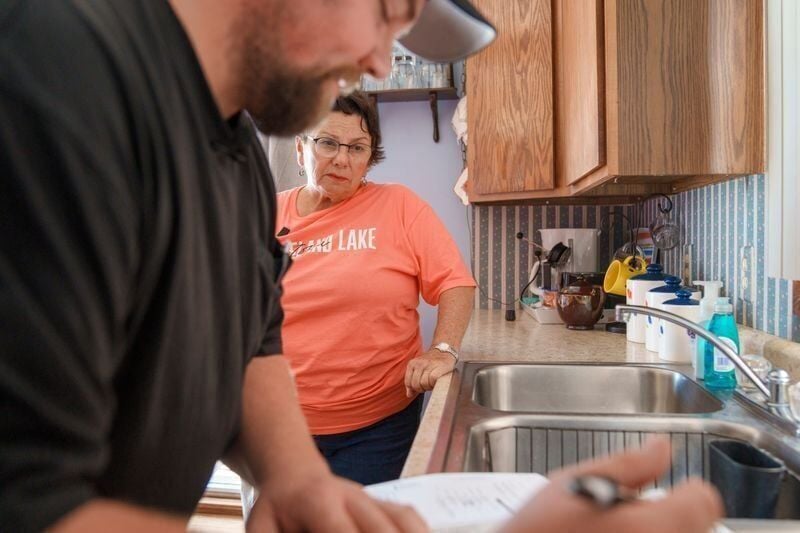
Ben Huntley, environmental health coordinator for Emmet and Palo Alto counties, performs a water test with Maureen Reeves Horsley, a nurse practitioner and Palo Alto County resident, on Wednesday, July 29, 2026.
"Iowa ranks second behind Kentucky in cancer incidence, but Kentucky is getting better, and Iowa is getting worse,” said Brett Altman, CEO of Cass Health. "There is little doubt that we will overtake them and infamously become the No. 1 cancer state per capita."
Iowa's cancer crisis is unfolding across one of the most intensively farmed landscapes in the world. About 84% of the state is farmland. In 2025, more than 13.5 million acres of corn and nearly 10 million acres of soybeans were planted across more than 86,000 farms in Iowa, according to the U.S. Department of Agriculture. Laid end to end, Iowa's 2025 corn harvest could stretch to the moon and back — roughly 99 times.
To grow all that, nearly 11 billion pounds of commercial fertilizer were sprayed on Iowa fields. And that's dwarfed by the 215 billion pounds of manure coming out of Iowa's livestock facilities annually, much of it also spread on fields. It would take more than 2 billion people an entire year to produce that weight in feces.
For generations, rural Iowans have taken pride in the mantra that they "feed the world." Now, they are questioning what that has cost them at home.
"In Iowa, it's not just the air we breathe," said Maureen Reeves Horsley, a longtime Palo Alto County nurse practitioner who lost her sister to breast cancer.
"In this Cancer Alley that we all live in, it's the soil that we grow out of. It's the water that we drink. It's the hog confinements, the big factory farms, the fertilizer, pesticides and everything else that poisons us every single day."
Now, she said, Iowa is facing a reckoning.
"This is really the awakening of the sleeping giant," Reeves Horsley said. "People are really starting to say, 'Oh my. The giant has been poked.'"
What is in the water?
On the vast Lost Island Lake in Palo Alto County, gentle ripples shimmer across the sunlit water. People here move a little slower, on what they like to call "lake time."
Ben Huntley, though, is not afforded that luxury.
The county environmental health technician spends his weeks bouncing between Palo Alto and Emmet counties, inspecting wells and, increasingly, answering the question: "What is in my water?"
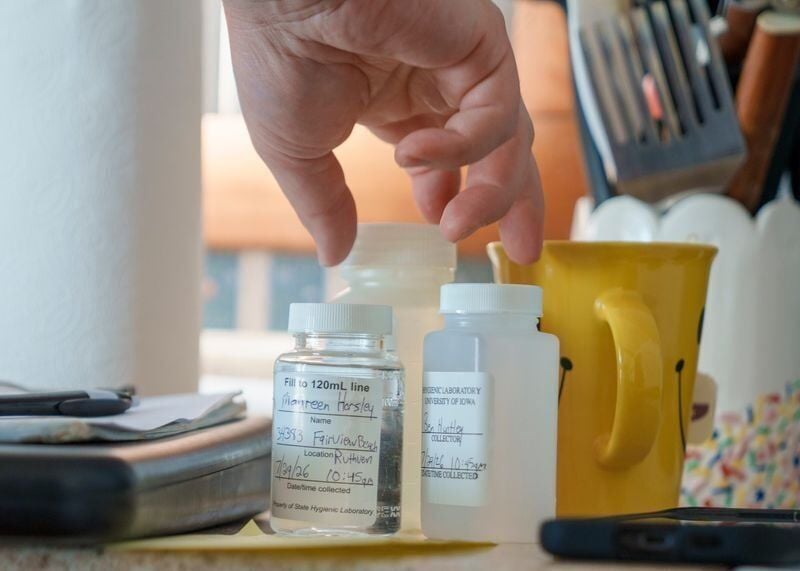
Ben Huntley, environmental health coordinator for Emmet and Palo Alto counties, performs a water test with Maureen Reeves Horsley, a nurse practitioner and Palo Alto County resident, on Wednesday, July 29, 2026.
"We're at the center of the cancer rates. Was I expecting that? Never," he told the Des Moines Register in late July, as he drew a sample from the private well at Reeves Horsley's lake cottage. "Because of the cancer rates, it has gotten a lot more people wanting samples and being curious."
About 282,000 Iowans rely on private wells, many in rural communities. Unlike municipal systems, the quality of the water in those wells is not regulated under federal law.
But there is plenty of reason for concern.
Beneath Iowa's fields lies an intricate system of more than 2 million miles of drainage tile — underground pipes that turn what was once marshy ground into some of the most productive farmland in the world.
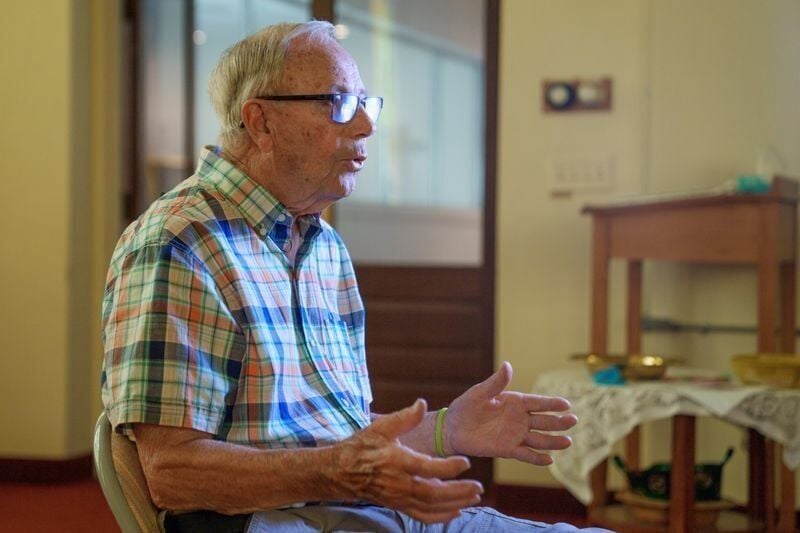
Al Puterbaugh has pancreatic cancer and lost family to cancer. His home county, Palo Alto, has one of the highest cancer incidence rates in Iowa.
The pipes move water quickly into streams, often picking up excess nitrate from fertilizer and manure as it leaches through the ground. Those streams are then effectively turned into drainage ditches, feeding larger rivers like the Des Moines and Raccoon rivers, which flow through some of the state's major cities. Research commissioned by Polk County says the rivers are among the worst nationally for nitrate pollution.
"You have all of our nitrates from the north coming down into Des Moines, while up here we have our heads in the sand," Reeves Horsley, who grew up on a Palo Alto County farm along the West Fork of the Des Moines River, said.
Downstream, Des Moines' water utility said it spent about $2.2 million in 2025 removing nitrate from drinking water. It must keep the levels under 10 milligrams per liter, per the U.S. Environmental Protection Agency's limit for drinking water.
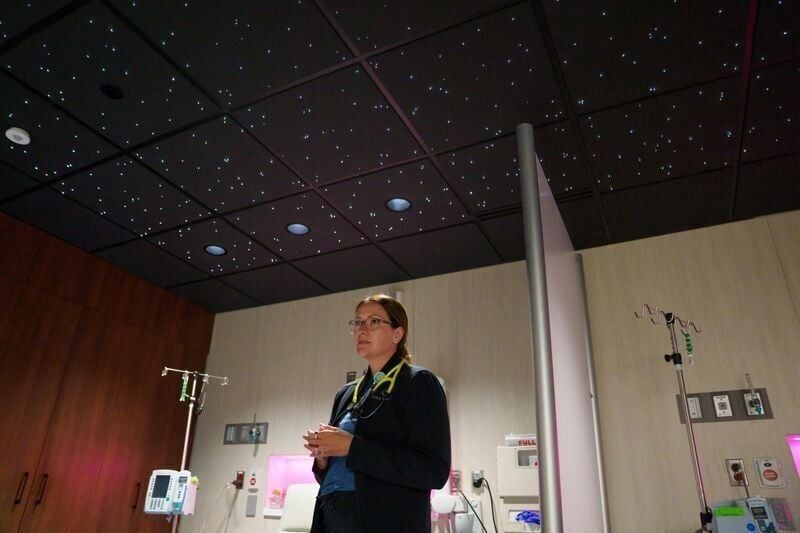
Nurse Emmy Benton works at the Tyler Family Cancer Center at Cass Health on Monday, Aug. 3, 2026, in Atlantic.
That limit was set more than 35 years ago to prevent a deadly infant blood disorder known as "blue baby syndrome," not cancer.
Research since has established long-term exposure to nitrate levels as low as 3 milligrams per liter can increase cancer risk. From 2021 through 2023, about 1.2 million Iowans were served by public water systems that recorded a nitrate test at or above that level.
Water from the tap in Reeves Horsley's kitchen tested at more than twice that nitrate level, at 6.9 milligrams per liter.
A landmark 2026 report by the Iowa Environmental Council and Harkin Institute explicitly identified agriculture as a contributor to Iowa's high and rising cancer rates, pointing to its role as the "dominant source" of nitrate pollution in Iowa watersheds and to a "cocktail" of pesticides and forever chemicals.
In 2015, Des Moines Water Works tried to send its bill upstream, suing drainage districts in three northern counties near Palo Alto and accusing them of not doing enough to prevent the funneling of nitrate into the city. It lost, first at the Iowa Supreme Court, and again in federal court, where a judge in 2017 punted the issue back to where it had long been stalled: the state Legislature.
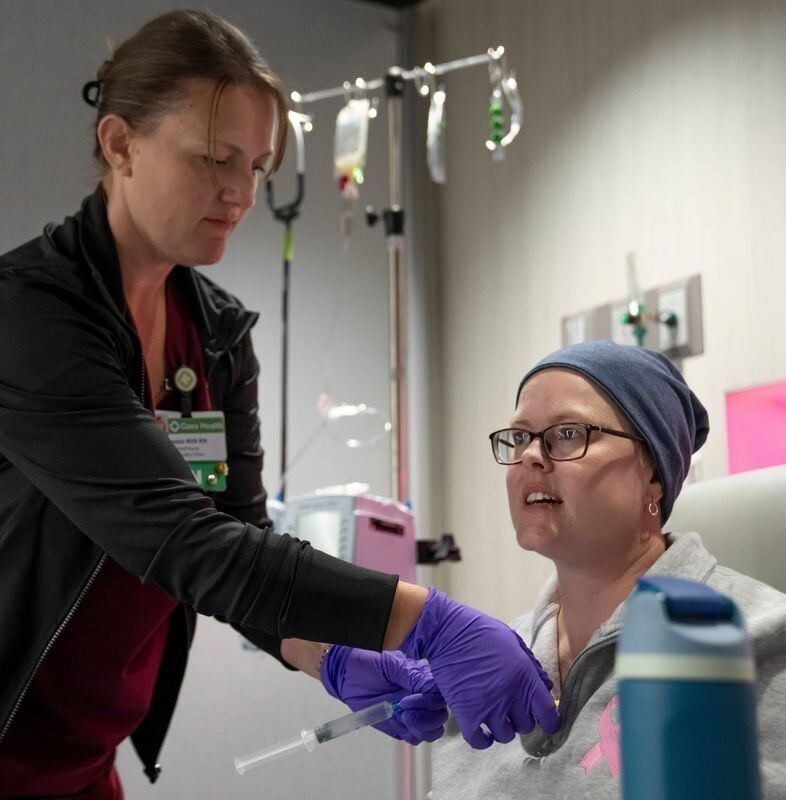
Victoria Means receives chemotherapy at the Tyler Family Cancer Center at the Cass County Memorial Hospital Monday, Aug. 3, 2026 in Atlantic, IA.
National cancer rates fall, Iowa's has spiked
In recent years, Iowa's cancer curve has been bending in the wrong direction.
Iowa's cancer incidence had been declining and roughly tracking the national rate. Around 2013, that changed: Iowa suddenly spiked upward while the national rate kept falling.
That came roughly three decades after the 1980s Farm Crisis ushered in a new era of Iowa agriculture: fewer, bigger farms, more livestock and heavier chemical use. Many cancers can take decades to surface after a harmful exposure.
"The reality is that today's cancer was not caused by something we did yesterday," Strohman, of Palo Alto, said. "It is from something that happened 30 or 40 years ago, and it is going to take a couple of generations to clear some of these things up."
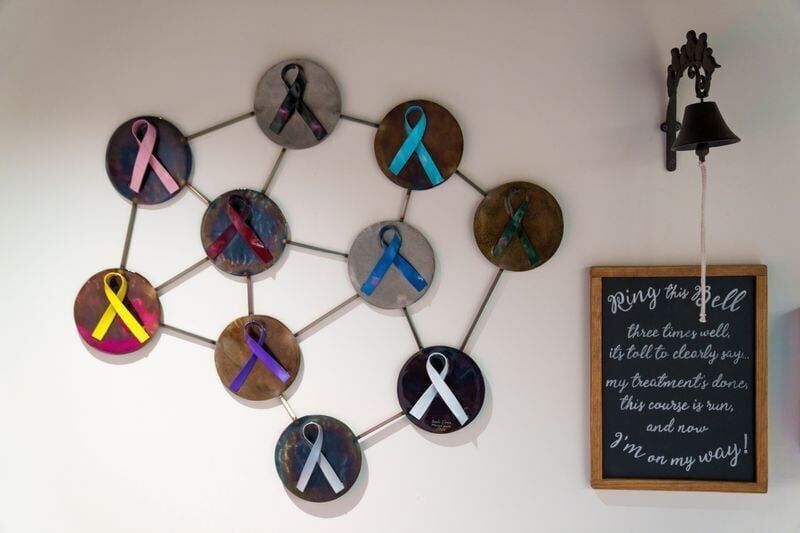
Cancer patients ring this bell at Cass County Memorial Hospital in Atlantic when they complete their treatment.
Al Puterbaugh, a third-generation farmer, lived through those decades from the tractor seat. He worked the land near Ruthven in Palo Alto County.
In 2015, he lost his 19-year-old grandson after a battle with brain cancer.
Eight years later, Puterbaugh's son died at 54 after years of health problems, including several cancerous tumors.
The next year, Puterbaugh lost Jean, his wife of 61 years, after her own battle with colon cancer.
Then cancer came for him.
The former teacher and Pioneer seed dealer was diagnosed with pancreatic cancer, an aggressive disease that is often difficult to detect and treat.
"You get a different perspective as to what this is going to mean for your family, the goals you had set and the things you wanted to do," he said, holding back tears.
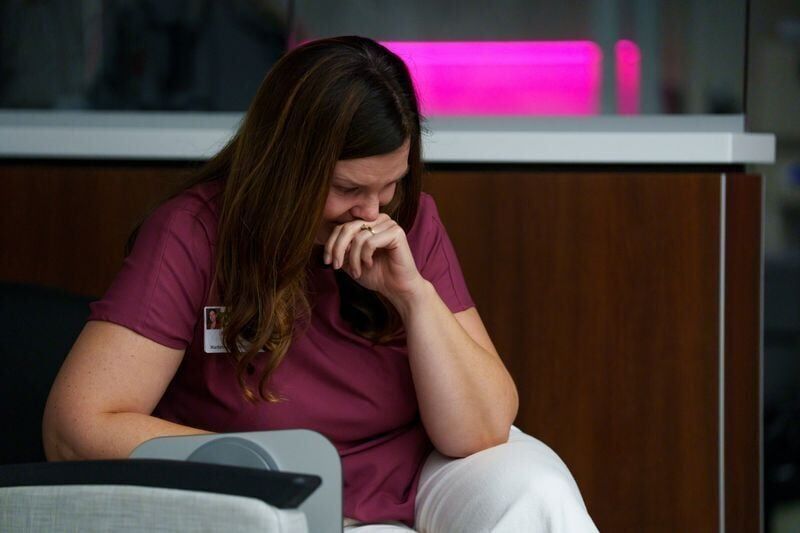
Ann McCurdy, director of marketing and communications and chair of the Cancer Action Plan Team at Cass Health, cries as she listens to one of the stories from a patient receiving treatment on Monday, Aug. 3, 2026, in Atlantic.
Now, after undergoing surgery, chemotherapy and radiation, the 86-year-old is cancer-free.
"I wouldn't wish it on anybody," he said. "I was 185 pounds when I went in for surgery, and I got down to 145 pounds. I'm still frail. It's tough to keep my weight at 147 to 150 pounds."
Puterbaugh said time has made him reckon with the forces driving the cancer around him.
"You have to blame the herbicide companies and chemical companies somewhat, and the farmers," he said.
A growing group of farmers is beginning to say the same.
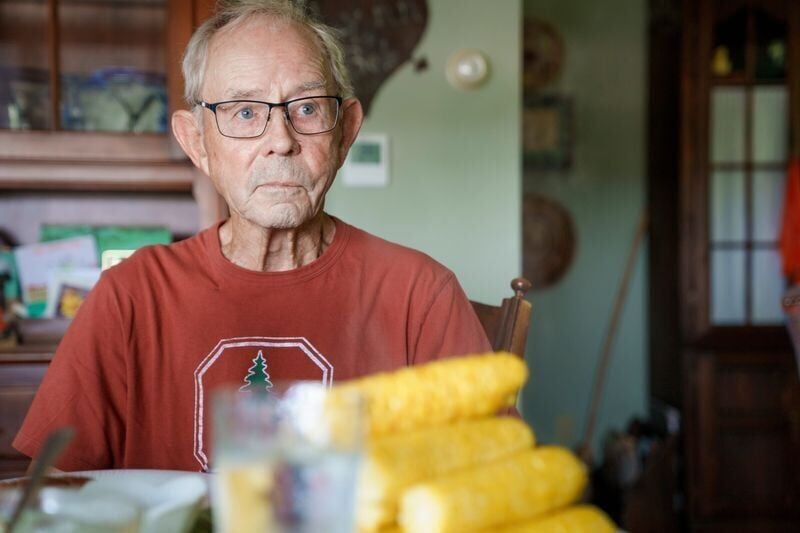
Bob Swan, who last year underwent treatment for duodenal cancer lives around 2 miles away from the Palo Alto County line. He visits with a reporter on Wednesday, July 29, 2026.
James Hepp, Matt Bormann and Zack Smith call themselves the Lobe Rangers, after the Des Moines Lobe area in which they farm. They once served on county boards of the Iowa Farm Bureau, part of the state's powerful agricultural establishment, and were held up as examples of farmers doing their part to protect the environment. Eventually, they said, they began to feel used.
"They put somebody like us up and say, 'Look, here's a farmer doing conservation. This represents all of Iowa agriculture,' when in fact it represents probably less than 5% to 10% at best," Smith said.
Iowa launched its Nutrient Reduction Strategy in 2013, the same year cancer incidence began spiking. The strategy has relied on voluntary action, asking farmers to adopt conservation practices such as planting cover crops to slow runoff and reduce nitrogen and phosphorus pollution flowing into waterways.
One scenario in the strategy envisioned cover crops on about 60% of corn and soybean acres to help reach the state's pollution-reduction goals. More than a decade later, in 2024, they covered less than 17%.
"I don't want to be part of a system that's potentially making people sick as a result of our actions," Hepp, who lost his sister to cancer, said. "We, farmers, need to look in the mirror and say we are potentially part of the problem."
Smith worries farmers, who make up around 2% of Iowa's population, will lose the public's patience if they do not.
"How much longer can we keep that up without losing our seat at the table?" he said.
Smith said he believes the current system is fundamentally flawed.
"We're all scared not to produce enough or keep up with our neighbor, and we create this hamster-wheel effect that we can never get off," he said. "We're getting sicker because of it, and we're subsidizing the whole damn thing. It doesn't make sense when you start adding it all up."
The next patient is already waiting
Cass Health expanded its cancer center in 2022, quadrupling its size. Four years later, it is once again struggling to keep up with the needs. Patients who once could see a specialist within a week of a referral may now wait months.
Here, beneath a ceiling lit with small star-shaped lights, Emmy Benton administers chemotherapy and immunotherapy to patients. Many have ports implanted beneath the skin of their chests so each treatment does not mean another needle searching for a vein already strained by months of infusions.
"There is a lot of stuff you take home with you at night," Benton told the Des Moines Register in late July, her voice breaking. "They become like your family. Any loss is hard. But you have to remember that the next day you are going back to work to help somebody else."
She said she is seeing younger and younger Iowans coming through the doors. Among them: Victoria Means, 34.
Means was only a few years into her own career in public health, where part of her job was helping uninsured and underinsured women obtain breast and cervical cancer screenings, when she found a lump in her breast.
"I was hoping against hope that it wasn't cancer," Means said.
It was. She was diagnosed with stage 3 triple-negative breast cancer.
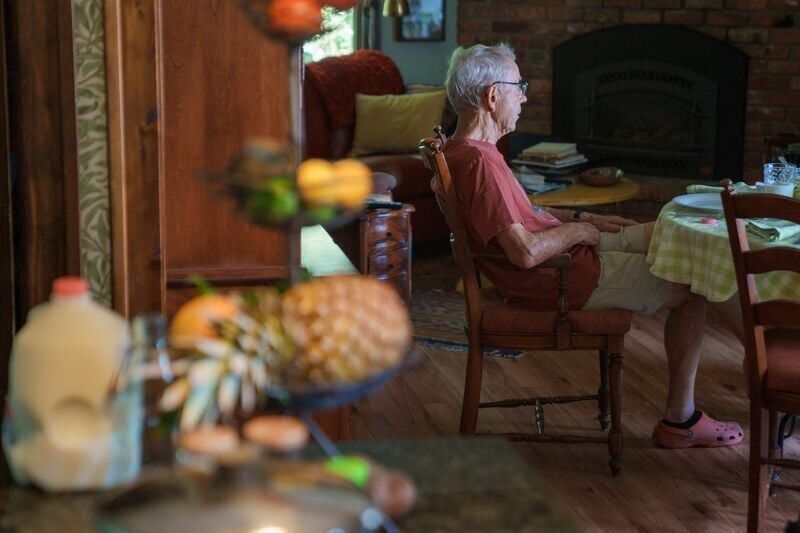
Lynn and Bob Swan live around 2 miles away from the Palo Alto county line Wednesday, July 29, 2026.
Means was on medical leave and receiving immunotherapy on the day she spoke with the Des Moines Register. Each bag of the infusion costs about $36,000 before insurance. Her husband took their three boys, ages 8, 5 and 2, to Adventureland theme park for the day — part of the family's effort to keep cancer from consuming too much of their summer.
Chemotherapy, she said, leaves her exhausted and nauseated. Then, as soon as she begins feeling better, another treatment is due.
"The drugs are awful. They suck. I hate them, but they're there so I can see my boys graduate high school," Means said.
Benton said it helps to keep her mind on the other side: the bell some patients get to ring when they make it through treatment.
"Seeing any of them ring the bell is like a weight coming off your shoulders. It is like, 'They did it. It's done,'" Benton said, tearing up. "The emotion that comes with it is incredible, and you are just so proud."
Cass County, home to roughly 13,000 people, is writing the playbook for its response as it goes. At the center is Cass Health, which has homed in on five cancers with particularly concerning rates. It is pushing colorectal, breast and lung screening and trying to catch prostate and cervical cancers earlier.
There is no single explanation for who will get cancer and who will not. Genetics and random mutations can play a role, as can tobacco and alcohol use, diet, inactivity and sun exposure. So can environmental risks, including exposure to chemicals and radiation. Often, several of those factors overlap throughout a lifetime.
The goal is not necessarily fewer diagnoses tomorrow, said Ann McCurdy, chair of the hospital's Cancer Action Plan Team. It is finding more cancers at stage 1 or 2 instead of stage 3 or 4. The challenge, she acknowledged, is that more screening may make the numbers look worse before they improve.
"We have to reach those younger populations now to hopefully prevent it," she said, noting that up to 40% of cancers are preventable. "This is the long game."
But the cards are increasingly stacked against rural hospitals across Iowa.
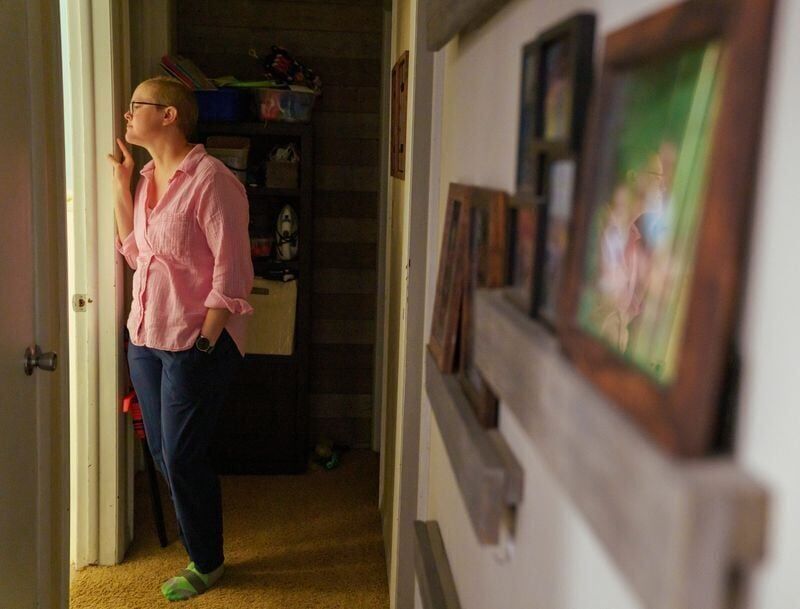
Victoria Means waits outside the bathroom as one of her 3 sons prepares for school Monday, Aug. 24, 2026 in Atlantic, Iowa.
Altman, Cass Health's CEO, said recent federal Medicaid cuts are expected to ultimately drive the hospital’s reimbursements down by about half, with the first round of reductions beginning in 2028. If the hospital does not continue growing, it will have to make cuts, starting with its biggest loss leader: maternity and childbirth care, known as obstetrics.
Autumn Keiser, a Cass Health family physician, said she has seen the fallout when rural obstetrics units close.
"When an obstetrics department closes, people lose access to not only care, but also cancer screenings," Keiser said. "Closing obstetrics, which is generally not a money-maker for a hospital, has all of these downstream effects."
For a county trying to screen its way out of Iowa's highest cancer rate, losing even part of that already limited capacity could be costly.
"Rural Iowa needs help," Keiser said. "If we lose more hospitals and services, it is going to get even worse."
'Is that what caused my cancer?'
In the garden at his home two miles across the Palo Alto County line, Bob Swan, a third-generation farmer and former Pioneer seed dealer, tends everything from tomatoes and peppers to kohlrabi and Savoy cabbage. He wages war with a stubborn groundhog burrowing under the electric fence.
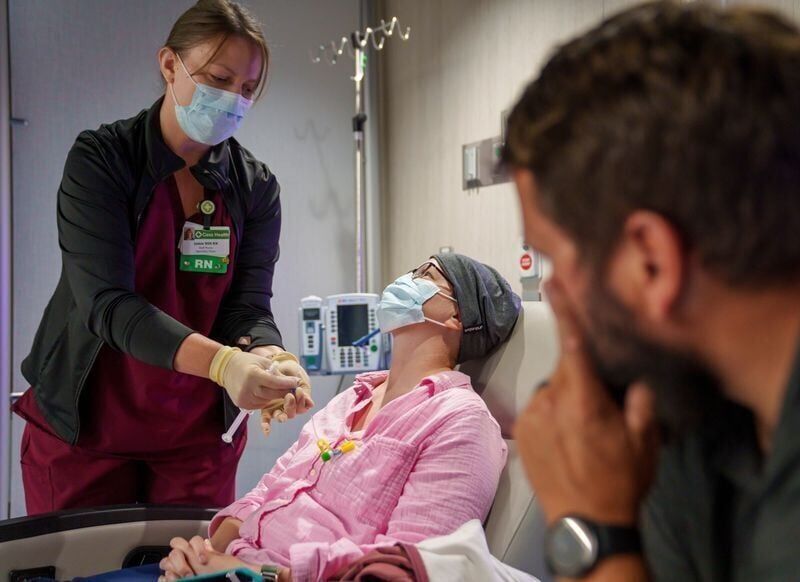
Nurse Jamie Bower prepares Victoria Means for her immunotherapy, while Victoria’s husband Ryan Means watches, at the Cass County Hospital Monday, Aug. 24, 2026 in Atlantic, Iowa. She receives this therapy roughly once per month and each time the medication costs tens of thousands of dollars, according to her bills. Victoria expresses that she is fortunate to have good insurance and is able to continue to work to keep her insurance.
"I'll be out, and I'll just forget all about cancer," Swan, who last year underwent treatment for duodenal cancer, said. He is one of about 175,000 cancer survivors living in Iowa today.
He wasn't always sure he would make it, he said. In 2025, after three infusions shrank his tumor from about 5 centimeters to 2, Swan underwent a six-hour Whipple procedure, removing parts of several digestive organs before surgeons reconstructed what remained.
"The rest of 2025 was kind of a lost year," Swan said.
Cancer is hardly foreign to him. His sister died of ovarian cancer. In and around Palo Alto County, home to fewer than 9,000 people, he can count roughly a dozen more people around him fighting cancer now.
"It was a betrayal," he said of routinely handling and spraying chemicals whose risks farmers, he said, were not told much about. "Is that what caused my cancer? I have no idea."
But for all the abundance surrounding Swan, buying fresh, healthy groceries nearby is almost impossible.
"There's no place to buy fresh food. It's only a dollar store," he said. "It's a food desert right here in the middle of some of the richest ground in the world."
Iowa farmers sold about $18 billion in crops in 2024, but the vast majority of that harvest was never destined for people to eat, instead becoming ethanol or livestock feed.
Farmers spend heavily on what keeps that system running. In 2022, they spent about $7.3 billion on fertilizer, agricultural chemicals and seed, making Iowa a massive market for agribusiness giants including Koch, Syngenta, Pioneer and its parent company Corteva, and Bayer, which owns Monsanto.
"Living here is like living in a chemical bomb," said Schroeder, the patient at Cass Health. "Our Iowa government doesn't seem to want to protect us, and the chemical companies have been given pass after pass. It's a travesty."
The state has largely resisted forcing changes on farmers.
In May, Gov. Kim Reynolds, whose husband has battled cancer, and Agriculture Secretary Mike Naig, who farms in Palo Alto County and once lobbied Iowa lawmakers on behalf of Monsanto, doubled down on voluntary conservation, announcing more than $300 million in conservation and water infrastructure funding.
Reeves Horsley said Iowa cannot keep relying on the same approach and expect a different result.
Her older sister Kathy was in her 20s, married and raising young children, when she developed breast cancer. Reeves Horsley was in seventh grade. By the summer before her sophomore year of high school, Kathy's cancer had spread to her liver. She died that July at 27.
In her final week, now-outdated hospital rules kept Kathy's children from visiting her room. Reeves Horsley brought them outside to the glass window.
"They could touch their hands to her hands," she said. "But they couldn't even give her a hug."
Reeves Horsley had been desperate for an answer, even as a child. In seventh grade, she made cancer the subject of a science project and promised God a few years later that if Kathy lived, she would spend her life trying to find a cure.
Kathy did not. Another sister, Marcie, later developed uterine cancer but survived. Reeves Horsley said she can now name at least 40 friends and patients in the area who have had cancer or died from it.
"There's real despair here," she said. "You work your whole life, and you're supposed to enjoy retirement, and then you find out that you have cancer. It's a dart hitting the balloon, and things just begin to collapse."
For years, cancer was something people here learned to live around. The numbers have now made it impossible to look away.
"The giant's been poked, and I think that the awakening has been gathering more attention," Reeves Horsley said.
Now, she said, attention is not enough. Something, somewhere has to change.
This report was syndicated from USA Today Network via Reuters Connect.
Have you or someone you know been affected by cancer? We want to hear your story. Reach Nick El Hajj at nelhajj@registermedia.com or share your experience at DesMoinesRegister.com/CancerStory.