

Iowa farmers seek government action against fertilizer monopoly
Iowa farmers told U.S. Deputy Agriculture Secretary Stephen Vaden they’re tired of giant fertilizer companies using their market heft to gouge them, especially as they struggle through a fourth year of possible losses.
Given the market dominance of companies like Koch Inc., Nutrien Ltd., the Mosaic Co. and CF Industries, “Farmers are simply told the prices and you’re forced to take it,” said Steve Kuiper, president of the Iowa Corn Growers Association Board.
Seeking government action on the issue, the group invited Vaden to meet with about 200 farmers on a farm near Ogden on Friday, Sept. 11.
Fertilizer prices have doubled, and in some cases, tripled, over the past six years, said Lance Lillibridge, a past president of the Iowa Corn Growers Association who moderated a panel discussion with Vaden and later took questions from fellow farmers.
“We’re sick of it,” said Jason Orr, who farms in northeast Iowa. “Everybody’s got their hands in our pockets, and we’re downright tired of it.”
Some Iowa growers are reporting they’re unable to even get a price for fertilizer purchases this fall, with retailers unsure they’ll have enough of the nitrogen, potash and phosphorus needed to grow next year’s crops, said Craig Floss, the Iowa Corn Growers CEO.
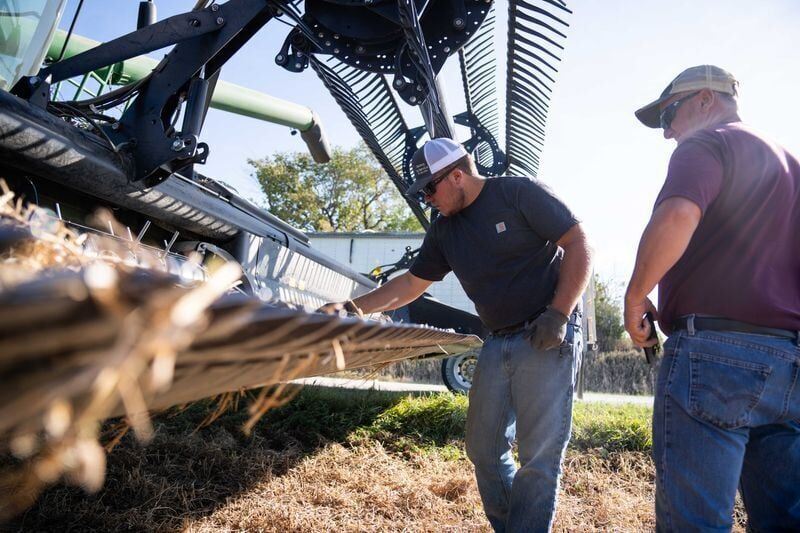
Kevin and Steve Kuiper troubleshoot a loose bolt on the combine used to harvest soybeans on Wednesday, Oct. 2, 2024, near Bussey.
Vaden said he understands farmers’ frustration and he expects a federal investigation into anticompetitive practices in the fertilizer industry will result in more than “a slap on the wrist.”
“The amount of harm here is billions and billions of dollars… on an annual basis,” said Vaden, who wants farmers to supply fertilizer price data to the government to support its probe.
“We’re talking about real remedies. And keep in mind that under the antitrust laws, it’s not just a fine,” he said. “There’s the possibility of injunctive relief to rearrange markets."
The Fertilizer Institute, an industry advocate, said in a statement Friday that fertilizer producers “compete fiercely with each other in a robust, global market" impacted by complex factors including changes in global production and demand, shifting trade patterns and geopolitical events.
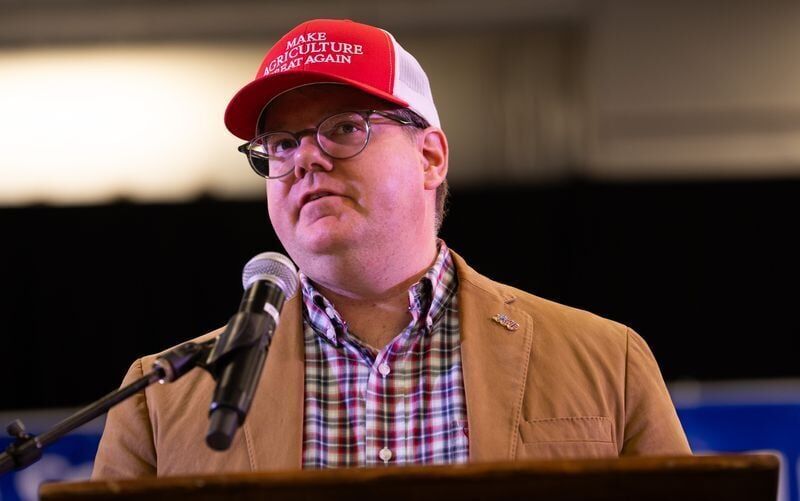
Deputy Secretary of Agriculture Stephen Vaden speaks during the 11th Annual Tennessee State Fair FFA Ham Breakfast at the Tennessee State Fairgrounds on Monday Aug. 17. 2026.
Most recently, the U.S. war with Iran has slowed or stopped tanker traffic in the Strait of Hormuz, which links the oil-rich Persian Gulf to shipping lanes. That has cut off about half of the global supply of urea, a widely used nitrogen fertilizer derived from oil. It's also blocked about 20% of the world's natural gas supply, a foundational input for most nitrogen fertilizers.
“The fertilizer industry has a deep commitment to meeting the needs of American farmers,” the industry group said.
Here’s what to know about what farmers discussed with Vaden.
Farmers say they need transparency on rising fertilizer prices
With rapidly rising costs, it’s getting more difficult for the next generation of farmers to get started, said Jordan Balderston, whose family farms in eastern Iowa.
Three weeks ago, Balderston said, his family was told they could get anhydrous ammonia, a key fertilizer, for $800 per ton. Now it’s about $950 a ton. “I don’t know how something like that” can increase so quickly, he said. “But it does.”
A recent rally in commodity prices — with corn trading for around $5 a bushel in Iowa, up about 90 cents since January, and soybeans close to $13 a bushel, up about $1.40 — isn’t enough to cover fertilizer’s spiking prices, Balderston said.
“We need transparency, to see what’s truly happening,” he said. “We need to pull back the curtain and see why these prices” are climbing.
Vaden, who farms in Tennessee, said it won’t be easy to change the fertilizer industry.
“We can’t just flip a switch,” he said.
With massive mergers that began in 2010, fertilizer costs stopped moving in sync with the price of corn, soybeans and other crops, Vaden said. Consolidation means the fertilizer industry has been “amassing pricing power."
It took the fertilizer industry “years to get to this point,” he said.
Ammonia plant startup exec says co-op leaders, farmers were threatened
Vaden said the Trump administration is focused on bringing more domestic fertilizer to the U.S. market, a move that can help create more price competition for farmers.
He pointed to CHS Inc., a farm cooperative, and OCP North America, a subsidiary of Morocco-based OCP Group, which announced last month they’re building a $450 million phosphate fertilizer plant in Louisiana, the first in the United States since 1984.
Also in Louisiana, CF Industries and two Japanese companies plan to build a $3.5 billion anhydrous ammonia plant.
But Vaden also heard from Linda Thrasher, co-founder of Greenfield Nitrogen, a farmer-sponsored company that's worked to build an anhydrous ammonia plant in Iowa. Thrasher said the group is moving the company to Illinois, where it can sequester its carbon emissions and qualify for federal clean energy tax credits to help finance the project.
Thrasher said local cooperatives, elevators and farmers faced retribution from large fertilizer companies for considering working with Greenfield Nitrogen.
"They're scared," Thrasher said, adding that one cooperative said "they'd be blackballed if they work with us. ... The intimidation is very real."
Vaden told reporters that testimony like Thrasher's sounded "like we're talking about the 'Godfather,' not the fertilizer industry."
"You don't have to be a lawyer ... to realize that something's not right," he said.
Could the farm downturn become the next Great Recession?
Kuiper said if fertilizer and other production costs don’t moderate, the country will face a collapse worse than the 2008 housing crisis that launched one of the deepest, longest recessions in U.S. history.
“Banks are getting very concerned,” he said, adding that small banks are “reaching their lending caps. … They either stop loaning money to farmers or somebody gets kicked off the boat.”
Farmers face a fourth year of possible losses as expenses reach record highs, outpacing prices for corn, soybeans and other crops. Ongoing trade wars with countries like China, Canada and Mexico have exacerbated the ag downturn, experts say. President Donald Trump has responded by sending farmers $12 billion to offset trade losses and has asked Congress to consider another $11 billion in support.
Lillibridge said the biggest challenge to the fertilizer industry is that its buyers are “financially broken.”
Iowa farm bankruptcies have jumped about 220% since 2020, the northeast Iowa farmer said, “while fertilizer monopolies have lined their pockets, profiting off livelihood of the American farmer.”
This report was syndicated from USA Today Network via Reuters Connect.