
COMMENTARY | IOWA STATE FAIR
Taking in the sights and sounds of politics at the Iowa State Fair
All that food to eat, be it on a stick or covered in butter.
All those pork chops to be flipped and hard-boiled eggs to be shared.
Erin Murphy
All those hands to shake and selfies to take.
And all those Soapbox speeches.
The Iowa State Fair is a rite of passage for political candidates running for state and federal office in Iowa.
Iowa candidates for Congress and statewide office — and, every four years, the candidates for president — come to the Iowa State Fairgrounds in Des Moines to mingle with and speak in front of thousands of prospective voters — and the media attention that comes with it.
This year’s Iowa State Fair has been no different. With the 2026 midterm elections set for November, candidates aplenty have been roaming the fairgrounds, doing all of the traditional things that politicians at the fair do.
But even for the politicians, it’s not necessarily all politics all the time at the Iowa State Fair.
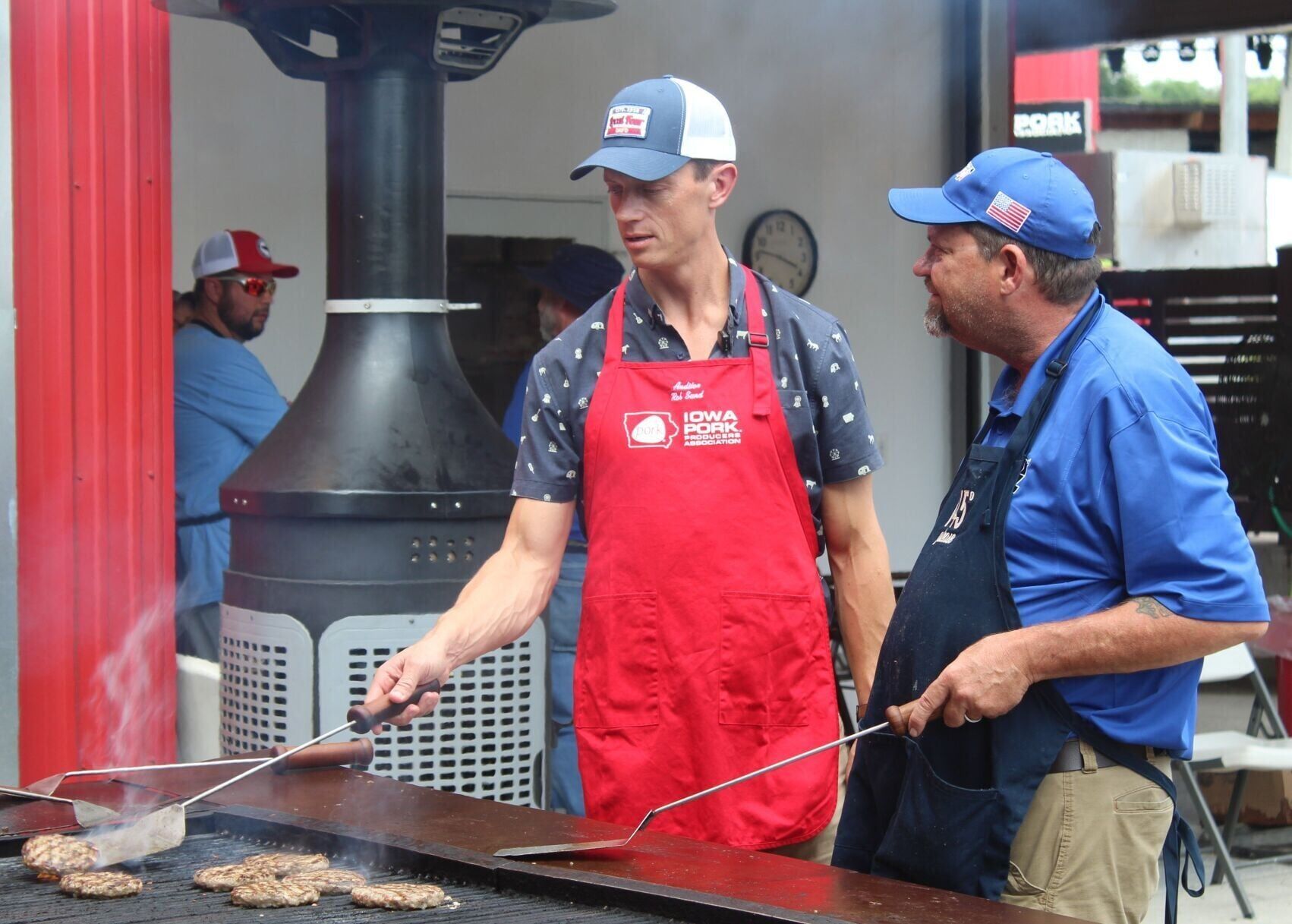
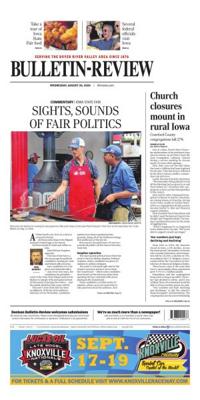
Rob Sand, the Democrat running for Iowa governor, flips pork chops at the Iowa Pork Producers’ Pork Tent at the Iowa State Fair in Des Moines on Aug. 13, 2026.
Soapbox speeches
The most purely political Iowa State Fair event is the Des Moines Register Political Soapbox, where candidates are given 20 minutes to address fairgoers.
The event is stationed right next to the Grand Concourse and just across from the Grandstand — which some candidates have found out the hard way when their speaking slot has coincided with music playing in the Grandstand.
Some candidates use their entire 20 minutes, others carve out some time to take questions from the audience. And most then field questions from reporters in a gaggle arranged by the Register.
Speaking of those crowds, unless the candidates organize their supporters, they are at the mercy of whoever decides to stop at the Soapbox and listen.
Crowd sizes for the candidates vary wildly: no more than a handful were seated when Libertarian congressional candidate Rick Stewart started his remarks on Saturday, Aug. 15. On the other hand, the crowds for Democratic gubernatorial candidate Rob Sand and Republican U.S. Senate candidate Ashley Hinson packed the area and spilled onto the concourse.
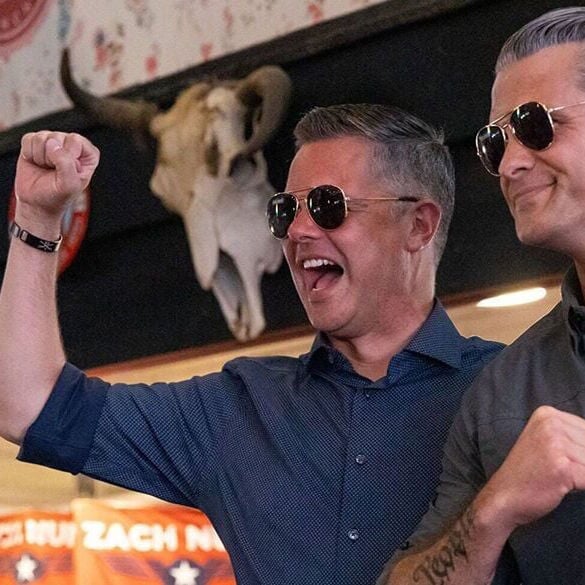
The Soapbox runs rain or shine, as Republican gubernatorial candidate Zach Lahn discovered on Friday, Aug. 14. Lahn spoke through a steady rain — which may be why he cut his remarks off after about eight minutes. (Lahn also spoke to reporters twice that day and made his way around the fairgrounds when the rain relented.)
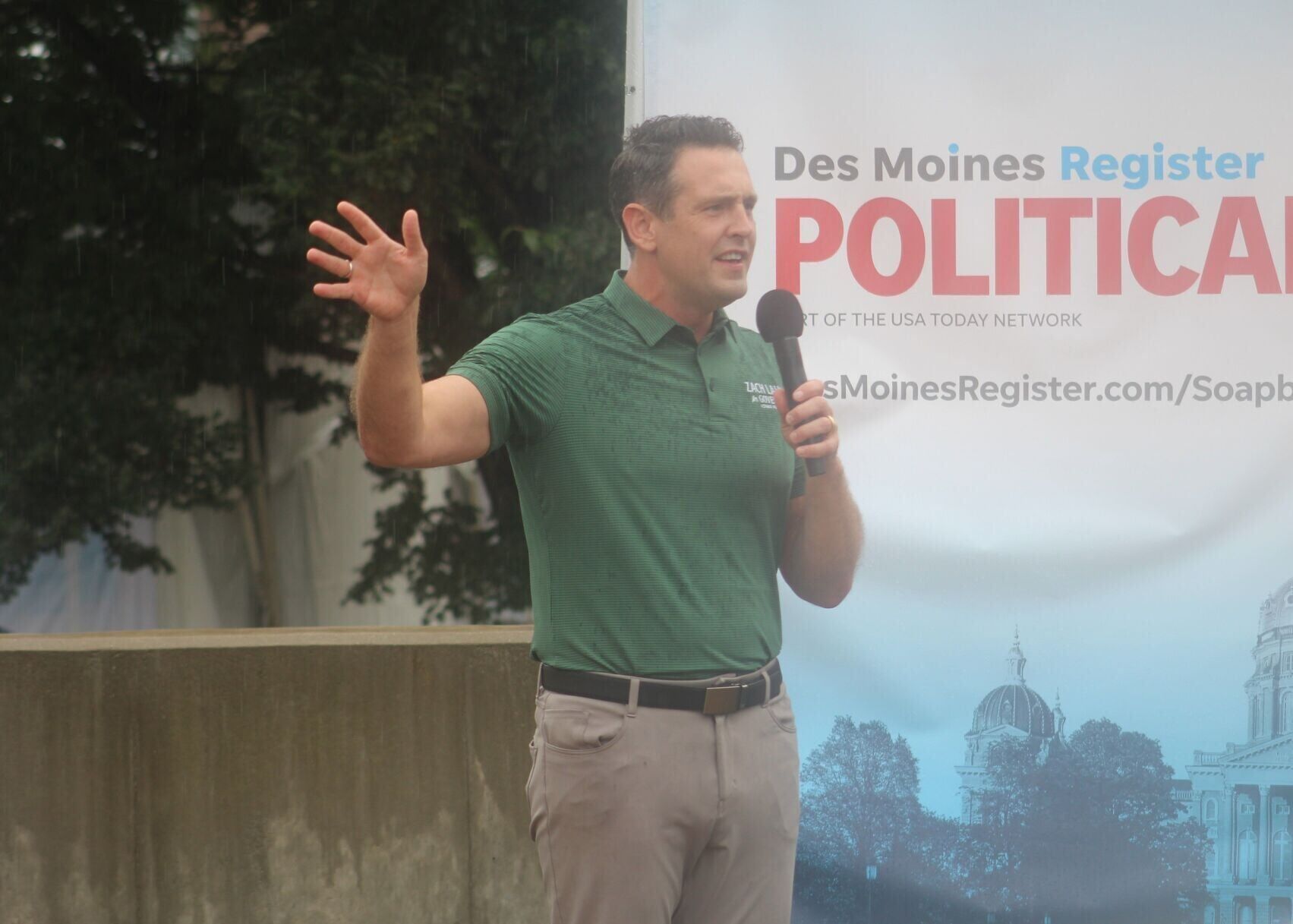
Zach Lahn, the Iowa Republican candidate for governor, speaks during a steady rain on the Des Moines Register Political Soapbox at the Iowa State Fair on Friday, Aug. 15.
Eating the food
If you want to believe that politicians are just like the rest of us, listen to them talk about Iowa State Fair food.
“I don’t know about you, but I’ve been trying to eat my way through the fair,” Hinson said during her Soapbox speech. “I’ve already had a couple of my favorites today. I had my pickle dog right down there. I had the bacon on a stick. How many of you have tried that? Just tried the ice cream with the butter and the salt on it. I highly recommend it.”

The Butter Dipped Ice Cream Cone at the Iowa State Fair was endorsed by U.S. Rep. Ashley Hinson, who’s running for the U.S. Senate.
Sand gave reporters a full-throated endorsement of one particular State Fair food, even if that food’s name proved elusive.
“I’ve tried two new ones this year, and the names I’m going to mess up because there’s so many words,” Sand told reporters after flipping pork chops at the Iowa Pork Producers Pork Tent — another grand State Fair tradition for politicians.
“All these new fair foods — they’re so complicated. I feel like I’m much older than 44 when I say that,” Sand joked. “The ultimate brisket bacon mac and cheese doughnut was amazing. Highly recommend.”
Sand was pretty close on that food’s name, which technically was the Ultimate Bacon-Brisket Mac & Cheese Donut. It is described by the Iowa State Fair as “signature mac and cheese loaded with bacon and brisket … breaded in a cake-style coating and finished with a sweet BBQ glaze … topped with chopped brisket and garnished with a slice of fresh jalapeno.”
“The perfect sweet and spicy bite,” the State Fair says — and apparently Sand agrees.
Family affair at the fair
Lahn’s youngest son, Fritz, had a robust Iowa State Fair experience — he entered the mullet competition.
“I gotta tell you, I did this whole thing for one reason, one reason only: tomorrow at 11 a.m. our youngest son, Fritz, is in the mullet competition over here, and we need you to all come support him,” Lahn announced, tongue in cheek, during his Soapbox speech. “Two years old, he’s going to take home the gold for the mullet.”
Fritz’s mullet did not take the top prize, but in the Mullet Contest, isn’t everyone who enters truly a winner?
Lahn also participated in the Iowa Governor’s Charity Steer Show, in which an exhibitor partners with a celebrity to auction off a steer. The proceeds from the auction benefit the Ronald McDonald House Charities of Iowa.
Lahn and his partner exhibitor, Madeline Olson, of Vinton, received the “People’s Choice Award” for getting the loudest applause, according to the Iowa Cattlemen’s Association, which is one of the event’s co-hosts along with the Iowa Governor’s Office and the Iowa Beef Industry Council.

Fair exhibitor Madeline Olson, from Vinton, and her celebrity partner, Republican gubernatorial candidate Zach Lahn, receive the People’s Choice Award after gaining the loudest cheers during the Governor’s Charity Steer Show at the Iowa State Fair in Des Moines on Aug. 15, 2026.
Sand, during an interview with reporters, talked about spending time at the fair with his family.
“We are here every year. We always come out, and the kids want to hit the big slide, and we go look at the butter cow, and I usually want to get a couple of pork chops on a stick and fried dough, or maybe a strawberry shortcake, and look at the animals,” Sand said. “Just kind of depends on how much time we’ve got here. But it’s a fun thing to do. … I have fun coming down, and so do my wife and kids.”
Sand read to children at the Iowa State Fair Country School, a former Warren County one-room school house that was donated and moved to the Iowa State Fairgrounds and is now sponsored by the Iowa State Education Association, the statewide teachers union.
Sand chose to read the children’s book “Humble Pie,” joking in his introduction that it is “something I get to eat every day as a candidate for governor.”
In a coincidence that can happen only at the Iowa State Fair, Sand showed up for the event wearing the exact same shirt as the man who introduced him, ISEA President Joshua Brown. Both had worn a shirt — complete with animals and fair rides — that they’d bought at the State Fair gift shop.
‘Iowa nice’ challenged
Unfortunately, it’s not always cotton candy and sweet ice cream at the Iowa State Fair when it comes to politics. Every once in a while, the more contentious side of politics makes its way to the fairgrounds.
The Soapbox crowds have been known to get a little rowdy from time to time. The Register does its level best to ensure otherwise, providing instructions before each candidate’s remarks to cheer but not jeer, and to keep signs lowered so everyone can see the stage.
Some mild tension developed in the crowd for Hinson’s appearance on Monday, with vocal supporters mixed with equally vocal opponents, with both sides holding signs. Things never got out of hand.
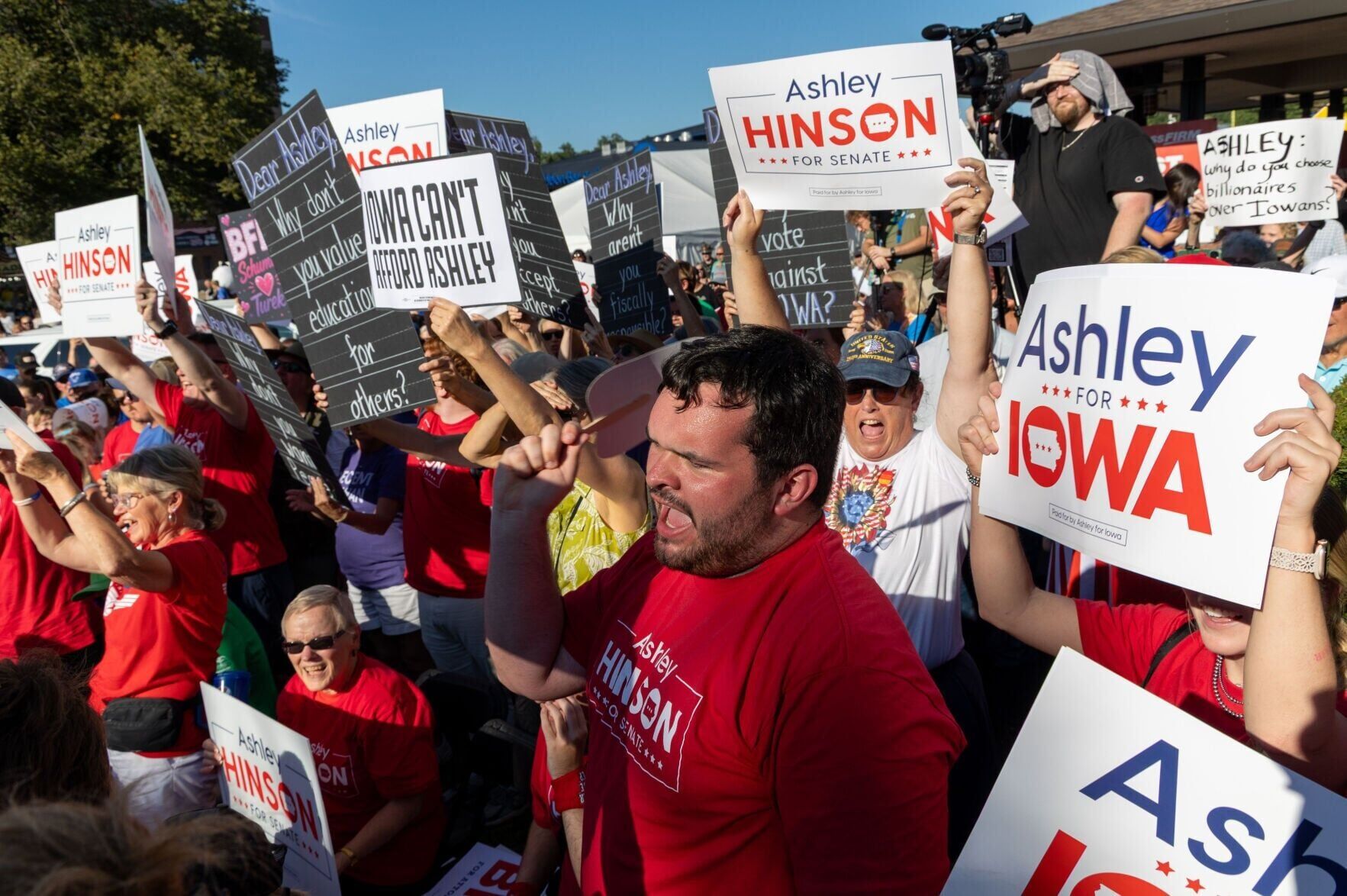
Members of the Ashley for Iowa campaign cheer as U.S. Rep. Ashley Hinson takes the Des Moines Register Political Soapbox stage on Monday, Aug. 17, at the Iowa State Fair in Des Moines. Other people held signs in opposition to her candidacy for the U.S. Senate, but the tensions never got out of hand.
And during a Friday, Aug. 14, news conference with Lahn and Republican Party of Iowa Chairman Jeff Kaufmann at the party’s booth inside the Varied Industries Building, a few people stood behind the line of reporters and made comments toward Lahn and Kaufmann. Campaign and party staff tried to shield the commenters from the news conference.
While those fairgoers came to the politics, sometimes the politics come to the fairgoers. On Thursday, Aug. 13, activists with the conservative advocacy group Turning Point USA at one point followed Sand as he walked through the grounds, loudly booing and jeering him.
And sometimes “Iowa Nice” falters at the fair in a more genuine, albeit not very family-friendly way.
As he made his way around the fairgrounds on Saturday, Aug. 15, Sand was recognized by a young woman who couldn’t believe who she was seeing. Sand offered to take a photo with her, which she happily accepted.
As Sand walked away to his next event, the young woman turned back to her friends and exclaimed with unbridled, uncensored excitement, “That was Rob (expletive) Sand! It’s (expletive) Rob Sand!”
Erin Murphy is the Des Moines bureau chief for the Cedar Rapids Gazette.
Is Iowa losing its religion? Church closures mount in rural communities (copy)
One at a time, Pastor Steve Struecker and members of his northwest Iowa church remove sacred items from the Zion Evangelical Lutheran Church during a service marking its closure nearly 150 years after opening.
First, they carry out the font where the town's children had been baptized for decades. Then the lectern, followed by the altar’s missal, candles, communion cup and cross.
Lastly, the church itself is shuttered.
“We remember with gratitude to God all the blessings he has given to us and those before us,” Struecker tells congregants as they say their final goodbye to the church.
Zion and its sister, Immanuel Evangelical Lutheran in nearby Livermore, are among dozens of churches closing across Iowa, unable to sustain themselves as congregations shrink, pastors become harder to find and financial support dwindles.
Zion President Dave Hanselman said he didn't want the beloved church to be bought and "forgotten about," becoming a vandalized nuisance for the small, struggling town.
"What's happened to us happened to the whole town," he said. "We're not able to support ourself any longer."
'Our numbers just kept declining and declining'
From 2010 to 2020, 285 churches closed in Iowa, a 6% decline. Across the same period, the number of Iowans who consider themselves church members fell by 211,000, a decline of 13%, according to the U.S. Religion Census, conducted by the Association of Statisticians of American Religious Bodies.
Those losses came at the same time Iowa's, increasingly urban, population grew 4.7% to 3.2 million people.
Hanselman said the congregation hung on for as long as possible. Struecker had decided to retire, and it was unlikely those who remained would be able to attract another pastor, he said.
“Our numbers just kept declining and declining,” as did the church's financial support, said Hanselman. The congregation also faced overwhelming costs to replace Zion's asbestos-filled roof and make other repairs. “And we weren’t picking up any young families with kids. ... It’s just what’s happening in small towns.”
It’s not only rural Iowa seeing such losses. Only three Iowa counties — Dallas, Adams and Keokuk — added church members over the last decade, the religion census shows.
Crawford County saw a 27.4% reduction in church membership after a decade, according to religion census data compiled by the Des Moines Register. In 2010, there were 39 congregations with 11,156 total members in the county. In 2020, that had dropped to 38 congregations with 8,102 members.
Zion will be demolished. Immanuel's building could be sold to a local business. But many others, like the former Loucks Grove Church in Adair County, which closed in 1999, join empty schools, businesses and homes as abandoned reminders of the state's dying rural communities.
In addition to the demographics, churches are struggling with divisions around social and political issues. The United Methodist Church in Iowa, for example, has lost dozens of congregations in disagreements over LGBTQ rights and same-sex marriage.
The trend has broad implications for Iowa. Places of worship are critical to a state’s social, civic and political fabric, experts say: They're polling places, food banks and blood drive locations. They're also where friends offer counsel and emotional support and young and old, liberals and conservatives, mingle.
Also, with state and federal governments pulling back the social safety net, there are fewer churches, especially in rural areas, to provide a second line of support.
Ryan Burge, a political science professor of practice at Washington University in St. Louis whose research focuses on the impact of religion on American life, sees the decline hitting in rural Iowa hardest, since access to good jobs and child and health care and other services already is limited.
Iowa loses most church members from traditional denominations, data shows
When he was growing up in northwest Iowa, said 72-year-old Hanselman, Lu Verne had three grocery stores, a hardware store, plumbers, electricians and other small businesses.
Life every Sunday was centered around church, bringing together aunts, uncles, cousins and neighbors.
Now, most of the businesses are gone. So, too, are many of the residents who belonged to Zion, with generations moving to larger towns to find jobs.
Lu Verne's population has dropped about 40% since 1980 to 260 people.
Now "people come and go," Hanselman said. "They move in, they move out. ... They don't really become part of our community."
Zion and Immanuel struggled to find a new generation of leaders, said Struecker, the churches' pastor. And while they were willing to carry on, longtime church elders were exhausted. "We could see the time to close had come," said Struecker, who farms near West Bend and began training to become a pastor at 50.
Iowa's mainstream churches have seen the largest drops in membership: Methodist, Lutheran and other Protestant denominations have fallen about 30%; evangelicals, 12%; and Catholics, 8%, the religion census shows.
Likely propelled by immigration, a small category called "other religions," which include Hinduism and Buddhism, spiked 59%, and Orthodox Christians climbed 44%.
The Catholic Archdiocese of Dubuque is now merging parishes and closing some churches, as have other Iowa dioceses in recent years, citing declining membership, fewer baptisms and aging priests. Those trends also have hit the United Methodist Church, which, separate from its disagreements over LGBTQ issues, voted in June to close 11 churches in Iowa.
Over time, Zion's members dwindled to about a dozen, Hanselman said. Still, the decision to close the church was hard. It's where generations of families were baptized, confirmed, married and buried.
“It’s going to hurt in really tangible ways, and we’re not going to realize it until it’s too late,” said Burge, who sees Iowa and the nation losing hundreds more churches in the years ahead.
"There was a lot of history in that old church for me," Hanselman said. "Now it's over."
A growing number of Iowans, Americans have no church affiliation
Demographics are against rural states like Iowa that lag behind the U.S. population growth rate of 7.4%, said Burge, the Washington University professor.
"The fastest-growing churches in America have one commonality — they're in a place of population growth," he said.
Churches also struggle as a growing number of people decline to formally affiliate with any religion, identified in demographic data as "nones." And the chance of attracting those people is low, Burge said. "Eighty-five percent of people who grew up without religion still have no religion as adults."
Even 49% of people who who identify with a particular religion say they seldom if ever go to services, according to a Pew Research Center survey in 2025.
Iowa "nones" climbed to 26% of the population in 2025 from 21% in 2013, said Robert Jones, founder of the Public Religion Research Institute, a Washington, D.C., nonprofit that researches the intersection of religion, culture and public policy.
That change tracks the national trend. Americans with no church affiliation make up 28% of the population, up from 21% in 2013, according to PRRI's American Values Atlas.
"We see young people, 30 and younger, leaving churches," Jones said. "A lot of it is around the politics of sexuality," with about 70% of young Americans supporting marriage equality.
In Iowa, 58% of residents support same-sex marriage, compared to 65% nationally, according to PRRI's survey.
"Churches have staked out a position that's very different... and that's created a lot of tension," Jones said. "When we ask young people why they've left, more than a third say... it's because of the negative teachings about LGBTQ people."
The opposite also is true: Members have left some mainline Protestant churches because they feel they've become "too liberal in their approach to same-sex marriage" or other social issues, he said.
Jones said it feels like America is becoming more conservative about social issues. But white evangelical Christians, whose views on those topics have gained increased prominence through their support of President Donald Trump, also are experiencing decline.
Iowa members of evangelical congregations shrank to 20% of the population in 2025 from 23% in 2013, PRRI's data shows; and nationally, membership fell to 13% from 17%.
The result of the 2024 elections, which returned Trump to the White House and gave Republicans full control of Congress, is "moving the country further to the right than it actually is," Jones said. He pointed, as an example, to data showing 6 in 10 Americans support providing immigrants in the country illegally a path to citizenship, in contrast to the GOP's advocacy for their deportation.
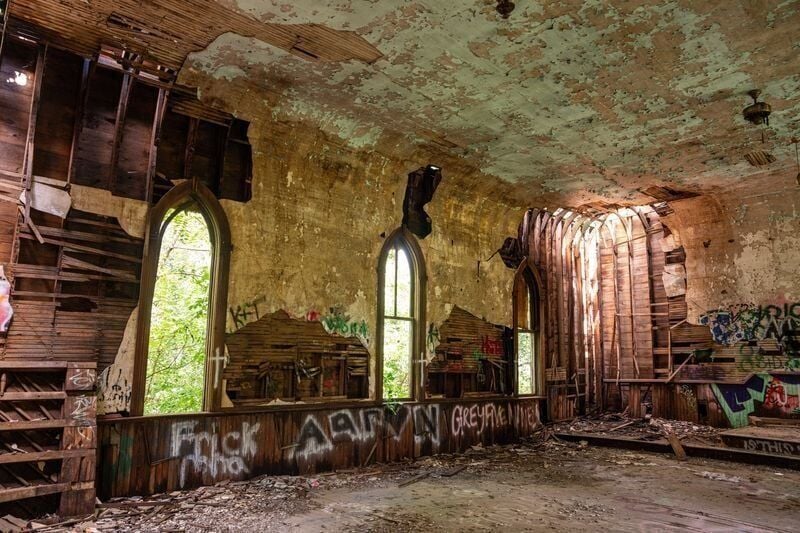
The interior of the abandoned Loucks Grove Church north of Greenfield in rural Adair County.
Iowans look for new church homes after theirs closes
In Lu Verne, Carter Nath and his wife, Caley, are still looking for a new church.
Nath, a Kossuth County supervisor who farms and runs a business tuning and repairing pianos, had been a member of Zion for about five years but served as the church's organist and pianist for nearly a decade.
His connection to the church ran deep, with an ancestor among the group that founded it in 1880. Along with providing music for services, Nath, 28, helped lead Bible studies, served as treasurer and helped with the church's Christ Kids Club, which brought as many as 35 children to Zion every Wednesday.
He met his wife at Zion and proposed to her there.
Nath and his wife are taking their time in finding a new church home, worshipping in Algona, Humboldt and elsewhere. But it won't be like going to church with people in your community, he said.
"It goes beyond knowing everybody's name," he said. "They're part of your everyday life. ... There's a sense of community, coming together and praying together."
And while Nath and others will likely find a new spiritual home, both he and Struecker, the former Zion and Immanuel pastor, worry about elderly members who are unable to drive to — or unwilling to join — a new church.
One elderly member who resisted going to another church often asked Struecker to keep Immanuel open. "She didn't want to go anywhere else," he said. Her husband's funeral was held at Immanuel, and she wanted hers there, too.
The woman, Audrey Rutz, died in May and her funeral was Immanuel's last.
"She wanted it to be me" who led the service, Struecker said. "I was the church's shepherd."