

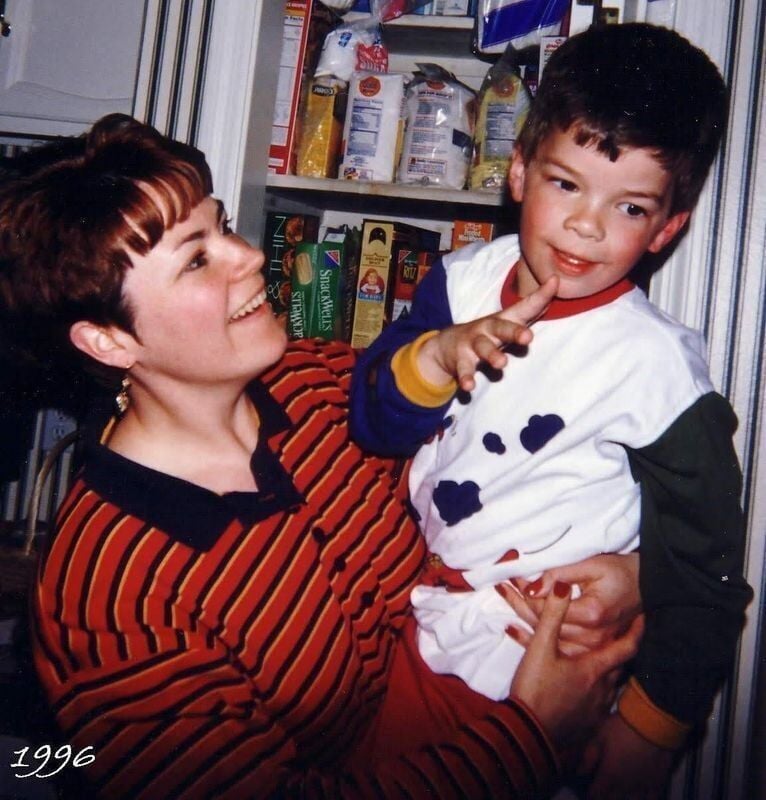
Leisa Walker holds her son, Sam, as he signs the word "mom" at 6 years old.
Leisa Walker holds her son, Sam, as he signs the word "mom" at 6 years old.
Leisa Walker holds her son, Sam, as he signs the word "mom" at 6 years old.
Leisa Walker holds her son, Sam, as he signs the word "mom" at 6 years old.
As the United States marks its 250th year, RAGBRAI will celebrate with a ride that showcases the small towns at the heart of the American heartland.
Announcing the pass-through and meeting towns April 3, Ride Director Matt Phippen said the Register's Annual Great Bicycle Ride Across Iowa will seek out quintessential American experiences. That includes an America 250 day when riders bound for the suitably named overnight town of Independence will be encouraged to dress in red, white and blue and decorate their bikes likewise.
It will be a display that's sure to spark nostalgia for July 4 parades in riders' childhood hometowns. Phippen also envisions giant U.S. flags hung from grain elevators and firetruck ladders over festive Main Streets, And he said a bike-borne crew that successfully experimented with putting up flagpoles and flags at veterans' homes during RAGBRAI 2025 will expand its mission this year to include towns along the entire route.
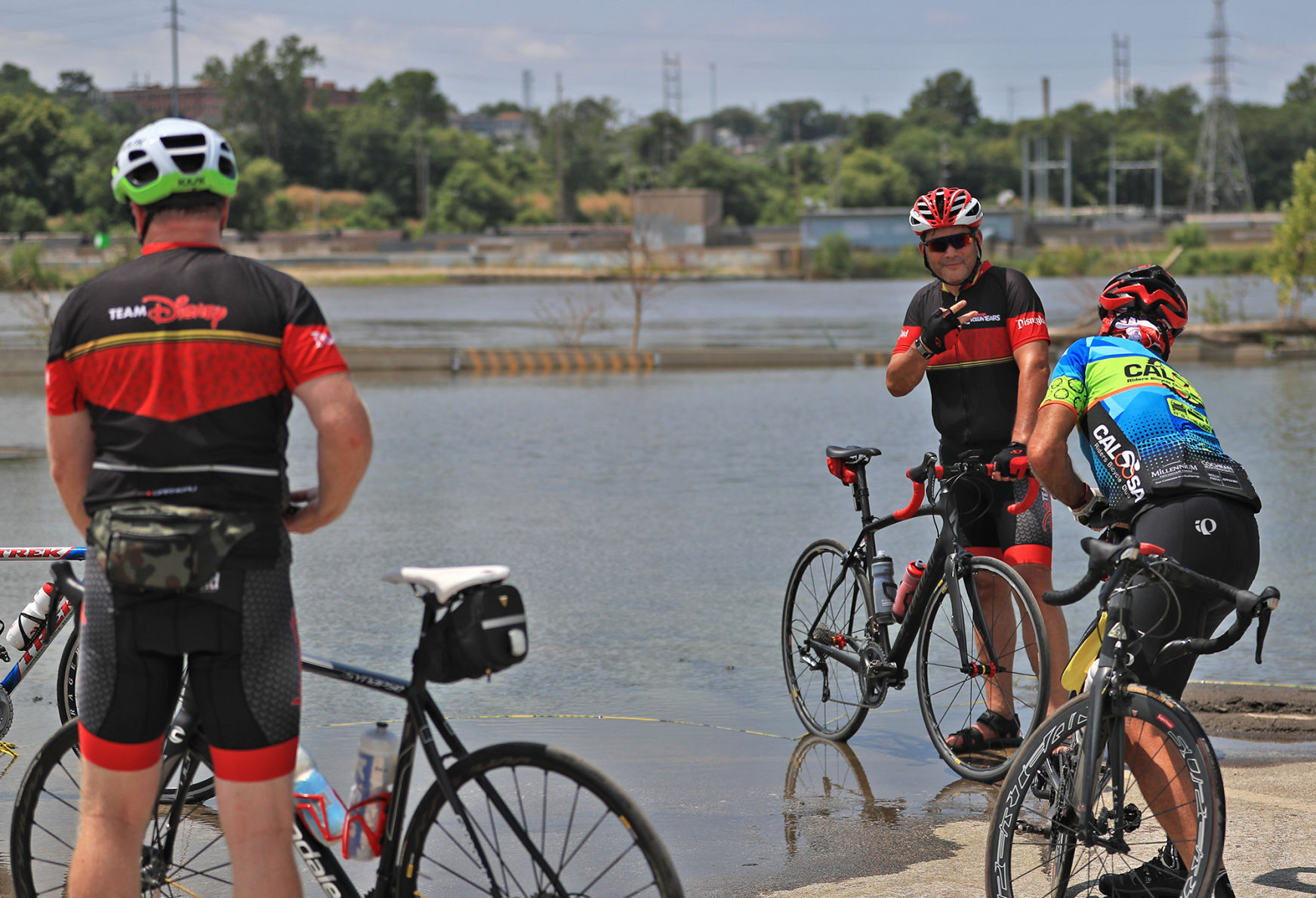
A bicyclist poses for a portrait as he performs the traditional tire dip with flood water from the Missouri River at the Stir Cove parking lot in Council Bluffs on Saturday, July 20, 2019.
Don't forget Freedom Rocks. They're an Iowa thing. Every one of the state's 99 counties has at least one, each painted with a unique design by dedicated artist Ray "Bubba" Sorensen.
Maybe a fireworks show, you ask? It's RAGBRAI. Anything is possible.
If riders "want to experience small-town Iowa, this is the year to do it," said Phippen, himself a native of an Iowa small town. "Every town on the route is a small town."
He said the ride will come close to, but never enter, two larger cities: Ames and Waterloo-Cedar Falls.
"You'll be able to see the water tower in Ames. That's the closest it will come," he said.
A highlight will be a visit to a place strongly associated with America's pastime and its small-town roots: the Field of Dreams complex near Dyersville. The park, serving as the Day 7 meeting town, features the cornfield baseball diamond from the 1989 movie "Field of Dreams" and the more recently built Major League Baseball park where the Philadelphia Phillies will play the Minnesota Twins in August.
Even the biggest town on the route, Dubuque, population 58,987, where the ride will conclude with its traditional Mississippi River tire dip, is the core of Iowa's smallest metro area. It's also Iowa's oldest city, a reminder that 2026 also is the 180th anniversary of Iowa's statehood.
All the towns have been on previous RAGBRAIs, but for many, it has been decades since the ride last passed through and in one case, 50 years.
"Every town we've talked to this year has been super excited to get us back," Phippen said.
For RAGBRAI old timers, more than a few of the towns — 13, to be precise, including overnight stops — debuted on SAGBRAI, the Second Annual Great Bicycle Ride Across Iowa, in 1974. And 11 debuted on the 1983 ride.
The starting, ending and overnight towns on the seven-day, July 19-25 ride were announced in January. Here are the towns between them that will greet riders with parties and pie.
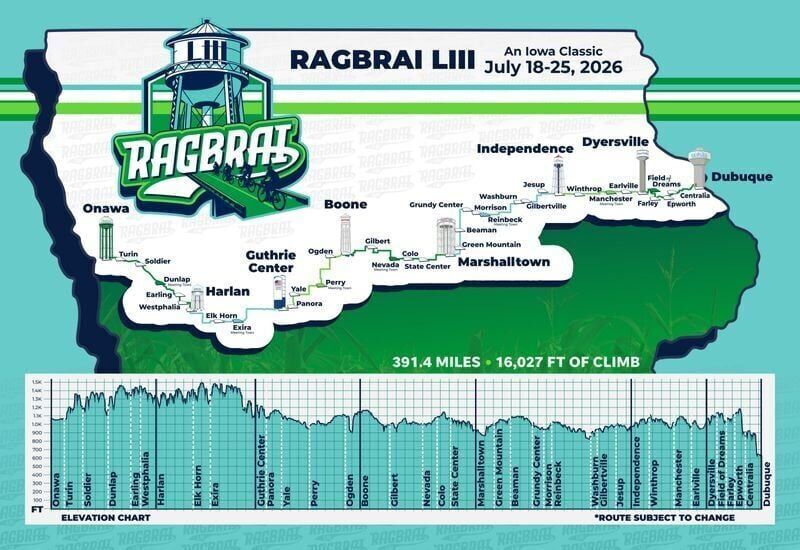
RAGRBAI announces a full route for 2026 that seeks to feature the best of small-town Iowa.
Highlights: The day's first stop fits the small-town theme: Turin, with a population of just 72, is the smallest city on the entire route. After Soldier, riders will begin their ascent of the scenic but steep Loess Hills.
Dunlap, Earling and Westphalia haven't appeared on the ride since 1983. Earling was the scene of a reportedly well-documented 1928 exorcism that helped inspire the 1973 classic horror movie "The Exorcist."
Though All-American, Westphalia, with a population of 126, preserves its heritage as a German Catholic settlement, with the towering St. Boniface Church on the National Register of Historic Places and its German Heritage Park.
Highlights: Elk Horn, like Westphalia, provides a reminder that a common part of the American experience is being descended from people who came from somewhere else to become citizens of a new nation. It's a town with Danish heritage and a giant windmill that was built in Denmark in 1848 and imported piece by piece to the town. Volunteers reassembled it for the 1976 Bicentennial celebration.
Elk Horn also is home to the Museum of Danish America and several other imported historic structures.
Highlights: RAGBRAI will stick to the big roads, but Panora, Yale and Perry also are stops on the Raccoon River Trail, a paved, 72-mile loop that's now part of an even larger loop with the 2024 completion of a connector to the High Trestle Trail and its famous tall bridge.
Perry is a town that's taken some hard knocks â a tragic school shooting in 2024 and the loss of its largest employer, a Tyson meatpacking plant, later the same year. Yet Perry Pride still shows in its lively downtown, with the circa-1913 Hotel Pattee and one of the most unexpected watering holes in any small town. Dubbed the Proletariat, it's lined with books and stuffed animal heads and features a Charles Bukowski quote on one wall. The owner's gentle but giant Russian wolfhound, named Yeats, is often on hand to mingle with patrons.
Perry's also famous as the starting point for the Bike Ride to Rippey, or BRR, a 26-mile excursion that's been held each February since 1977, regardless of the weather.
Highlights: Ames, home of Iowa State University, is the urban hub of Iowa's Story County, but Nevada (pronounced Neh-VAY-duh) is its thriving county seat, the largest of the charming Main Street towns on the Day 4 route.
Colo sits where the historic, transcontinental Lincoln and Jefferson highways cross. Niland's Cafê at their intersection is famous far and wide for its homestyle cooking and authentic, un-updated decor. Colo also was home for a time to Mountain Goats front man and horror novelist John Darnielle, whose "Universal Harvester" is set in Nevada.
Gilbert holds the distinction of being the town on this year's route that has gone the longest without a repeat RAGBRAI visit. It last hosted riders in the Bicentennial year of 1976.
State Center is known for its extensive community rose garden and annual Rose Festival and parade, held in June.
Highlights: Day 5 is the longest ride of the week, but it has plenty of towns to break up its 81.4 miles.
You'll have a hard time finding so much as a hill in Green Mountain. It was named by settlers from the Green Mountain State of Vermont and is famous as being the site â or close to the site â of a terrible train wreck in 1910 that killed 52 people.
Morrison and Reinbeck are two more towns that haven't been on the ride since 1983. The latter has a fine aquatic center for those wanting to cool off. There's even a slide. Among its most famous residents: Debra Saylor, a blind pianist who finished third in the prestigious Van Cliburn international competition in 2000. It also has a link to the Brooklyn Bridge. John Roebling, the engineer behind the renowned span over New York's East River, for a time held as an investment the land on which the town was later built, according to a town history.
Highlights: How can you tell Manchester, population 5,283, is one of the biggest non-overnight towns on the 2026 route? Its aquatic center has three slides. Enjoy! It also has one of the most impressive courthouses, with a 135-foot-tall clock tower. And there's a whitewater park on the Maquoketa River that flows through the center of town.
Highlights: No question about the high point of this day's ride: It's the Field of Dreams. The movie starring Kevin Costner and James Earl Jones was shot here, and the ballfield built by Costner's character, farmer Ray Kinsella, is its centerpiece, bordered by corn that will be higher than an elephant's eye by late July. Will the ghost players make an appearance?
Riders, while enjoying this breakfast stop, also will get to take a look at the field MLB built for the occasional pro games it has hosted here beginning in 2021. The coming of the big league brought construction of a paved road to the site, which allows it to make its RAGBRAI debut.
The optional loop that brings the day's mileage to 100 for those who choose to ride it is marking its 40th year as a RAGBRAI feature. It's named for RAGBRAI co-founder John Karras, who until he died in 2021 at age 91 handed out commemorative patches to everyone who completed the optional stretch. Its location and those of the also-optional gravel routes are an annual feature of RAGBRAI for five years and will be announced in May.
RAGBRAI registration is open. Sign up at ragbrai.com/registration.
This report was syndicated from USA Today Network via Reuters Connect.
Watching members of the Iowa National Guard’s 34th Infantry Division break formation at Wednesday’s welcome home ceremony in Cedar Rapids was like seeing a stone being tossed into a calm, cool lake.
First, there was absolute stillness from the more than 100 uniformed men and women standing at attention against the backdrop of a massive American flag. But with one word from their commander — “dismissed” — movement rippled outward.
Shoulders relaxed. Smiles grew, and soldiers’ eyes began to search the crowded room for their loved ones. A collective sigh of relief could be heard before the display of complete control gave way to organized chaos.
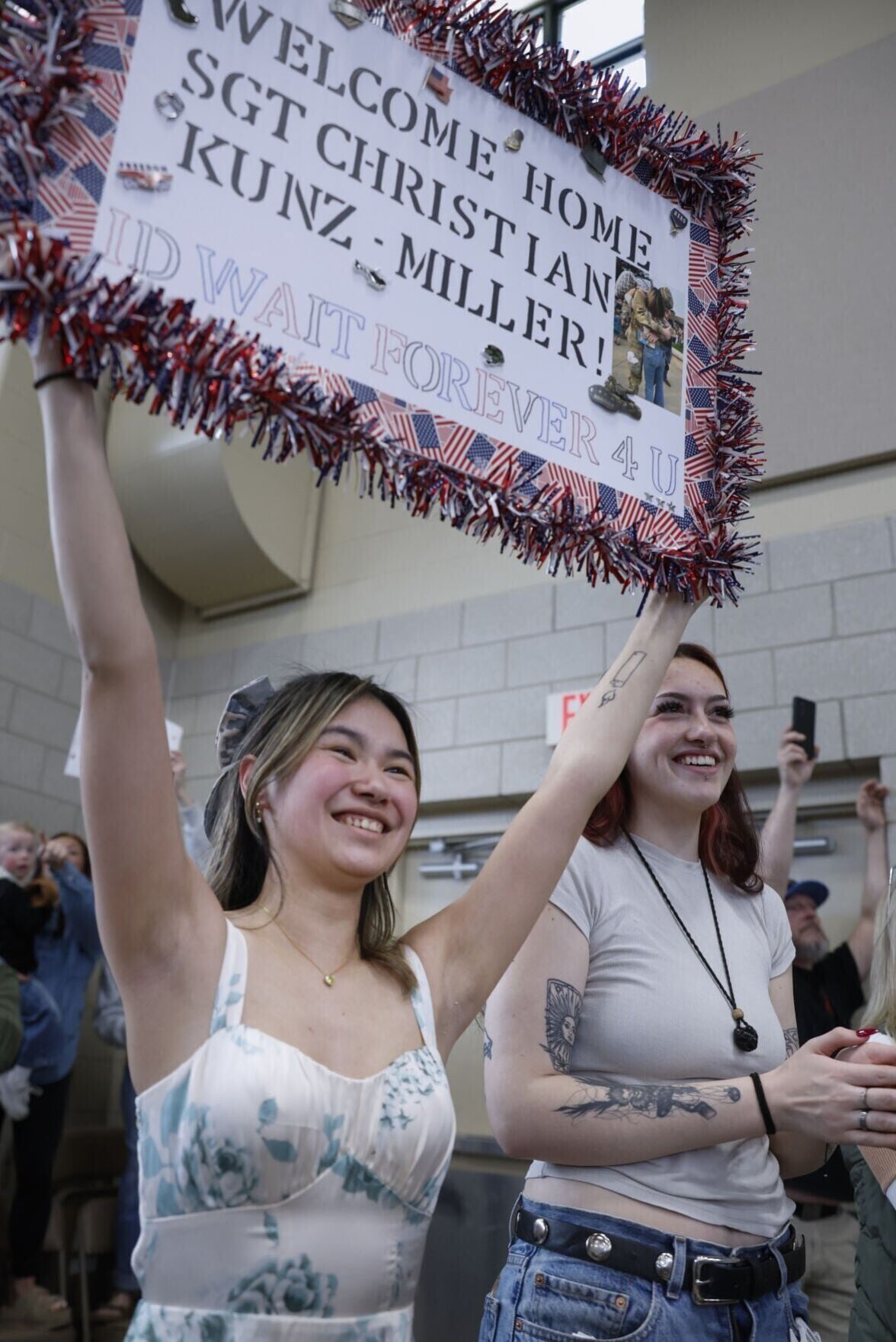
Nadia Pridemore (left) of Bettendorf smiles and holds a sign for her boyfriend, Sgt. Christian Kunz-Miller, as she and friend Katie Lampe wait to greet him after a welcome home ceremony at the Iowa National Guard Armory in Cedar Rapids on April 8, 2026.
“Today, we celebrate safe returns, long-awaited hugs and the reunions that remind us what really matters,” remarked Capt. Tim Hadley, a chaplain with the Iowa National Guard. “And we thank (God) for bringing them home.”
The group of about 140 Iowa Guard soldiers were the latest group from the 2nd Brigade Combat Team to return stateside after a nearly yearlong deployment as part of Operation Inherent Resolve, a counterterrorism initiative in Syria and Iraq.
Hundreds of friends and family members flooded the Iowa National Guard Armory in southwest Cedar Rapids on Wednesday to welcome them home following a brief ceremony.
Iowa Gov. Kim Reynolds gave the event’s opening speech, repeatedly thanking the Guard members for their months of service and for the many risks and sacrifices associated with such an effort.
Two soldiers from the brigade combat team died late last year — Sgt. Edgar Brian Torres-Tovar, 25, of Des Moines, and Sgt. William Nathaniel Howard, 29, of Marshalltown — in Palmyra, Syria, from injuries sustained while engaging “with hostile forces.”
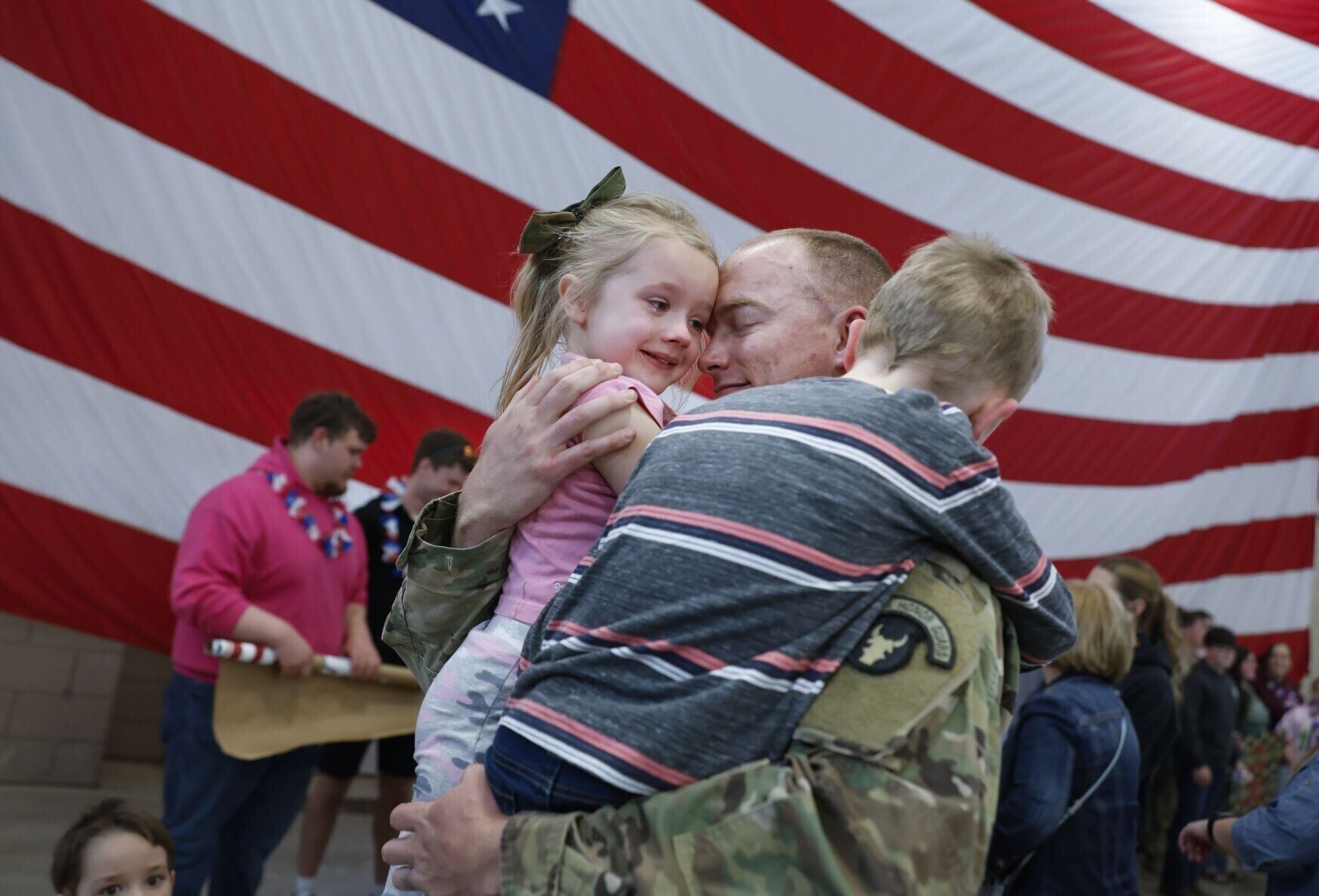
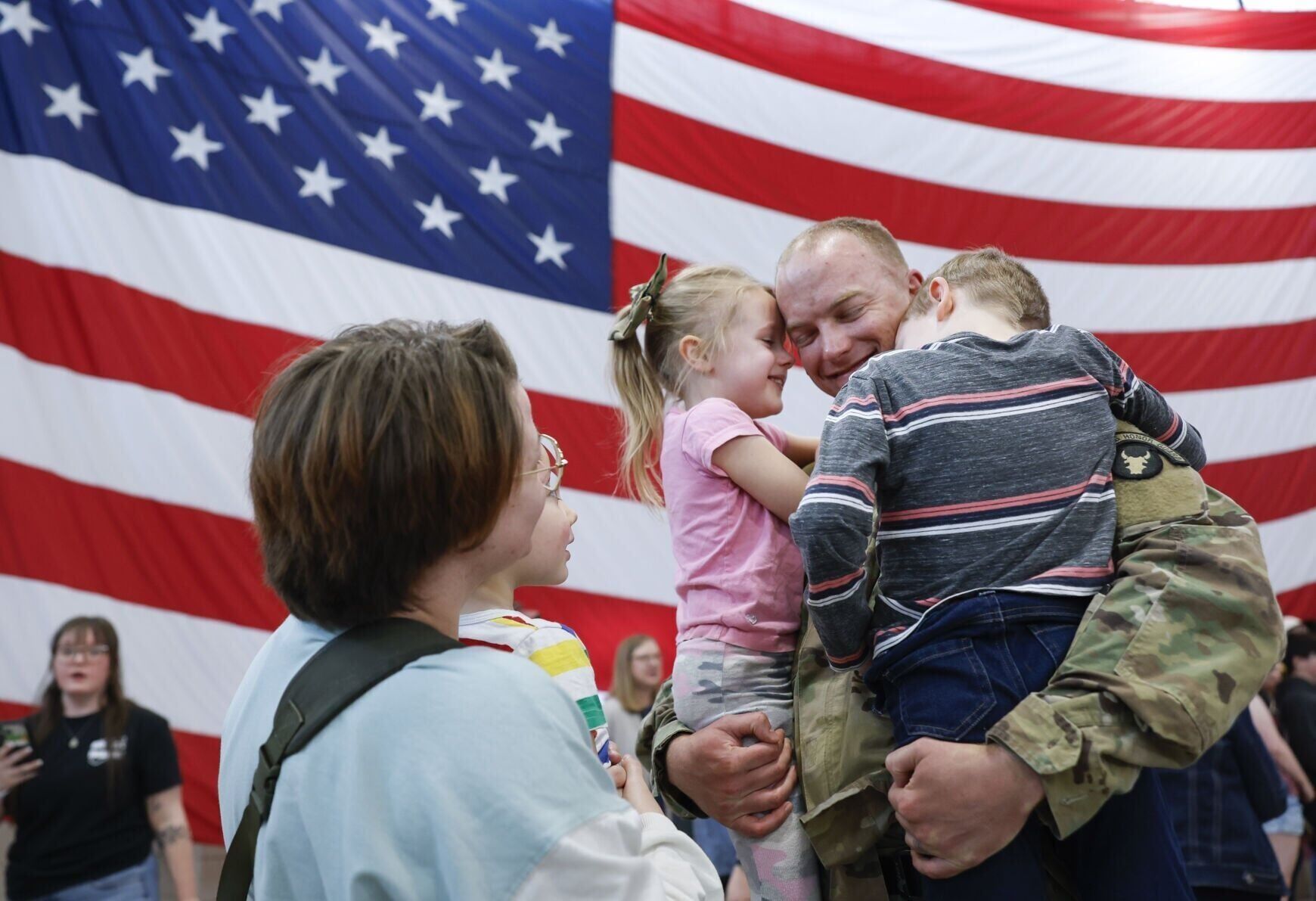
Capt. Lucas Tener of Cedar Falls hugs his daughter, Elizabeth, 6, and son, Nolan, 7, during a welcome home ceremony at the Iowa National Guard Armory in Cedar Rapids, Iowa, on Wednesday, April 8, 2026. About 140 members of the Iowa National Guard returned from deployment supporting Operation Inherent Resolve.
“Today, we honor your service,” Reynolds told the returning soldiers. “We also honor the memories of your two brothers in arms … whose legacies now live on in you. On behalf of the people of Iowa, please know that we will never, ever forget.”
Reynolds was joined on stage by Iowa National Guard Adjutant General Maj. Gen. Stephen Osborn. U.S. Rep. Randy Feenstra, and staff members representing the offices of U.S. Rep. Ashley Hinson and Sens. Chuck Grassley and Joni Ernst.
Iowa Gov. Kim Reynolds gestures as she and U.S. Rep. Randy Feenstra welcome home about 140 Iowa National Guard soldiers at the Iowa National Guard Armory in Cedar Rapids Wednesday, April 8, 2026.
But throughout the event, the focus remained squarely on the returning soldiers and their loved ones.
“To the families, thank you,” Osborn said. “I want to thank every one of you for your support of these soldiers, your support to our great state and our nation. … These soldiers cannot do what they do (without you).”
At the program’s conclusion, soldiers rushed into the crowd to embrace their friends and family — many of whom had brought small flags, flowers or commemorative signs along to mark the occasion. Tears of joy were a common sight, as were hugs, kisses and raucous cheers.
Some of the reunions were quieter, however, such as the one shared between Sgt. Matthew Sanchez and his wife, Destani, who upon the soldiers’ dismissal connected from across the room like two ends of a strong magnet.
Capt. Lucas Tener of Cedar Falls hugs his daughter, Elizabeth, 6, and son Nolan, 7, while wife Cynthia holds their other son Xavier, 3, during the Wednesday, April 8, 2026, welcome home ceremony at the Iowa National Guard Armory in Cedar Rapids. About 140 members of the Iowa National Guard returned from deployment supporting Operation Inherent Resolve.
The first thing the pair did was embrace in a long, silent hug before breaking apart to simply take it all in. It was Matthew’s second deployment, Destani said, but the first since the young Iowa City couple had gotten married.
“It doesn’t really get easier,” she said. “So it’s really nice — really genuinely nice — to have him back again.”
More than 500 Iowa National Guard soldiers remain deployed in Middle East