Sharon Link is prone to kidney stones — that’s what she thought was making her bleed sometimes when she used the bathroom. But a CT scan her doctor ordered revealed a fast-growing tumor in her uterus instead.
After her diagnosis, Link dove into research. The more she read, the more links she found between her everyday behaviors and cancer. Was it the carcinogens in her laundry detergent? Was it something in her diet? When Link learned about the connections between pesticides and cancer, she kept returning to the thought there was an environmental factor at play.
“There’s just more stuff on farm fields than there used to be,” said Link, who lives in northeast Iowa’s Fayette County. “I’m 65. When I grew up, they didn’t crop dust, they didn’t spray things out of planes.”
Link isn’t the only one with questions. Authors of a report released Wednesday by the Iowa Environmental Council and the Harkin Institute for Public Policy & Citizen Engagement say it was inspired by Iowans’ desire to understand how the state’s cancer rate and environment might be connected.
The report, ”Environmental Risk Factors and Iowa’s Cancer Crisis,” is intended to inform Iowans and give them a starting point for action.
Iowa has the second-highest cancer incidence rate in the nation and is one of only two states where the rate is rising. While the U.S. has seen an overall decline in cancer rates, Iowa’s rate is sharply increasing. According to the 2026 Cancer in Iowa report, an estimated 21,700 Iowans will be diagnosed with cancer this year and 6,400 will die from the disease, underscoring the scale and urgency of the issue.
![]()
Colleen Fowle, Iowa Environmental Council
Submitted photo
Filling in the gap between scientific and public knowledge
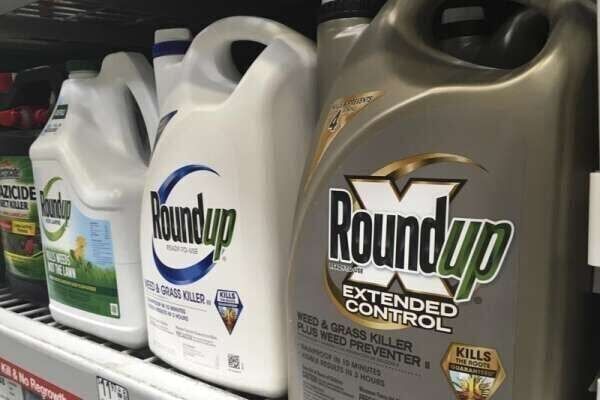
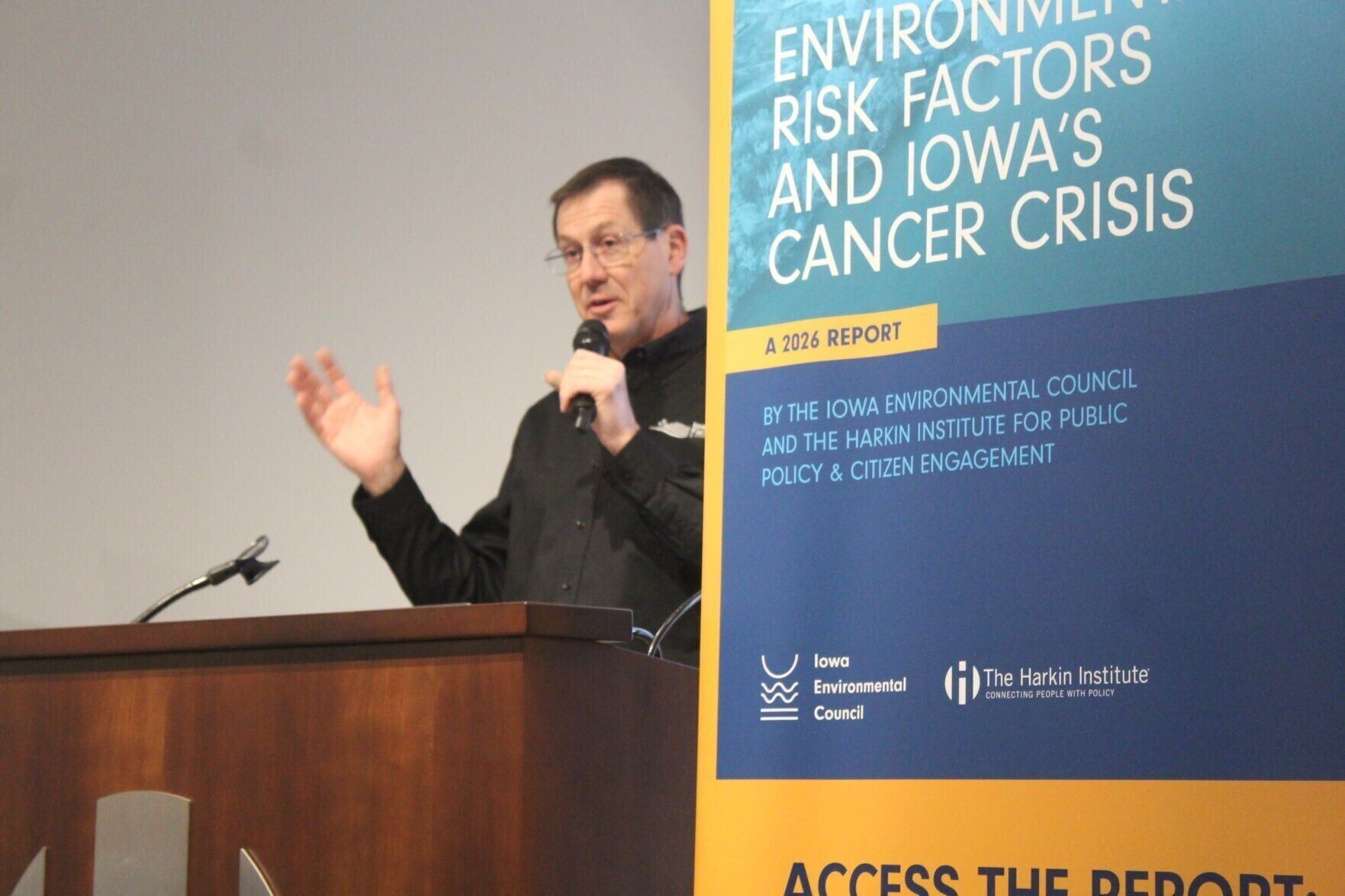
Adam Shriver, director of wellness and nutrition policy at the Harkin Institute at Drake University and one of the report’s authors, said he was approached by a group of concerned citizens who wanted to understand what factors beyond individual actions could be driving the state’s high cancer rate.
![]()
Adam Shriver, director of wellness and nutrition policy at the
Harkin Institute at Drake University, speaks during a press
conference on a report connecting environmental exposures to cancer
trends in Iowa.
Tom Barton/The Gazette
“We were hearing a lot of stuff about personal behavior, eating less and smoking less and drinking less, but in Iowa, there’s this big elephant in the room of the intensive, industrial way in which we practice agriculture,” Shriver said.
The same group of people had also reached out to the Iowa Environmental Council, a nonprofit coalition of organizations working on environmental issues in the state.
Along with the Harkin Institute and the Iowa Farmers Union, the council hosted a series of listening sessions in 2025. Colleen Fowle, the Iowa Environmental Council’s water program director, said she was surprised that scientists’ concerns lined up so consistently with the public’s concerns.
![]()
Colleen Fowle, Iowa Environmental Council
Submitted photo
“We felt in a prime position to fill that gap and take the scientific information, communicate it to the general public and help them become more informed about the topics they wanted to know more about,” Fowle said.
To close that gap, experts from the Iowa Environmental Council, the Harkin institute and other collaborators conducted an extensive review of existing research, with their key findings highlighted in the final report.
Unknowns persist, but shouldn’t delay action
The report flags five noteworthy environmental risk factors found in Iowa: pesticides, PFAS, nitrates, radon and industrial activity. Each has its own section in the report outlining how people typically come into contact with it, how it shows up in the state and its ties to cancer.
Iowa has some of the highest nitrate levels in drinking water in the U.S., extensive pesticide use, elevated radon concentrations in homes and growing concerns about PFAS contamination.
In Iowa, 13 of the 16 cancer sites identified in the report as connected to pesticides, nitrate, PFAS and radon exceeded the U.S. incidence rate in the most recent five-year period (2017–2021). Of the adult cancers linked to these environmental risk factors, 11 of 15 types are increasing in Iowa. Among people under age 50, six in 10 associated cancer types are rising.
Part of what makes the puzzle so complicated, though, is how little is known about how these contaminants interact with each other and change over time.
Studies on a pesticide’s safety, for example, focus on how toxic the active ingredients are when they’re applied. Far less is known about how active ingredients from different products interact, what happens as these chemicals break down over time, or how other ingredients in the pesticides, such as solvents and dyes, factor into the equation.
“We’re just starting to get a handle on the association between the main ingredient, or the main contaminant, and how that’s affecting our health, and all of these really complex interactions are going to take time to more fully understand,” Fowle said.
The difference between correlation and causation is another tricky needle to thread. It’s nearly impossible to prove something directly caused a cancer case. But, Shriver said, if cancer risk and an environmental contaminant are correlated – meaning exposure to the contaminant “reliably increases” cancer risk — it’s worth exploring the connection.
“When it comes to nitrates, for example, we know that when people digest nitrates, it gets converted into nitrites, and those can lead to mutations, and those mutations can cause cancer,” Shriver said. “So there is this plausible biological story that can be told about why it could lead to cancer.”
A growing body of evidence shows nitrate levels far below the EPA drinking water standard of 10 milligrams per liter are associated with increased risks of colorectal, ovarian, bladder, thyroid and prostate cancers.
That doesn’t mean knowing the whole biological story is required to act, Fowle said.
The report encourages the use of the precautionary principle, an approach for preventing harm in situations with scientific uncertainties. When there’s enough evidence to reasonably suspect a connection between environmental exposures and cancer risk, the precautionary principle says it’s the responsibility of those arguing against action to prove the connection is flawed rather than for proponents of change to prove it’s absolutely certain.
“We need to act when we have the information,” Fowle said. “If we have information, and we’re not acting on it, that’s a failure.”
Carrie Johansson, senior director of policy and programs with Iowa Environmental Council speaks about a new report linking environmental facto…
Environmental exposure and agriculture
Iowa’s intensive agriculture footprint results in some of the highest pesticide application rates in the nation. The state ranked fourth nationally in pesticide use by weight from 2015 to 2019. Chemicals such as atrazine and metolachlor have been detected for decades in surface water, aquifers, public drinking water systems and private wells.
Nitrate pollution also has increased over time. Public water systems have struggled to stay below federal safety limits, while many private wells exceed them. Iowa has the highest concentration of large animal feeding operations in the country — about 2.5 times more than the next highest state. The Des Moines and Raccoon rivers rank in the top 1% nationally for nitrate concentrations, with roughly 80% originating from agricultural sources.
Matt Russell, executive director of the Iowa Farmers Union, said farmers have a direct stake in the state’s cancer crisis because they live with the same environmental risks as other Iowans.
![]()
Matt Russell, executive director of the Iowa Farmers Union,
speaks during a Wednesday, March 25, 2026, news conference about
the role of agriculture in addressing environmental factors tied to
cancer in Iowa.
Tom Barton/The Gazette
He said the group is not opposed to pesticides, fertilizer or Iowa’s farm economy, but argued the state must do more to support changes in farming practices that can reduce harmful exposures.
Russell said that includes diversifying crop systems, using fertilizer more efficiently, reducing reliance on pesticides and spreading livestock production more evenly across the state. He framed the issue not as a threat to farmers, but as an opportunity to invest in family farms, cleaner water, healthier soils and farmer-led solutions.
“Addressing the cancer crisis in Iowa isn’t a threat to Iowa farmers, it’s an opportunity,” Russell said.
Matt Russell, executive director of the Iowa Farmers Union, talks about changes to be made in response to a new report linking environmental f…
Shriver added many of the cancers rising fastest in Iowa are those most strongly linked to environmental exposures.
“Certainly, the environment is not the only thing driving Iowa’s high and rising cancer rates, but it is absolutely clear that Iowans are being exposed to a wide mix of toxic substances in our environment at levels not seen elsewhere in the United States,” he said. “Cancer is complex, and we need to work to reduce all of the risks connected to it, but there is an important difference between risk factors that people can choose to avoid in our everyday behavior and those that are imposed by decisions largely outside of our control.”
Policy change is the next step
Link’s latest scan in February found no cancer. She’s still playing it safe — she has a reverse osmosis system set up for her water and washes all her produce in a vinegar or baking soda solution. Link said she wanted to be more involved in environmental advocacy as well, but she didn’t feel she could make a difference.
“I don’t know, as far as being just one person, what I could do,” she said.
That’s what the report is for, Shriver said: to help Iowans find balance between individual and systems-level changes they can make. Some cancer drivers, like smoking, drinking and exercise, are things people can personally address. But others, like water pollution and pesticide application, need to be pushed for on a political level.
“We are not in a neutral policy environment,” Shriver said. “The risks that we’re facing are the results of the things that we prioritize in our policies and the things that we ignore when we’re creating our policies.”
Adam Shriver, director of wellness and nutrition at the Harkin Institute for Public Policy, speaks about a new report linking environmental fa…
Several policy recommendations are outlined in the report. Fowle said some, like enforcing regulations and increasing monitoring and transparency, are “low-hanging fruit,” while others, like investments in research and technical improvements, will take more effort.
Though the report is finished, Fowle said the Iowa Environmental Council’s work is not done. Now that the document is complete, it’s time to share it.
“Our whole goal is to better inform Iowans across the state, especially connecting with rural Iowans who are disproportionately affected by cancer,” Fowle said. “This is just the beginning.”
Carrie Johansson, senior director of policy and programs with the Iowa Environmental Council, said one immediate priority is preserving the state’s water quality monitoring system.
![]()
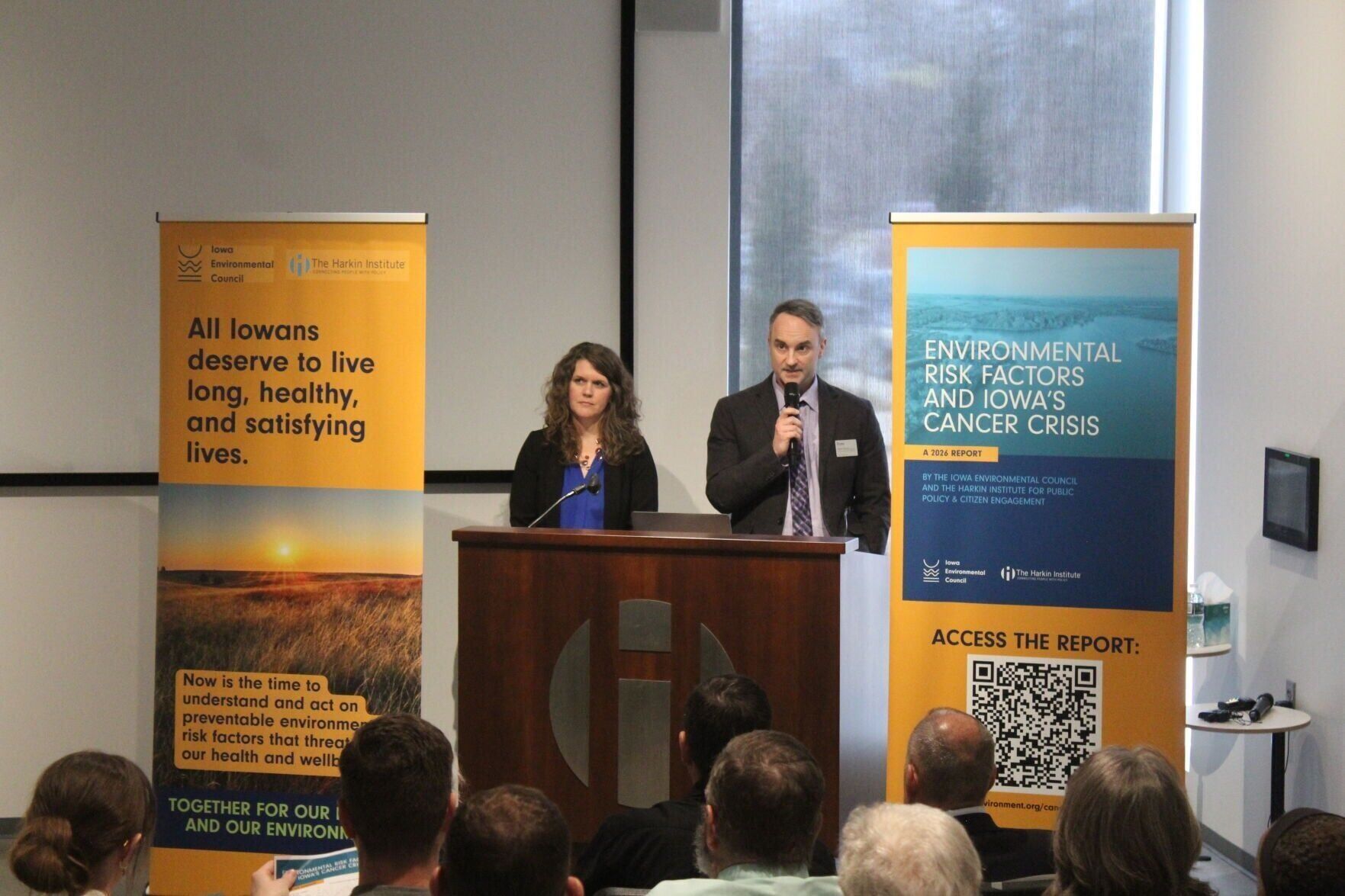
Carrie Johansson (left), senior director of policy and programs
at the Iowa Environmental Council, and Adam Shriver (right),
director of wellness and nutrition policy at the Harkin Institute
at Drake University, speaks during a press conference on a report
connecting environmental exposures to cancer trends in Iowa.
Tom Barton/The Gazette
“So one of the things that we’ve been urging lawmakers to do all session is to fund our state of the art water quality monitoring network at the University of Iowa Hydro Science and Engineering Department,” she said. “If those sensors are not funded, they are slated to go offline this summer. It’s unacceptable to allow that to happen.”
She also expressed frustration with Iowa GOP lawmakers pushing legislation in recent years to shield agricultural chemical manufacturer Bayer from lawsuits alleging the company failed to warn consumers of potential health risks when product labels comply with federal requirements, while noting support for a bill focused on radon mitigation in new home construction.
Although the liability shield bill passed through the Iowa Senate in 2025, House lawmakers have not taken up the issue this session.
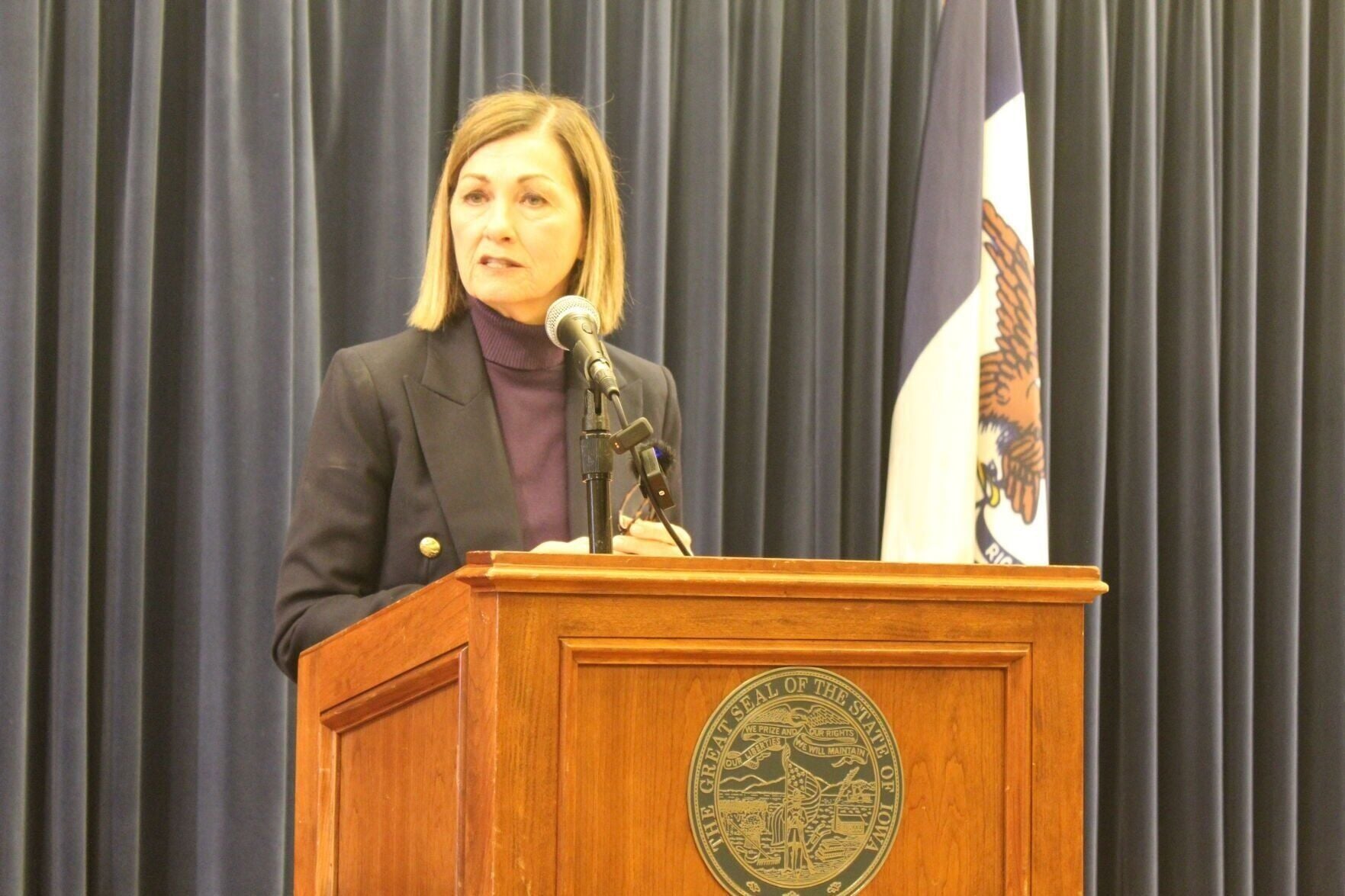
The issue resurfaced in February when President Donald Trump signed an executive order aimed at boosting domestic production of glyphosate-based herbicides and elemental phosphorus, invoking the Defense Production Act to prioritize their manufacture as a national security matter.
Bayer, which acquired Monsanto — the original developer of glyphosate-based Roundup — in 2018, has faced years of litigation alleging that glyphosate exposure can cause cancer, particularly non-Hodgkin lymphoma. The company, which operates a Roundup production facility in Muscatine, argues that because the Environmental Protection Agency has determined glyphosate is not carcinogenic, it should not be required to include cancer warnings on product labels.
Although the EPA has concluded glyphosate does not pose a cancer risk, a federal district court in 2022 ordered the agency to revisit that determination, according to Reuters. The International Agency for Research on Cancer has classified glyphosate as “probably carcinogenic to humans.”
Some Iowa farmers have expressed concern that without the liability protections, access to widely used pesticides such as Roundup could become more limited.
“We do not need to accept early death as a natural part of life in Iowa,” Johansson said. “… We have allowed powerful interests to dictate what happens on our land in our state for too long. Iowans are asking for change loud and clear, but the response from policymakers has been a deafening silence.”
The full report, maps, citations and other resources are available at iaenvironment.org/cancerproject.