
Iowa House passes limits on license plate reader use
Camera measure now returns to Senate

A Flock camera is seen at an entrance to Lowe’s in northeast Cedar Rapids, on Oct. 13, 2025. The home improvement store has three stationed in its parking lot.
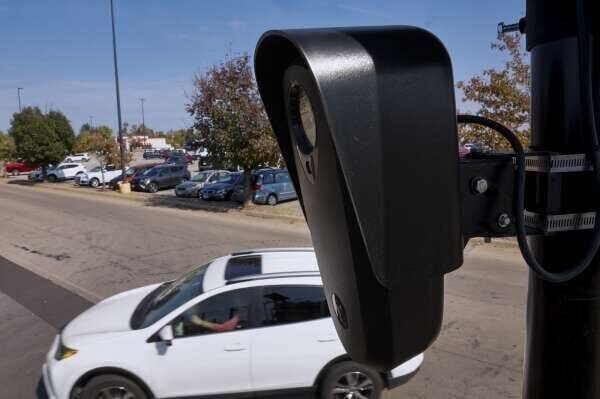
A Flock camera operates at the entrance to Lowe’s parking lot in northeast Cedar Rapids in October 2025. At the time, the home improvement store had three automatic license plate cameras stationed in its parking lot. Iowa lawmakers are looking at guardrails for use of the cameras by law enforcement, though the bill is silent on the use of cameras in the private sector.
DES MOINES — The Iowa House on Thursday approved legislation placing restrictions on the use of automatic license plate readers, sending the measure back to the Senate after adopting a series of amendments aimed at balancing law enforcement needs with privacy concerns.
The bill, Senate File 2284, passed the House on a 77-11 vote. State Rep. Eric Gjerde, a Cedar Rapids Democrat and police officer, joined 10 Republicans in opposing the measure.
Lawmakers described the proposal as an attempt to establish clearer guardrails around a rapidly expanding surveillance technology that can track vehicle movements by scanning and storing license plate data.
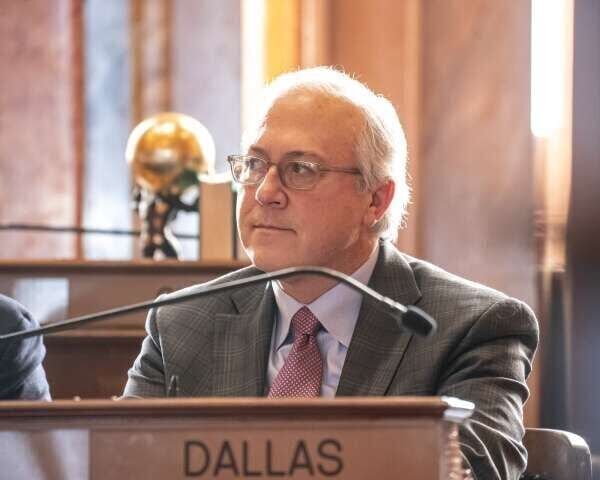
Rep. David Young, R-Van Meter, looks on during the first day of the legislative session in January 2025 at the Iowa Capitol in Des Moines.
“This is a real balance to protect liberty (and) make sure that our communities were safe,” Rep. David Young, R-Van Meter, said during floor debate, pointing to concerns about the growing presence of cameras and data collection in public spaces.
Coralville to remove license plate reader cameras
New guardrails on plate reader use
As amended by the House, the bill would require cities and counties to formally authorize the use of automatic license plate readers through local ordinances before deploying them.
Those ordinances must spell out which vendors provide the technology and who is allowed to access the systems, adding a layer of local oversight.
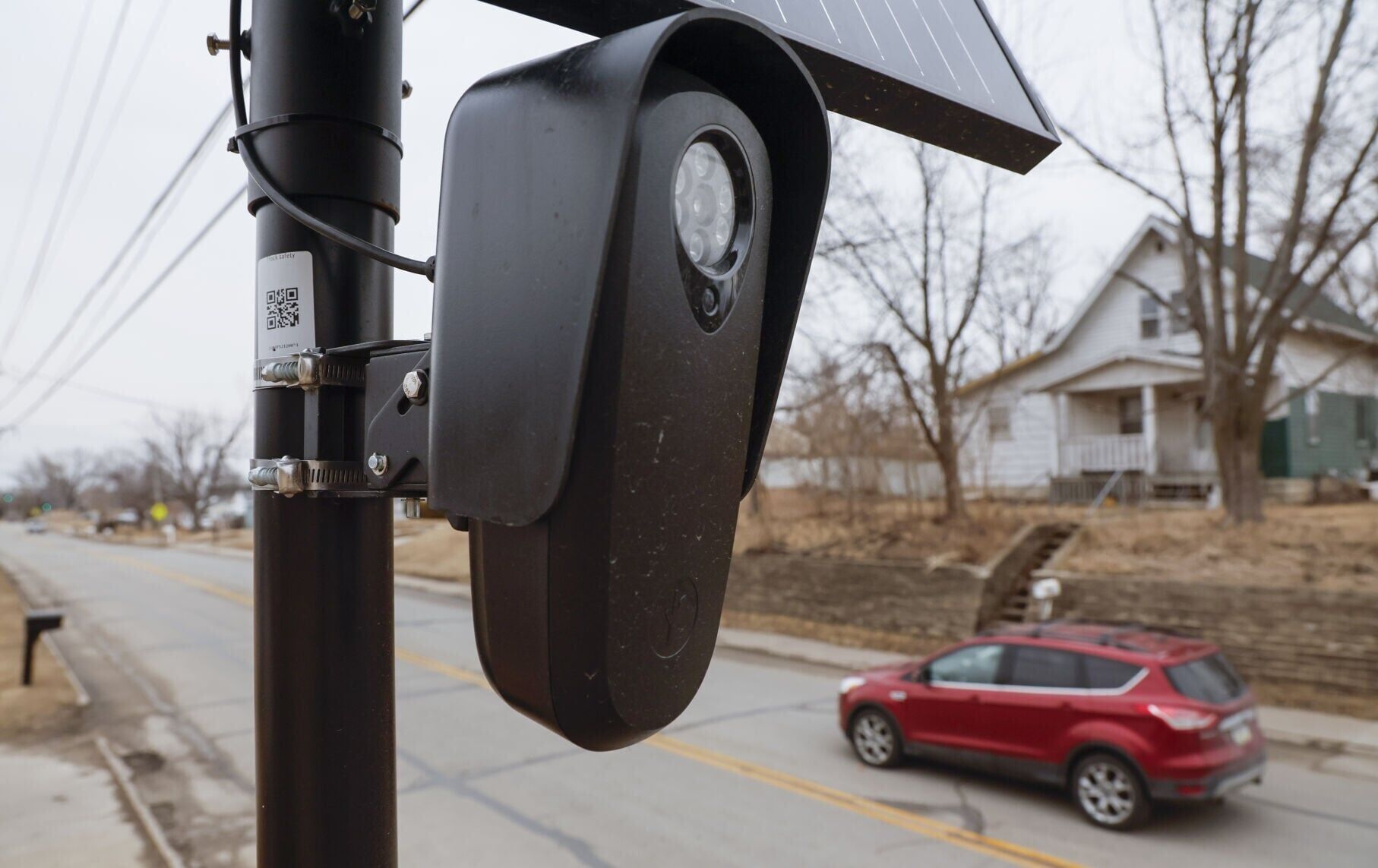
A Flock license plate reading camera records the southbound lane of J Street SW in Cedar Rapids on March 4, 2025.
The legislation also includes several restrictions on how the technology can be used:
• Data retention limits: Images and associated data captured by plate readers must generally be deleted within 30 days, unless tied to an active criminal investigation.
• Search accountability: Law enforcement searches of the database must be tied to a specific case or call for service and logged, with agencies required to maintain records and conduct regular audits.
• Limits on data sharing: Plate reader data cannot be broadly shared with third parties, except in limited cases such as law enforcement or insurance fraud investigations.
• Ban on facial recognition: The bill prohibits using the systems to identify individuals based on facial images.
Rep. Megan Jones, R-Sioux Rapids, the bill’s floor manager, said the changes were crafted to “walk that line between making sure we are giving our law enforcement officers the tools that they need to be successful, but also making sure that government isn’t over collecting data and surveillance of Iowans.”
Worried about surveillance, some states enact privacy laws and restrict license plate readers
Privacy concerns
Lawmakers from both parties acknowledged the tension between public safety and civil liberties as they debated the measure.
Rep. J.D. Scholten, D-Sioux City, said the bill reflected a compromise.
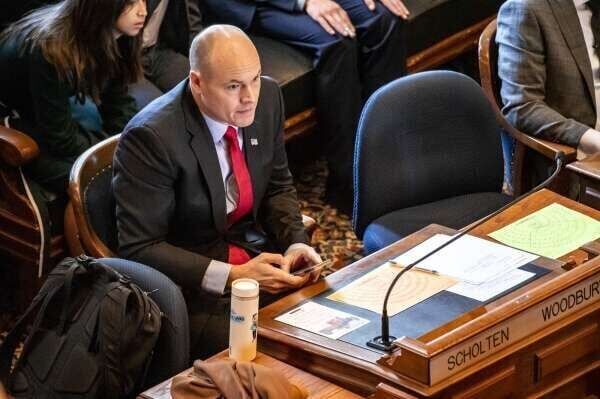
State Rep. J.D. Scholten, D-Sioux City, looks on during the first day of the legislative session in January 2025 at the Iowa Capitol in Des Moines.
“I think this is a challenging situation where we’re trying to balance law enforcement, allowing them to do their job, with the fear of a surveillance state,” Scholten said, adding while the amended bill might not be “perfect,” it’s “a collaboration” that “is better than what we have in existence already.”

State Rep. Zach Dieken, R-Granville
Rep. Zach Dieken, R-Granville, a state trooper, warned that lawmakers would need to revisit the issue as technology and laws evolve.
“This is a wonderful tool,” Dieken said. “The problem isn’t necessarily with the technology … (but) this body has to watch this like a hawk … or we’re going to be treading some dangerous waters.”
Opponents argued the bill does not go far enough, particularly in regulating private companies that collect and sell license plate data.
Rep. Ryan Weldon, R-Ankeny, cautioned that while the legislation restricted government use, it left private vendors largely untouched.
“The same information we’re restricting government from using can still be collected, aggregated and sold by private companies with zero oversight,” the lawmaker said during debate, calling the measure “a half measure.”
Young pointed to provisions he said would establish state oversight of vendors. The bill states the Department of Public Safety shall develop and maintain a list of approved automatic registration plate readers and vendors.
ACLU: Patchwork oversight
A December report from the American Civil Liberties Union of Iowa underscored the lack of consistent statewide rules governing automatic license plate readers, warning that a patchwork of local policies leaves gaps in oversight.
The report found that Iowa has “almost no laws” regulating how the cameras are used, resulting in wide variation between law enforcement agencies in how data is collected, stored and accessed.
ACLU of Iowa calls for statewide regulations for license plate reader cameras
Researchers documented inconsistent practices across departments, with some agencies requiring detailed search logs and audits, while others provide little transparency or oversight. In some cases, reasons for database searches were recorded only as vague terms like “investigation” or “suspicious,” without further explanation.
ACLU officials warned that without statewide standards, the technology could be vulnerable to misuse.
“We’re all at the mercy of the good judgment of the police,” ACLU of Iowa Legal Director Rita Bettis Austen said.
The report also highlighted the scale of data collection already underway.
Based on information from agency transparency portals, license plate readers detected at least 4.3 million vehicles across Iowa in a single month, averaging more than 219,000 vehicles per agency.
The report concluded that without comprehensive statewide safeguards, Iowa risks seeing the same types of misuse reported in other states, where license plate reader systems have been used improperly for personal or unrelated investigations.
Additional provisions
In addition to the plate reader provisions, the bill maintains language from the Senate version that limits how automated systems can be used in traffic enforcement, including prohibiting citations from certain automated vehicle noise enforcement systems under specific conditions.
Violations of the bill’s provisions would be classified as a simple misdemeanor.
What’s next?
Because the House amended the bill, it now returns to the Senate for consideration of the changes before it can be sent to the governor’s desk.
Tom Barton covers state government and politics. Comments: (319) 398-8499; tom.barton@thegazette.com