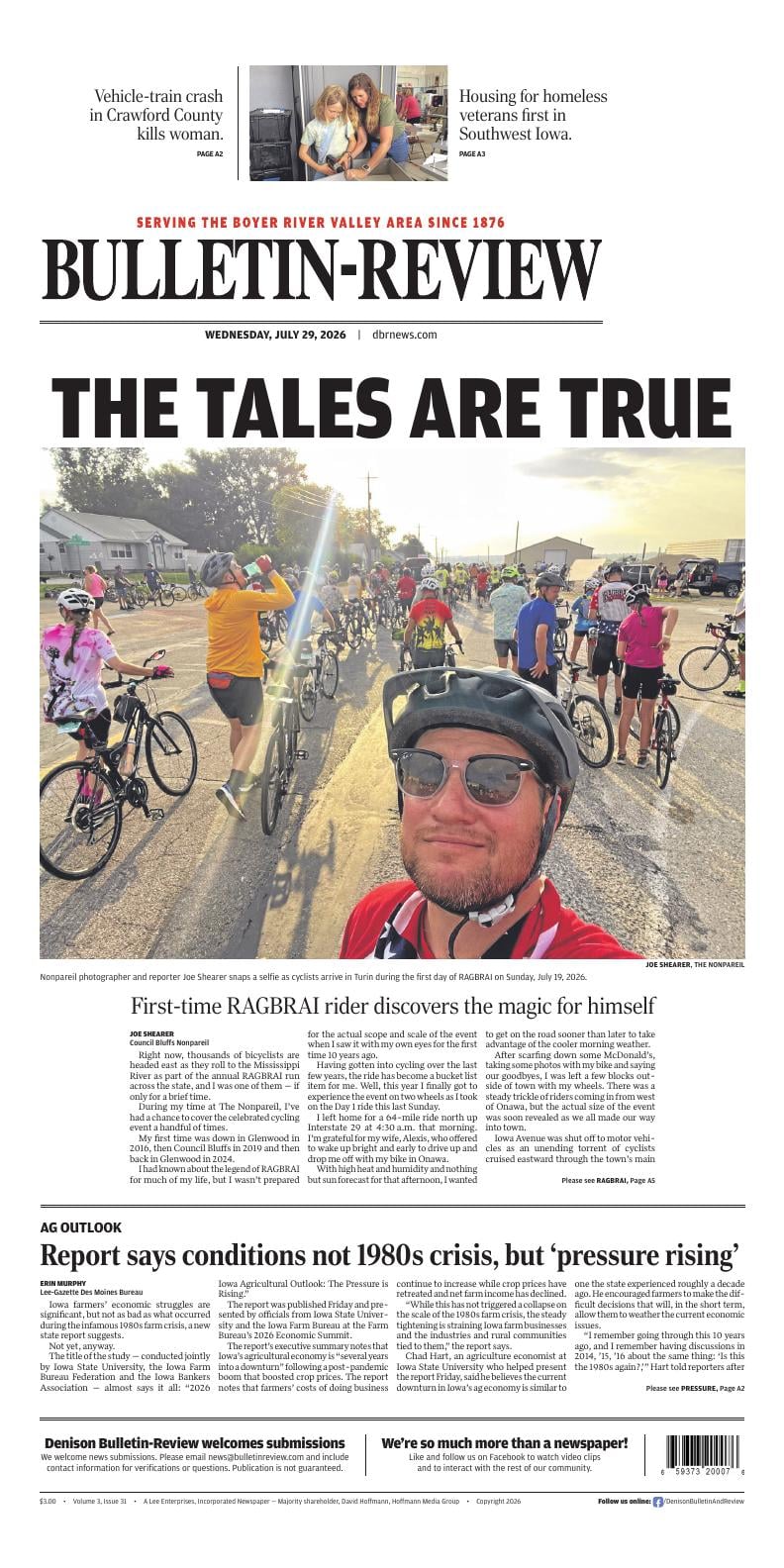
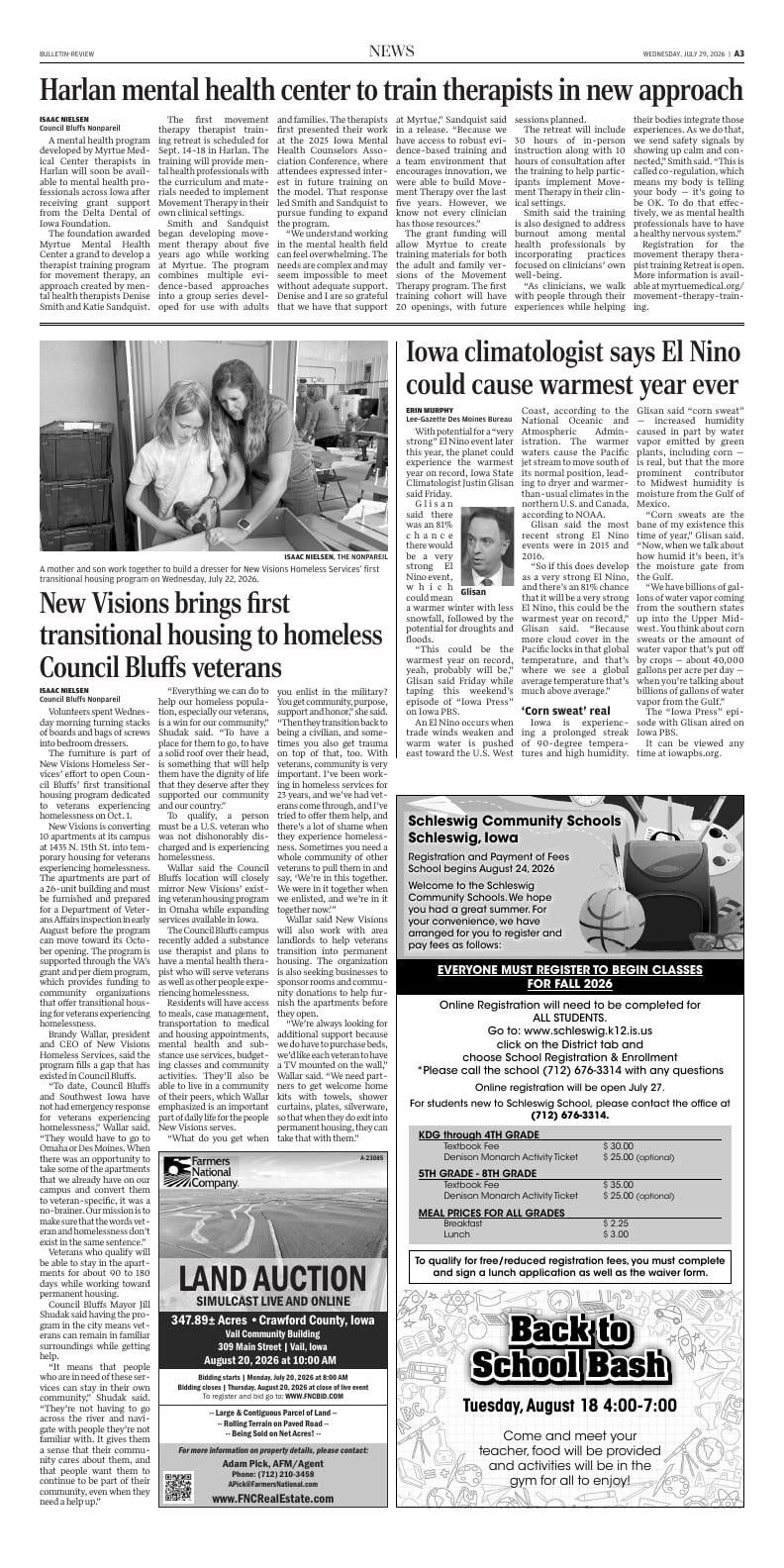
Iowa farmers’ economic struggles are significant, but not as bad as what occurred during the infamous 1980s farm crisis, a new state report suggests.
Not yet, anyway.
The title of the study — conducted jointly by Iowa State University, the Iowa Farm Bureau Federation and the Iowa Bankers Association — almost says it all: “2026 Iowa Agricultural Outlook: The Pressure is Rising.”
The report was published Friday and presented by officials from Iowa State University and the Iowa Farm Bureau at the Farm Bureau’s 2026 Economic Summit.
The report’s executive summary notes that Iowa’s agricultural economy is “several years into a downturn” following a post-pandemic boom that boosted crop prices. The report notes that farmers’ costs of doing business continue to increase while crop prices have retreated and net farm income has declined.
“While this has not triggered a collapse on the scale of the 1980s farm crisis, the steady tightening is straining Iowa farm businesses and the industries and rural communities tied to them,” the report says.
Chad Hart, an agriculture economist at Iowa State University who helped present the report Friday, said he believes the current downturn in Iowa’s ag economy is similar to one the state experienced roughly a decade ago. He encouraged farmers to make the difficult decisions that will, in the short term, allow them to weather the current economic issues.
“I remember going through this 10 years ago, and I remember having discussions in 2014, ’15, ’16 about the same thing: ‘Is this the 1980s again?,’” Hart told reporters after the presentation. “If you look at the data, what it showed was that ag did muddle through it. We did find ways to hold steady on a lot of these financial ratios, even though the incomes weren’t all that strong anymore.”
Unlike the 1980s farm crisis, the current issues facing farmers is one of cash flow, not assets, Hart said.
In other words, farmland remains valuable and most Iowa farmland is owned and paid off. But many farmers have low cash flow.
Hart likened it to an individual who has a healthy retirement account but not much in their checking account to pay day-to-day bills.
‘No relief in sight’
Christopher Pudenz, the Iowa Farm Bureau Federation’s economics and research manager, said the longer the downturn continues, the more likely farmers will have to consider deploying their assets.
“The title of this report is that the pressure is rising because to keep going with (Hart’s) analogy, if you don’t have enough money in your checking account year after year after year, eventually the wise thing to do is to tap into your retirement account. And in farming, that looks like tapping into assets,” Pudenz said. “That could lead to a solvency issue, could lead to more bankruptcies if you have this liquidity issue year after year after year.
“And we’re three years into this at this point. A few more years, and we could see more issues.”
Pudenz said unofficial professional projections for 2025 through 2027 suggest farm incomes will continue to decline.
“So you’re looking at a downturn that’s forecasted to be at least six years long, with no relief in sight,” he said.
Can’t rely on China
![]()
Former U.S. Trade Representative Robert Lighthizer speaks to
reporters Friday, July 17, 2026, during the Iowa Farm Bureau’s 2026
Economic Summit at DMACC’s FFA Enrichment Center in Ankeny.
Erin Murphy, Cedar Rapids Gazette
Robert Lighthizer, the former U.S. Trade Representative during President Donald Trump’s first term, said he believes China will live up to its recent trade agreements with the U.S. in the short term.
But farmers should not count on U.S. exports to China as a reliable source of income in the long-term, he said in his keynote address.
“I think that if you if you’re depending long term on China as a key part of your export market, there’s a lot of risk, just an enormous amount of risk — geopolitical risk, economic risk,” Lighthizer told reporters. “And their own domestic policy is contrary to being dependent on these kind of imports.”
Asked whether China as a market was worth fighting to retain, Lighthizer said yes, but with a caveat.
“I would say yes, but you have to be clear-eyed. You have to take off the rose-colored glasses,” Lighthizer said. “There are all these issues that are overpowering, and one of them is China does not want to do something to help America because of the geopolitical rivalry. China, for perfectly valid reasons, doesn’t want to be dependent on imports."
Lighthizer added: “So in the meantime, yeah, for sure, my advice is take advantage, sell, do what you can. But realize that long range, you’re going to have to figure out an alternative.”