
Polling found that Midwestern homeowners want elected officials to do more to help lower home insurance premiums.
Polling found that Midwestern homeowners want elected officials to do more to help lower home insurance premiums.
Polling found that Midwestern homeowners want elected officials to do more to help lower home insurance premiums.
Polling found that Midwestern homeowners want elected officials to do more to help lower home insurance premiums.
Crawford County Supervisor Dave Muhlbauer, lieutenant governor candidate left, and State Auditor Rob Sand, gubernatorial candidate take questions from media members after their speeches at the Iowa Democratic Party state convention, June 13, 2026, Roosevelt High School, Des Moines.
Crawford County Supervisor Dave Muhlbauer was officially nominated and approved Saturday at the Iowa Democratic Party state convention as State Auditor Rob Sand’s running mate for the 2026 Iowa gubernatorial campaign.
Muhlbauer, a fifth-generation farmer, said Iowans are upset with the state’s direction, and that the state is “potentially looking” at a farm crisis, citing tariffs and a six-year high in farm bankruptcies. He called for “rotating the crops” — in other words, changing the state’s elected leadership — to address these issues.
“People are frustrated, they see who our current elected officials serve and it is powerful insiders and special interests and they feel left behind,” Muhlbauer said. “I am a real farmer and know a thing or two about rotating crops. Let me say this loud and clearly, it is time to rotate the crops here in Iowa.”
The IDP state convention was held at Roosevelt High School in Des Moines, with 423 people in attendance. The event featured speeches from Iowa Democrats running for statewide and federal office, including Muhlbauer, Sand, state Rep. Josh Turek, the Democratic candidate for the U.S. Senate and Taylor Wettach, a candidate for state auditor and lawyer from Muscatine.
Sand and Muhlbauer spoke with reporters after their speeches. When asked about criticism from Republicans who allege his family farm has contributed to water pollution, Muhlbauer said he found the attacks “ironic and hypocritical.”
“I just find it rich that they want to attack farmers. It just tells me how disconnected they are with the challenge we face,” Muhlbauer said. “I feel like I’m better suited to face those challenges and help fix the problem. Farmers want to be a part of the solution and they want their voices to be heard.”
Farmer and businessman Zach Lahn, the Republican candidate for governor, has faced criticism from Democrats, including the Sand campaign, for previously living and being registered to vote in Kansas as of 2024. Lahn routinely flies back and forth from Kansas to Iowa as some of Lahn’s children are based in Wichita. Lahn is also a co-founder of a private school in Wichita.
In a June 9 statement on X, Lahn accused the Sand campaign of lying about his Kansas residency, claiming that the Gazette misquoted him by reporting that he and his family would “move to and live in Iowa full-time” if elected governor. Lahn also claimed that Sand believes that all illegal immigrants “deserve a place” in Iowa.
“I’m a sixth-generation Iowan living on the same farm that’s been in our family for 125 years. I never said anything like this. Notice there’s no quote? It’s because they don’t have one. I didn’t say it,” Lahn said. “Rob Sand claims to be a different kind of politician, but he started this campaign by lying about me and my children in a deeply personal way. Meanwhile, Rob thinks every illegal deserves a place in Iowa, but our family isn’t Iowa enough for him?”
When asked about Lahn’s comments, Sand said all his campaign has done is “repeat” Lahn’s own words.
“He said, ‘If elected, I will change my living situation and be here as much as humanly possible,’” Sand said. “This is a guy who admits he’s not really in Iowa all that much. That’s all. That’s not a lie. It’s his own words. People should hear them. I want everybody in this state to hear those words from Zach Lahn because I think it tells you most of what you need to know.”
Sand added that accusations from Lahn and other Republicans claiming he thinks “every illegal deserves a place in Iowa” is a “lie.” He said he believes Ian Roberts, former Des Moines Public Schools superintendent, should be deported.
“They don’t want to have a conversation about what they’ve been doing in Iowa with 10 years of one-party control. I have said repeatedly, people who have a criminal record, we ought to just deport him. I don’t know why we’re paying to put Ian Roberts in prison,” Sand said. “We’re giving him three hots and a cot, and he’s not supposed to be here. We ought to just send him away. I agree that people who are attacking public safety are harming public safety, I have been clear from the beginning that I don’t want them here, but they’re going to lie about what I believe, because they don’t want to talk about what they’ve done.”
During his speech, Sand said that Iowa has ranked toward the bottom of the U.S. in key metrics under one-party leadership.
“We have arrived at the point where, for the last three years, we have averaged 48th for personal income growth,” Sand said. “We are 50th for economic growth and we are number one for cancer growth. Just this week, the Annie E. Casey Foundation said that we are in the bottom half for education. That’s not good enough.”
Sand said when he was growing up, Iowa had a government where Republicans and Democrats worked together, despite differences, and that has been missing in the state over the past decade.
“We haven’t had that in the state of Iowa for a long time,” he said. He accused Republicans of misplaced priorities, saying as Iowa’s educational ranking is in the “bottom half” of the country, “those jokes over in the State Capitol building” are focused on making the state auditor’s job harder.
Turek, who defeated state Sen. Zach Wahls to win the Democratic nomination for Iowa’s U.S. Senate seat in a heated primary race, received loud cheers and a few boos from attendees when taking the stage. He did not address the boos.
Turek said that the 2026 election presents an opportunity for Democrats to gain control in Iowa, saying that he is hopeful about the party’s chances.
“This is not the Iowa I grew up in. This is not the state that we all love, but I’m also feeling hope here in Iowa for the first time in a very long time,” Turek said. “The status quo is not working. We need to fight for the people, not the billionaires and large corporations.”
Wettach, during his speech, said he believes Democrats have the best chance to gain more control in Iowa in a decade.
“As your state auditor, I would expand transparency, so folks know where their hard-earned taxpayer dollars are going,” Wettach said. “Democrats, independents and Republicans are recognizing how vital this fight is and how important it is to make sure we continue to have an independent watchdog in this office. This is the year we have the best chance that we have had in 10 years to turn things back in our state, but it’s going to take everybody.”
Iowa Capital Dispatch is part of States Newsroom, a nonprofit news network supported by grants and a coalition of donors as a 501c(3) public charity. Iowa Capital Dispatch maintains editorial independence. Contact Editor Kathie Obradovich for questions: info@iowacapitaldispatch.com.
For the first time, Iowa's education ranking has tumbled into the bottom half of states, falling to 27th nationally, according to the 2026 Kids Count Data Book.
The study from the Anne E. Casey Foundation, dedicated to improving children's lives, measures data for each state’s standing in overall child well-being, education, health, economic well-being, and family and community.
The report is based on data collected from 2020-24, scoring and ranking each state compared with the nation in the five categories.
Iowa ranks 10th nationally and has a score of 667 in overall child well-being, above the national score of 547. Iowa ranks 10th in economic well-being, 14th in health and 17th in family and community.
However, the state lags in education.
Iowa's education ranking of 27th is the first time since the creation of the Kids Count report in 1990 that Iowa has fallen into the lower 25 states.
The report gave Iowa a score of 394, below the national score of 417 in overall child well-being.
Sean Finn, a policy analyst for Common Good Iowa, a nonpartisan advocacy organization, said the organization finds Iowa's ranking “very concerning.” He blames a lack of school resources for the state's poor ranking.
“The schools have been asked to continue doing the same quality of work, but with fewer resources, and that has just kind of continued year after year after year,” Finn said.
Iowans will vote Nov. 3 on an amendment to constitution requiring a two-thirds majority in Iowa legislature to increase income taxes. Finn said that if passed, the amendment would make it “really, really hard to make sure that the schools continue to get resources,” through state funding.
“On an individual school to school level, the needs vary across districts and schools, but the state’s responsibility is making sure they get enough funding to cover those needs,” Finn said.
The state Legislature has also put limits on property tax increases, which school districts use to generate revenue.
Republicans have argued they've increased funding for K-12 education each year since taking over control of the Iowa Legislature in 2017.
Gov. Kim Reynolds gave a funding boost of $160 per student for Iowa schools in February for the 2026-27 fiscal year, increasing the education budget by 2% by spending $3.98 billion on K-12 education.
But Anne Discher, the executive director of Common Good Iowa, said in a press release that lack of funding “will create consequences that will ripple for generations.”
“Iowa has a robust history of serving children well, but recent leaders have lost the plot,” Discher said. “This report clearly demonstrates that we are heading in the wrong direction.”
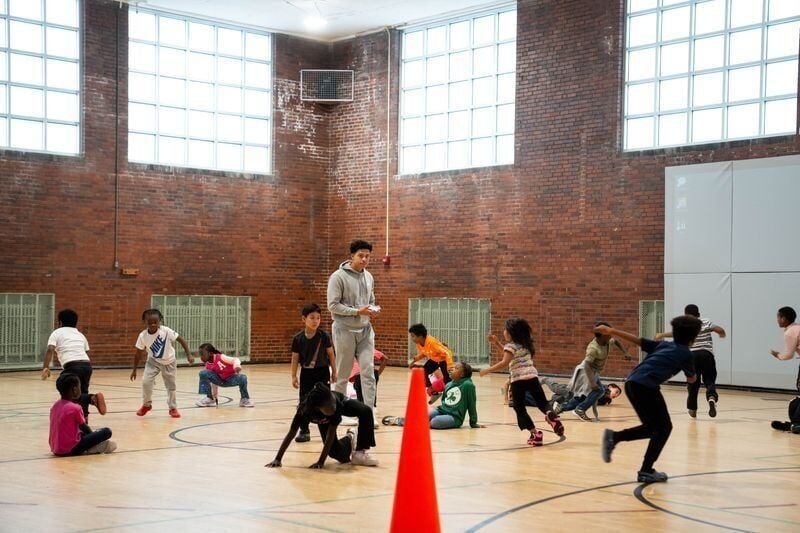
Students participate in physical education during a day at Moulton Elementary School on Oct. 28, 2025, in Des Moines.
In Iowa, 71% of fourth graders were not proficient in reading in 2024 — 6 percentage points higher than the 2019 findings. The report noted the importance of mastering reading at that age, which makes it easier for the student to progress in other subjects such as social studies and science.
Iowa students' English Language Arts test scores show recent improvements, with proficiency rates ranging from 68% to 80%, according to an Iowa Department of Education press release last August. Kids Count said eighth graders’ math level showed 73% were not proficient in math in 2024, increasing from 67% in 2019.
Lack of preschool participation for 3 and 4 year olds in Iowa rose, going from 53% in 2015-19 to 57% in 2020-24.
“One of the things that’s probably, pretty alarming I think, is the decrease of kids accessing preschoolers,” Drake University Literacy Education professor Jill Johnson said. “There are a lot of younger kindergarteners that haven’t had any type of schooling or early literary experience with a formal setting outside what they may or may not have received in their homes."
Johnson believes the decrease in preschool participation is the result of cost.
“Preschools are expensive. And while we recognize the value of them, even in our state, it’s a real expense for some families,” Johnson said. “If you have to choose between putting groceries on the table or not, you’re going to choose groceries. Families are having to make really hard decisions.”
Iowa Department of Education Communications Director Heather Doe said the Kids Count report "does not reflect student performance based on the most recent data." She said a recent report by the National Institute for Early Education Research nationally ranks Iowa sixth in preschool access for 4 year olds and 21st for 3 year olds.
"Using the most recent statewide data, Iowa demonstrates it is delivering remarkable results for students across multiple measures, including those outlined above," Doe said.
In 2023 and 2024, 13% of Iowa high schoolers failed to graduate on time, increasing from 8% in 2019. Johnson believes a change in demographics is a reason behind the increase.
The Iowa Department of Education said in April that 88.8% of high school students in the class of 2025 graduated, meaning 11.3% of the class did not.
“Sometimes our school systems have been slow to respond to the change of the needs of the kids coming,” Johnson said. “I think that diversity is certainly beneficial to our community in so many ways, but that also means that as schools we need to respond and be flexible in how we address the needs of all learners that come to us.”
Johnson said the Iowa school systems are “really trying to respond and meet the kids where they are,” but it’s difficult.
“We want to meet their needs, but their needs are changing and are different than 10 years ago,” Johnson said. “While we want to focus solely on academics, we have kids that are coming hungry, we have kids that are special needs, that have health issues. So we’re trying to meet them where they’re at so that we can get to the learning.”
This report was syndicated from USA Today Network via Reuters Connect.