
With funding cut, Iowa volunteers step in to carry on water monitoring
Since the loss of funding for Iowa’s statewide water monitoring system, Iowans have stepped up to monitor local waterways.
“It’s like being a Boy Scout or a fifth-grader again, going out and doing a project — and who doesn’t like playing in the water and looking for critters and measuring things?” said Todd Mattison, a Des Moines volunteer.
In 2023, the Iowa Legislature approved a $500,000 budget reallocation that effectively ended dedicated federal and state funding of the University of Iowa's real-time water quality monitoring program in 2026.
With Iowans increasingly concerned about agriculture-related water pollution — especially high levels of nitrates — volunteer water monitors regularly test waterways and share the data across the state.
Some local governments, including Polk County, have since taken over monitoring and the University of Iowa received a federal grant of $500,000 in August to bolster its water-monitoring infrastructure. But the volunteers, uncertain about the government's commitment to maintaining the monitoring system, continue their work.
“I needed to get involved because if the state government was taking action that decreased the collection and visibility of data, then the least I could do was add some data to a public site where it was still visible," said volunteer water monitor Annie Grieshop, who tests small creeks fed directly by agricultural drainage tiles in rural Melbourne.
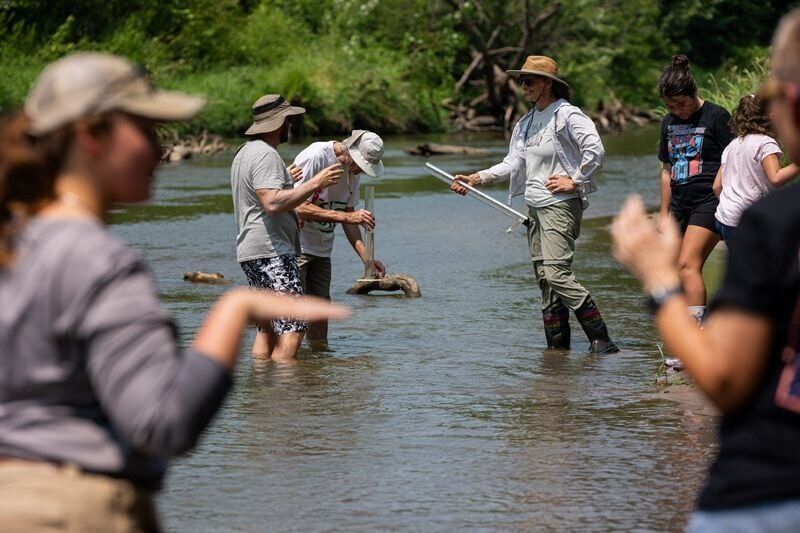
Members of the Nishnabotna Water Defenders, an environmental advocacy group based in southwest Iowa, participate in a water-surveying field day in collaboration with Montgomery County Conservation on Aug. 3, 2026, in Red Oak.
In Des Moines, Mattison, a member of Iowa Citizens for Community Improvement, receives nitrate testing kits through the organization’s partnership with the Izaak Walton League of America’s Nitrate Watch program. The league publishes the mapped data on its website at iwla.org/nitrate-watch and the Clean Water Hub at cleanwaterhub.org, where it adds in additional readings of contaminants such as E. coli.
As is clear from the online maps, Iowa has been the most active state for the programs, with the highest concentration of data reporting and requests for test kits, league officials said.
“The program’s proliferation in the past few years in Iowa ... has led to greater awareness of the issue,” said Heather Wilson, the Midwest region coordinator for the league’s Save Our Streams program. “It’s kind of this loop that’s perpetuating greater awareness, greater involvement and greater concern for nitrate pollution.”
Wilson said the league currently partners with nine organizations throughout the state.
The league’s conservation efforts, which include Nitrate Watch and Save Our Streams, were built on the foundation of IOWATER, a statewide volunteer program that ended in 2016 due to budget cuts and declining participation.
“It was never really part of our plan to do exactly what IOWATER did, but trying to keep the spirit of IOWATER alive in enabling citizen science and supporting volunteer water reporting," Wilson said.
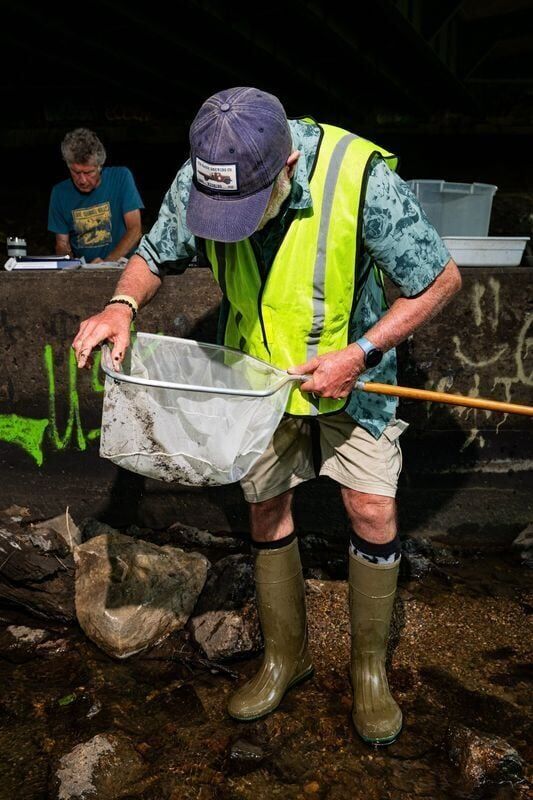
Steve Falk, a volunteer water tester with Polk County Conservation, inspects a D-net for aquatic organisms during a macroinvertebrate survey of Walnut Creek near Colby Park in Windsor Heights on Aug. 8, 2026
The volunteer data reporting continues year-round, tracking the surge in nitrates in the Raccoon and Des Moines rivers, the Des Moines metro's primary sources of drinking water, that occurred from December to July. Central Iowa Water Works issued temporary bans on lawn watering in summer 2025 and 2026 to preserve nitrate treatment capacity.
Mattison said he regularly tests two locations: “One on the Des Moines River just under the Women of Achievement Bridge… and then I also test on the Raccoon River south of Principal Park.”
Also with the Izaak Walton League, the environmental advocacy group Nishnabotna Water Defenders sponsors a volunteer water monitoring program in Atlantic in southwest Iowa.
“What we are trying to do with Nitrate Watch [is] to essentially continue to add to the data set of what the nitrate levels might be since we were possibly losing some of that data through the loss of the sensor network,” said co-founder and secretary Jodi Reese.
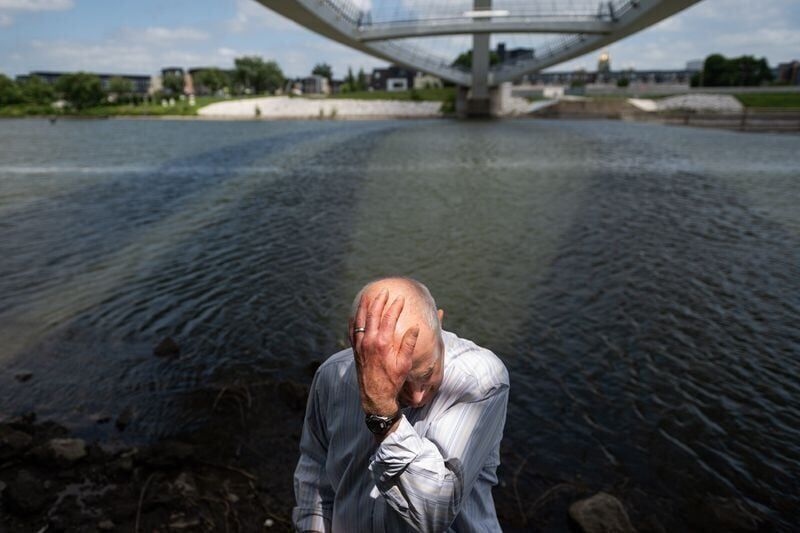
Todd Mattison wipes sweat from his forehead after conducting a nitrate reading of the Des Moines River on June 29, 2026, in Des Moines. Mattison is a volunteer water tester for several nonprofit organizations and regularly tests two locations along the river in the city, including one just south of Principal Park.
“But the second part of that was to get people recognizing that they are part of the water… to give them an action,” Reese said. “It is not a partisan issue — it is a health issue. It’s a livelihood issue for all of us.”
“We’re all joined by the same goal, which is just bettering the land that we live on," said Cassandra Barbosa, a naturalist at Montgomery County Conservation in Red Oak. Barbosa facilitated a field day in August in partnership with the group.
"I feel very validated when I do get to work with volunteer groups because those people are not paid for this," she said. "They just genuinely care about the environment."
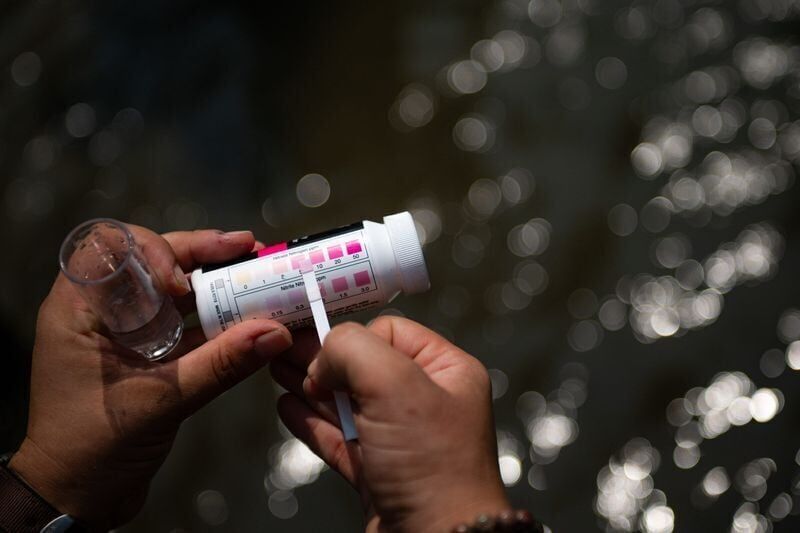
Montgomery County Conservation naturalist Cassandra Barbosa conducts a nitrate level reading of the Nishnabotna River during a water-surveying field day in collaboration with the Nishnabotna Water Defenders, an environmental advocacy nonprofit on Aug. 3, 2026, in Red Oak.
Volunteer water quality monitor Steve Falck facilitated his own field day with a group of volunteers in Windsor Heights in August. The group conducted a survey for Polk County Conservation in Walnut Creek of macroinvertebrates â small creatures like worms, larvae, snails and crayfish whose numbers are a marker of a watershed's health.
Falck, a retired environmental lobbyist and former Iowa state representative, drew comparisons between the renewed interest in volunteer water monitoring and the defunct IOWATER program.
“There are volunteers willing to do this. It is not rocket science," he said. "What we need to do is just start the ball rolling on this and expand and rebuild what we used to have.”
But water watchers across the state shared similar concerns about the limitations and potential drawbacks of relying on a decentralized volunteer network in the absence of a state-sponsored monitoring system. Renewed interest in water monitoring alone is not enough to overcome the lost funding, they said.
“When you’re dealing with volunteers, they’re going to test where they can," said Grieshop, the volunteer. "You don’t get as much testing of the field tiles and small creeks because it’s more difficult and there aren’t as many people (out) in the country to do that.
“I am overjoyed to see how many people are testing; it’s amazing. You go to Clean Water Hub and look at all the data points on that map, and it’s just phenomenal," she added. "But it’s still not enough data, because what the University of Iowa was doing was .. monitoring constantly, and we don’t have anything like that now.”
Despite their geographic dispersal, these grassroots-oriented organizations and individuals are united in their visions for the future.
“We all want a livable world. Specifically, a world where you can turn on the faucet, and you’re not fearful of the invisible pollutants causing short- and long-term health consequences to you or your family,” said Reese of the Nishnabotna Water Defenders.
“I really fear that the action of crowdsourcing and community governments paying for the sensors will set a precedent that the Legislature does not have to take bold action to put that money back in and keep the sensor network going,” Reese added.
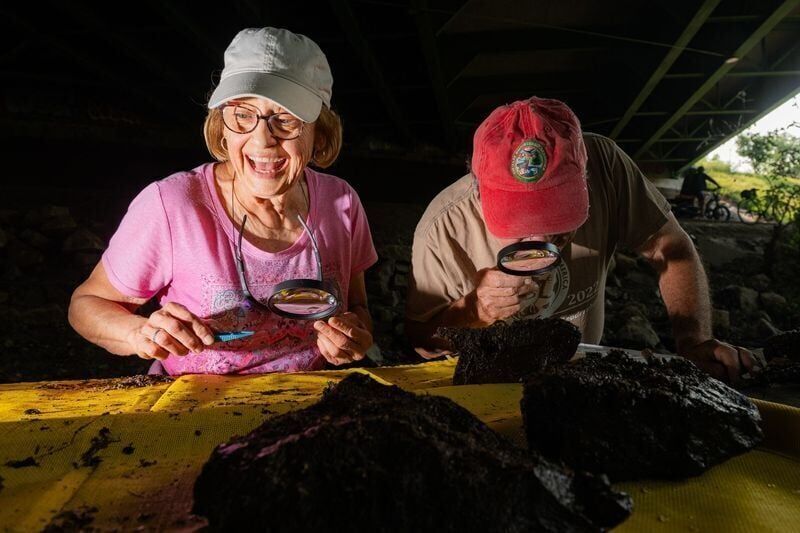
Julie Leniton, left, and Mike Delaney conduct a macroinvertebrate survey facilitated by Polk County Conservation at Walnut Creek on Aug. 8, 2026, in Windsor Heights.
But Mattison said he believes the rising concern about water quality will eventually force the state to renew its commitment.
“The awareness of the water quality problems… has increased, and I think that’s going to compel the state government to respond and to do something about it," he said. "It won’t change overnight. It won’t change immediately, but I think there is a lot more will and attention from the public."
Wilson oversees a lot of the partnerships between the Izaak Walton League and local advocacy groups as the Save Our Streams coordinator. She said what volunteers can offer through their individual data submissions is just as vital as a state-sponsored monitoring system.
“We would love to see policies that embrace water quality and human health at all levels, but the way that that happens using our data is going to have to have that grassroots element," she said. "It’s much more meaningful if we zoom in close, if we amplify individual efforts and tell individual stories. Yes, the goal would be change at a large scale, but I think it begins with small local action."
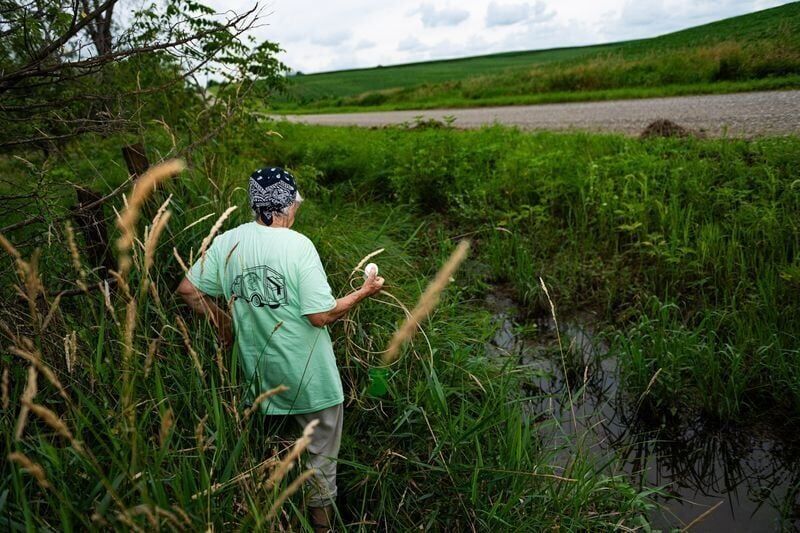
Volunteer water tester Annie Grieshop walks through tall grass after collecting a water sample from a creek for nitrate testing on July 10, 2026, just outside of Melbourne.