
June primary voting data shows Iowa men veering right
The Iowa Secretary of State's office posted the statewide statistical report for June's primary election at the end of July, to little fanfare. It's a breakdown of who voted in the election by party, age and gender.
There are a lot of numbers in a lot of tables.
But the data holds some insights into Iowa's political landscape that help explain how Republicans have opened up such a big lead in voter registrations and what sorts of people are among the 200,000 Democrats who have left the active voter rolls.
With June's primary producing increased turnout on both sides of the aisle — thanks to multiple contested races without incumbents — the new report offers an opportunity to dig into the shifting demographics of Iowa's politics.
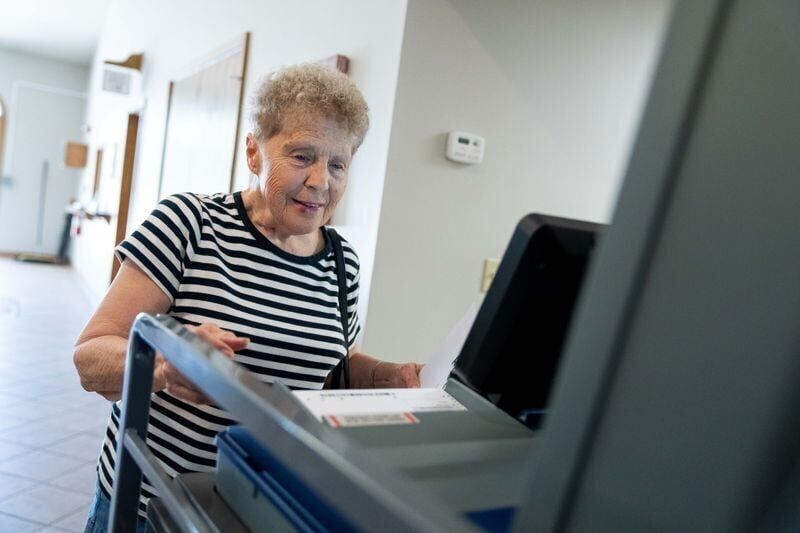
Thalia Thomas votes in Iowa’s 2026 primary election on June 2, 2026, at Oakwood United Methodist Church in Pleasant Hill.
Here are notable takeaways:
Men drove Iowa's big shift right
There has long been a gender split between the two major political parties in Iowa, like the rest of the nation. Iowa women have been more likely to be registered as Democrats, while men have been more likely to be registered as Republicans, both by varying margins.
Over the past 20 years, and particularly the past six, Republicans overcame a Democratic lead in voter registrations and then opened up a massive lead. To do that, they made strong gains among both men and women. But their surge was considerably stronger among men.
By the June 2020 primary election in Iowa, the gender gap was about even between both party and gender. Democrats had a roughly 84,000-voter advantage among women, while Republicans had a roughly 72,000-voter advantage among men.
Since then, Republicans have almost entirely erased the Democrats' advantage among women and more than doubled their advantage among men.
In the June 2026 primary election, 3,883 more women were registered as Democrats than Republicans, while 176,955 more men were registered as Republicans than Democrats.
The new data shows Democrats were able to recoup some gains among women — Republicans actually held a slight advantage in voter registrations among women as of the 2024 general election — but men continue to shift right, to the extent that Republicans are approaching double the amount of men registered as Democratic men.
In addition to these totals, about one-third of the men registered to vote in Iowa are registered with neither party.
Republicans have advantages across generations, especially Gen X
The Iowa Secretary of State's office generally splits voter statistics into five age groups, comprising voters who are under 25, 25-34, 35-49, 50-64 and 65 or older.
Republicans have made gains across all five age ranges over the past 12 years and now have more registered voters in each group than Democrats. (In 2014, Democrats held slight advantages among voters younger than 25 and voters between the ages of 25 and 34.)
But the most interesting age range may be voters ages 50-64. The group can be considered a rough proxy for Gen X, although it does also capture the youngest Baby Boomers.
Iowa's population has been gradually getting older as its overall median age increases. You can see this in the increasing number of voters ages 65 or above.
But, while the other age ranges — those younger than 50 — have remained relatively stable, the number of voters ages of 50 to 64 has been shrinking. That decrease has hit the Democratic side of the voter rolls much harder.
Since 2014, the number of voters between the ages of 50 and 64 registered as Democrats has dropped by one-third, while the number of voters in the same age range registered as Republicans has remained stable. (No-party voters in the age range have also dropped, but not by as much.)
The result is an age cohort in which Republicans have about 67,000 more registered voters than Democrats, the largest disparity of any age group.
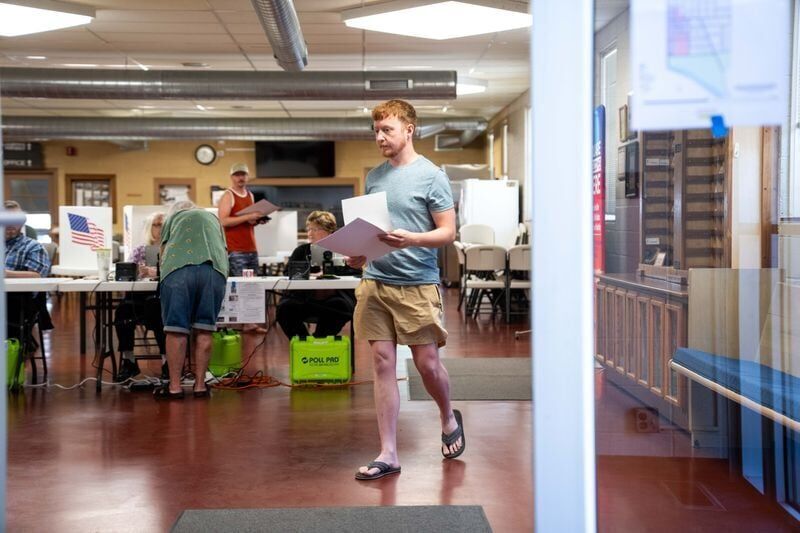
Ryan Jamieson casts his ballot in Iowa’s primary election on June 2, 2026, at Union Park United Methodist Church in Des Moines.
Increased primary turnout among younger Democrats
Having more registered voters is one thing, but getting those voters to show up on Election Day is a different matter.
Democrats were slightly more successful in that endeavor in June's primaries, in terms of percentages. While 44% of voters registered to one of the two major political parties are Democrats, 47% of the ballots cast in the primaries were by Democratic voters.
The difference was most notable across the younger age groups. More Iowans under the age of 50 are registered Republicans than Democrats, but in June's primary election, Democrats had higher turnout than Republicans among voters younger than 50. Statewide, the primary featured high-profile contests among Republicans running for governor and Democrats running for U.S. Senate.
The Democratic turnout among voters younger than 25 stands out. Nearly half of all voters in that age group aren't registered to a major political party — party affiliation tends to increase along with age — but 60% of those who are registered to a major party are Republicans.
Despite that deficit, about 61% of ballots cast by voters younger than 25 in June's primaries were cast by Democrats.
That's a bright spot Democrats will look to build on ahead of November's general election, but primary election turnout doesn't always correlate to general election turnout — or general election results.
A sizable contingent of voters registered to other parties or no party will also participate in the general election, unlike in Iowa's closed primary system.
Older voters most likely to cast absentee ballots
The state statistical report for the June primary election also includes data on absentee ballots.
Fewer absentee ballots were cast in the primary than the 2024 general election, in which more than 40% of all votes were absentee. About 17% of votes in the 2026 primary were absentee.
The same demographics were likeliest to use absentee ballots: people ages 65 or older (23%) and Democrats (21%) were atop the list, as they were in 2024's general election.