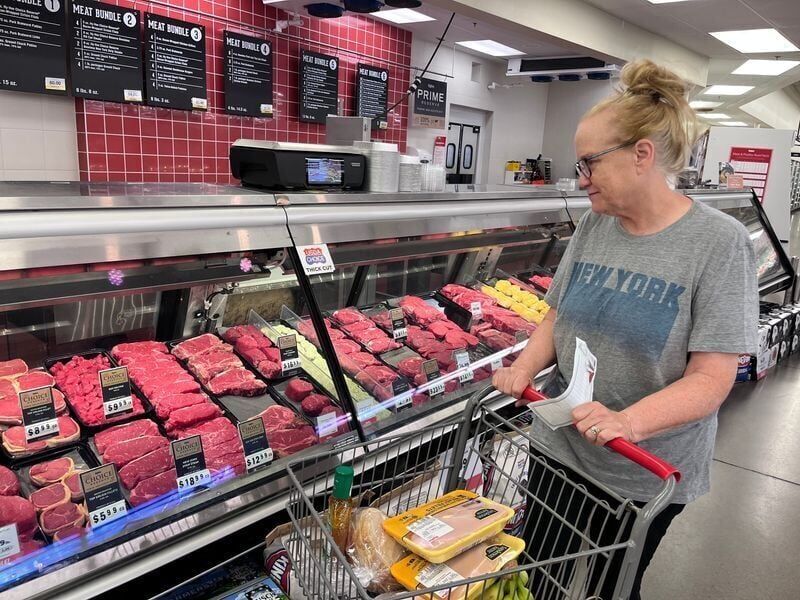
Mary Howe loves steak. But the retired mortician, who gets by on Social Security benefits with her husband, doesn't buy it anymore.
"I just really gotta watch it," the 67-year-old said at the Hy-Vee on Valley West Drive in West Des Moines. "Hamburger's got to be on sale. I don't even touch the steak."
"I'd love to buy a big roast, you know, a Sunday roast," Howe added. "I don't do that."
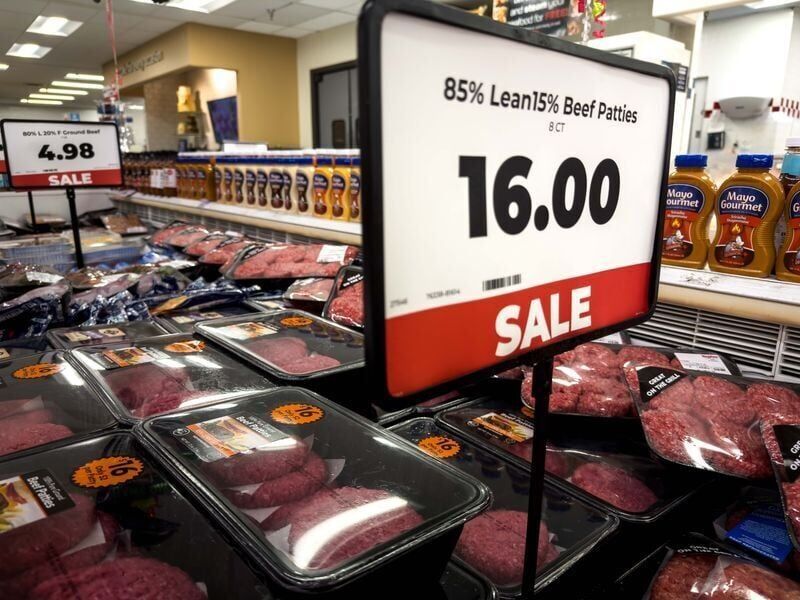
The 80% lean ground beef commonly used in hamburgers cost $6.83 per 1-pound tube at the store that day. The per-pound price reached an all-time U.S. record average of $6.89 in July, according to St. Louis Federal Reserve data, up 77% since 2020.
The price of all beef has soared as the U.S. cattle herd has dwindled to its lowest headcount in 75 years, amid pastures devistated by drought.
In the last few months, the Howes have taken to eating more chicken and pork.
"Right now, I can get this," Mary Howe said, pointing to the packs of chicken breasts in her cart, "for $3.84."
![]()
Mary Howe, 67, shops for beef at the Valley West Hy-Vee in West
Des Moines. She says beef has become too expensive for her and her
husband to keep eating regularly.
Israel Schuman, Des Moines Register
Iowans still buying beef, despite the prices
Dramatic beef price increases stem from more than low supply. As prices have soared, Americans' appetites for beef has increased along with trends like carnivore diets and protein-maxxing. Year-over-year fresh beef retail sales increased for 23 consecutive months until May, according to data provided by the agricultural technology firm Ever.Ag.
“Demand has been so good that prices can continue going up," said Abby Greiman of Ankeny, a beef market analyst for the Texas company, which has offices in Ames. "Retailers can continue charging more for beef because consumers are going to keep buying it."
At Price Chopper on Ingersoll Avenue, Janice Kranovich eyed the rows of steaks before putting one in her cart. The 63-year-old said she'll buy beef at almost any price.
"I live on hamburger," said Kranovich. "Burgers, everything you can make with ground beef."
She's not the only one still buying beef without much hesitation.
At the Jordan Creek Costco in West Des Moines, Andrew Carey, 40, said he buys in bulk and freezes what he can. Prices haven't touched how much beef makes it into his cart.
When told prices are up 77% since the COVID-19 pandemic, Carey said the figure "felt about right" to him. He said he and his girlfriend are very frugal, eating almost exclusively at home.
"I'm not really doing anything to get around the prices other than just buying bulk," he said.
Instead, his household has made cuts elsewhere.
"We've done that with any of the superfluous stuff, like junk food and snacks," he said. "We are making those choices."
![]()
Ground beef sits in a cooler at Hy-Vee on Sept. 4, 2026, in West
Des Moines.
Cody Scanlan, Des Moines Register
Where are shoppers buying their beef?
Kranovich and Howe both said they shop multiple grocers, looking for discounts or lower everyday prices for necessities.
Kranovich said she buys most of her groceries at Walmart but gets her meat elsewhere. She tries to avoid Hy-Vee, which she believes typically has higher-priced meat, though it's more convenient for her than the Price Chopper location where she was shopping. On the day she was there, it had ground beef marked down to $4.99 per pound.
Howe shops at Aldi most often, but, as a longtime couponer, finds specific items or deals elsewhere.
Meanwhile, with beef prices making headlines, retail sales in recent months have edged off of the record volume of 2024 and 2025, and grocers are taking measures to bolster the market.
The Fresh Thyme store near Valley West Mall in West Des Moines regularly runs $3.99-a-pound beef specials to bring customers in, store meat manager Anthony Koester said.
"We sell a lot of beef at that price," Koester said.
Johnston-based Fareway, which includes "Meat and Grocery" on its signs at every store, emphasizes quality. It markets its Our Own hamburger brand at its signature meat counters as being ground in-store daily from excess steak and roast cuts. Jeff Dooley, working behind the meat counter at Fareway's University Avenue store near Valley Junction, said the store-brand beef comes from Midwestern farms.
Hy-Vee promotes both quality and price. It devotes a page of its website to its "superior-sourced" Midwest beef, emphasizing that "our beef comes from Midwest family farms that raise corn-fed cattle for better quality, marbling, and flavor."
It also seeks to match or undercut competitors' beef prices. For example, a sign in the Hy-Vee where Howe was shopping showed its price on 1-pound ground beef rolls was the same as that of the nearest Walmart.
Hy-Vee spokesperson Tina Potthoff said the chain has kept prices steady on some beef items over the past year. Those include: the 5-ounce bacon-wrapped fillets still sell for $3.99, the same prices as in 2025; New York Strip steaks are $1 cheaper; and sirloin steaks are the same price.
![]()
Johnston-based Fareway includes "Meat and Grocery" on
its signs at every store, emphasizing its signature meat
counters.
Philip Joens, Des Moines Register
When will beef prices drop?
President Donald Trump said on Aug. 21 that he would allow 300,000 metric tons of ground beef to be imported to the U.S. tariff-free from Brazil and Argentina to “substantially lower the price of ground beef for working families."
It's attracted attention from consumers hoping for lower prices, but also those wanting to know where their beef comes from. Potthoff said the company has fielded multiple questions about the policy from customers through its online portal.
Greiman, like other market experts, said the change is unlikely to lead to a quick reduction in consumer beef prices — if prices drop at all.
To meet high demand and make up for a downsized cattle herd, the U.S. already has been importing beef at record levels, totaling 1.1 million metric tons through June, according to the American Farm Bureau Federation. That was up 12% from the same period in 2025, with most of the product coming from Australia, New Zealand and Brazil, the world's top beef producer.
"Brazil is the player (the Trump import policy) really affects," Greiman said. "But there was already going to be quite a bit of beef coming into the U.S. from Brazil."
Owing to the record imports, the U.S. has limited capacity to store substantially more beef, she said.
"What will probably happen is that, since Brazil is not dealing with the tariff, the beef that's flowing in from Brazil will displace beef flowing in from other areas," she said. "And we end up with a very similar amount of beef flowing into the U.S. that we would have been expecting. Because of that, I don't think that it's actually going to impact the price of ground beef at the store."
For prices to finally slow their momentum, Greiman said, the cattle herd must be rebuilt. That could take years, and is a risky undertaking for ranchers. They may not be able to recover the cost of breeding and feeding more animals if increased supply results in falling prices.
Greiman grew up around her grandfather's Wisconsin cattle farm. She knows it takes more than three years for a female calf to begin producing offspring that reach the food supply. The same process for, say, chickens, takes only eight or nine months.
"It's like steering a little jet ski versus steering a massive yacht," she said of the difference between poultry and beef supply levels. "There is no quick fix, even if consumers and this administration would like to find one."