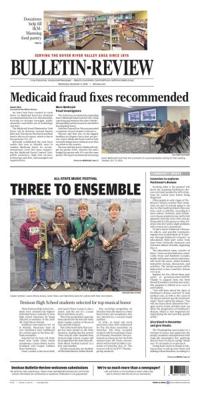

Iowa task force finalizes recommendations to crack down on Medicaid fraud
An Iowa task force created to crack down on Medicaid fraud has finalized recommendations for Gov. Kim Reynolds, focusing on stronger oversight, public awareness and better use of technology and data.
The Medicaid Fraud Elimination Task Force, led by Attorney General Brenna Bird, met Tuesday for the fourth and final time to discuss its report, which is due to the governor Oct. 29.
Reynolds established the task force earlier this year to identify ways to combat Medicaid fraud. Its recommendations cover five areas: improving the Medicaid Fraud Control Unit, public awareness, high-risk services, technology and data, and managed care organizations.

Iowa's Medicaid Fraud Task Force presents its recommendations during its final meeting Tuesday, Oct. 27, 2026.
More Medicaid fraud investigators
The task force recommends expanding Iowa's Medicaid Fraud Control Unit, citing a growing gap between the state's Medicaid spending and the resources devoted to investigating fraud.
Solicitor General Eric Wessan presented a summary of each chapter to the force.
Wessan said that one of the biggest headlines in Chapter One is that, per person, Iowa’s Medicaid Fraud Control Unit currently brings more criminal cases than any other in the country.
Wessan said that Iowa’s Medicaid budget has grown 129%, whereas the unit’s budget has grown only 31% over the same period. The report recommends increasing staffing to optimize the unit's efficiency.
“Iowa has a strong False Claims Act, and no civil fraud attorneys can use it. So, the committee recommends a civil fraud component in the attorney general's office, and growing the Medicaid fraud control unit to 24 positions with civil and criminal prosecutors, investigators, auditors and analysts,” Wessan said.
The chapter also touches on full law-enforcement authority for investigators and on new anti-kickback and civil-penalty laws.
Public awareness
The task force recommends making it easier for Iowans to recognize and report Medicaid fraud.
“Iowans cannot report fraud they do not recognize through channels that they cannot find,” Wessan said. “So the chapter recommends a clear definition of fraud and clear reporting steps on the HHS website.”
The report also calls for consistent messaging among agencies and a plain-language video explaining what constitutes Medicaid fraud and how Iowans can report it.
High risk services
The report identifies Medicaid services at higher risk for fraud and calls for using data to strengthen oversight.
It also calls for improved electronic visit verification to help confirm that services billed to Medicaid were actually provided.
Technology and data
Meanwhile, Chapter Four aims to utilize technology and data, recommending a program integrity technology unit. The unit would help monitor spending on fraud-fighting technology vs. what it finds.
Wessan noted that fraud often hides in data.
Managed care organizations
The report calls for stronger oversight of managed care organizations, including steps to verify that Medicaid providers are serving Iowans.
Managed care organizations are health plans that coordinate medical services for Medicaid recipients. The task force identified several ways to strengthen provider verification.
“The chapter recommends using counter data, provider revalidation, secret shopper surveys and directory audits,” Wessan said.
Wessan closed his presentation by noting that some recommendations could be implemented immediately, while others would require additional funding or legislative action.
“But the bottom line is simple. Iowa already does more with less than almost anyone. With the right tools, the right people and the right structure, we can do a great deal more yet,” Wessan said.