

Abortion pill access emerges as next battleground in Iowa and beyond (copy)
National anti-abortion leaders said Tuesday that the movement had fallen short four years after the U.S. Supreme Court overturned Roe v. Wade, arguing that abortion pills mailed across state lines had undercut state restrictions such as Iowa’s near-total abortion ban.
Susan B. Anthony Pro-Life America President Marjorie Dannenfelser and Bob Vander Plaats, president and CEO of the Iowa-based Christian conservative group The Family Leader, called for federal action to restore in-person dispensing requirements for abortion medication and urged enforcement of Iowa’s new law taking effect July 1.
“The whole states-only experiment is a failure. It has been tried and failed,” Dannenfelser said during a Tuesday call with reporters.
The call came one day before the fourth anniversary of Dobbs v. Jackson Women’s Health Organization, the June 2022 U.S. Supreme Court ruling that overturned the constitutional right to abortion and returned abortion regulation to states.
The number of abortions in the U.S. has increased since then, nearly doubling by 2025 compared with 2021. According to reports from NPR and the Guttmacher Institute, the rise is primarily driven by the expansion of telehealth and the widespread mailing of abortion pills, despite state-level bans.
Federal intervention
Dannenfelser said states with abortion restrictions had seen those laws undermined by abortion medication mailed from other states, and she called on the U.S. Department of Justice to settle Louisiana’s lawsuit against the Food and Drug Administration challenging mail-order access to mifepristone.
She argued the Biden administration acted too quickly when it loosened federal restrictions on dispensing abortion medication and said the Trump administration should immediately settle the case rather than wait for years of litigation.
“If the federal government, through the DOJ, settles with … the state of … Louisiana over this, it would immediately restore the in-person dispensing in a medical climate,” Dannenfelser said. “And women would have informed consent.”
Dannenfelser said the Alliance Defending Freedom had petitioned for expedited review of the case but argued that even an accelerated appeal likely would reach the U.S. Supreme Court, delaying action. “If we don’t settle … then we have a very long runway. And that is unacceptable,” she said.
Iowa’s restrictions
The comments come as Iowa prepares to implement another abortion restriction. A law banning most abortions once cardiac activity can be detected — generally around six weeks of pregnancy and often before many people know they are pregnant — took effect in July 2024. Beginning July 1, Iowa will require abortion-inducing medication to be dispensed in person by a healthcare provider.
Supporters say the law is needed to protect women and prevent out-of-state providers from circumventing Iowa’s restrictions. Abortion-rights advocates and legal experts say the law may not stop providers in states with shield laws from mailing pills into Iowa.
Vander Plaats said Iowa should pursue legal action against providers who violated the state law.
“We passed a law in the state of Iowa; we believe in state sovereignty. If you’re gonna violate our law, there’s gonna be a lawsuit, and we’re gonna make you pay,” Vander Plaats said.
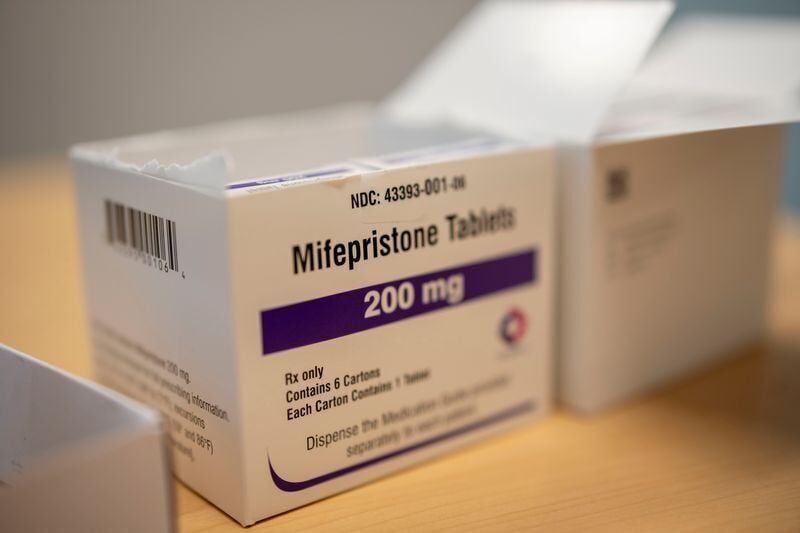
Mifepristone tablets sit on Dr. Sarah Traxler's desk in her office at the Planned Parenthood clinic in Ames, Thursday, July 18, 2024.
Planned Parenthood
Medication abortion has become increasingly central to abortion access nationally and in Iowa. Guttmacher Institute data show medication abortions accounted for 63% of all abortions nationally in 2023, up from 53% in 2020.
Planned Parenthood North Central States said this week its patient navigator program had helped more than 10,000 patients access abortion care since Roe was overturned, with most patients using the program coming from Iowa and Nebraska. The organization said it provided 80% fewer abortions in Iowa in 2025 than in 2023, a decline it attributed largely to Iowa’s six-week abortion ban, while travel by Iowa patients to Nebraska rose 220% and travel to Minnesota rose 46%.
Ruth Richardson, president and CEO of Planned Parenthood North Central States, said in a statement that the Dobbs decision created “profound disruption and chaos” but also “inspired resilience and care for community.”
“As rights and access are constantly under attack, the need for abortion care continues,” Richardson said. “We provided more abortions last year than we have since 2022, even with harsh and restrictive abortion bans in many of our states. Every patient who is empowered to control their body, life and future is clear evidence that no one can erase our demand for reproductive freedom. The work continues so everyone can access safe and legal abortion no matter what.”
The organization said Iowa’s abortion restrictions had forced patients to travel farther, take more time off work and incur greater costs to obtain care while increasing confusion about what services remained legally available. Planned Parenthood said Iowans accounted for one-third of the patients assisted by its patient navigator program last year and noted that medication abortions accounted for 87% of abortions provided in Iowa in 2025, up from 71% in 2023.
Planned Parenthood has said it will continue providing abortions in Iowa in compliance with state law when no cardiac activity is detected or under the law’s limited exceptions. Richardson has said the organization will continue dispensing abortion medication in Iowa where permitted under state law while helping Iowans obtain care from providers in other states.
The organization said patient care at its Iowa health centers would remain largely unchanged after the July 1 law took effect because it offered only in-person abortion care since Iowa’s six-week abortion ban took effect in 2024. It said the new law was more likely to create confusion among patients than alter how Planned Parenthood provided care.
Planned Parenthood said it did not provide medication abortion by mail in Iowa and did not anticipate legal challenges stemming from the new law. It added that if access to mifepristone changed because of ongoing federal litigation, it was prepared to continue providing medication abortion in Iowa under updated protocols and within applicable legal requirements.
The organization disputed claims that requiring patients to receive abortion medication in person improves safety, saying the safety of mifepristone and telehealth abortion care is supported by extensive medical research. It cited studies showing medication abortion has a serious complication rate of less than 1% and argued that additional restrictions make care harder to access rather than safer.
Planned Parenthood’s Des Moines and Iowa City health centers, along with the Emma Goldman Clinic in Iowa City, are among the only facilities in Iowa still dispensing abortion medication. Planned Parenthood closed its Cedar Rapids, Ames, Sioux City and Urbandale clinics in 2025.
National restrictions
Dannenfelser said Susan B. Anthony Pro-Life America planned to spend $160 million across the 2026 midterm and 2028 presidential cycles, including in Iowa’s governor’s race, U.S. Senate race and congressional contests.
Vander Plaats said Iowa’s 2026 elections would test whether Republican candidates continued to emphasize abortion restrictions. He pointed to the governor’s race, the U.S. Senate race and three congressional races as key contests.
“Iowa’s shown that you can win by being bold and courageous when it comes to the life issue,” Vander Plaats said.
Beyond restoring in-person dispensing requirements, Dannenfelser called for Congress to pursue what she described as “the strongest pro-life national protection that can be passed” and argued the movement should advance the broadest abortion restrictions capable of winning sufficient political support.
She said the movement should not abandon federal legislation after Dobbs, arguing that “the states-only strategy really was an experiment that failed very quickly” and that elected officials should move quickly to enact additional national abortion restrictions.
“Immediately to stop the flow of drugs through the mail … that will immediately save thousands of lives in states where pro-life protections have been passed,” she said. “And then the strongest pro-life national protection that can be passed, that can win.”
Asked whether the anti-abortion movement is better off than it was four years ago, both speakers said no.
“Are we better off today? No, we’re killing more babies today. We’re being more creative in how we kill more babies today. We’re endangering more women today,” Vander Plaats said.
Practical impact
Sally Frank, a Drake University law professor whose expertise includes women’s rights, said Iowa’s July 1 law was unlikely to substantially alter how most Iowans obtained medication abortions because the state’s six-week abortion ban already had pushed many patients to seek care elsewhere.
“By the time they learn they’re pregnant … they’re going to out-of-state providers, and luckily they are still going to be able to do that. This doesn’t do anything to close that off,” Frank said.
Frank said patients were likely to continue relying on telemedicine providers in states with shield laws that protected physicians prescribing abortion medication across state lines.
She questioned whether the Justice Department could simply settle Louisiana v. FDA in the manner advocated by Susan B. Anthony Pro-Life America. Frank said manufacturers of the abortion drugs had intervened in the litigation and likely would have to agree to any settlement.
“I believe they’ve already intervened because their rights would be clearly affected,” Frank said. “They would be a party to the case and the case could not settle without their agreement.”
Frank said the anti-abortion movement’s renewed emphasis on federal legislation faced steep political hurdles.
”I don’t see either the abortion rights people succeeding, or the anti-abortion people succeeding in getting legislation passed, because I don’t think either side is going to get 60 votes in the Senate,” she said, pointing to the filibuster as a major obstacle.
Instead, Frank said she expects abortion policy to continue evolving state by state, with differing states' legal regimes shaping where patients seek care.