This content is unavailable. Please contact customer service for more information.
Already a subscriber? Login or Activate your account.
You've reached the end of the standard E-Edition.
This content is unavailable. Please contact customer service for more information.
Iowa Gov. Kim Reynolds declares disasters in Harrison and Crawford counties
scott.stewart
Iowa Gov. Kim Reynolds issued a disaster proclamation on Monday for Carroll, Crawford, Grundy, Harrison, and Washington Counties in response to severe weather on April 13.
Reynolds' proclamation allows state resources to go to response and recovery efforts, according to a news release, as well as activating the Iowa Individual Assistance Grant Program and the Disaster Case Advocacy Program. It remains in effect for at least 30 days.
Individual grants up to to $7,000 for households based on income level are available for home or car repairs, replacing personal property or food, and temporary housing expenses. Original receipts are required. Case advocates help create disaster recovery plan while providing guidance, advice and referrals to obtain servicse or resources
Iowa delegation pushes bill to cut fertilizer tariffs
Legislation would remove phosphate fertilizer tariffs and issue refunds as Iowa farmers face rising costs
Tom Barton
Lee-Gazette Des Moines Bureau
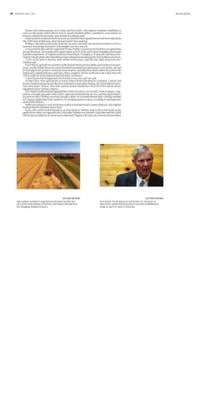
Farmer Lance Lillibridge and his daughter, Tess, stand in a
field on their farm in rural Vinton in June 2020. He said rising
fertilizer and fuel costs have put farmers in a “bad spot” this
planting season.
The Gazette
Iowa U.S. Rep. Mariannette Miller-Meeks introduced legislation Wednesday aimed at lowering fertilizer costs for farmers after House Republicans declined to allow a vote on her amendment to the farm bill that would have eliminated tariffs on phosphate fertilizer imports from Morocco.
Iowa Republican U.S. Sens. Chuck Grassley and Joni Ernst introduced a companion bill in the Senate alongside Sens. Roger Marshall and Cindy Hyde-Smith to eliminate trade duties on a key agricultural input.
The proposed “Lowering Input Costs for American Farmers Act” would remove trade-related duties on phosphate fertilizers imposed under Sections 122 and 301 of the Trade Act of 1974 and revoke countervailing duty orders placed on Moroccan phosphate fertilizer imports in 2021. The legislation would also require refunds of previously collected deposits, providing what Miller-Meeks calls immediate relief for farmers struggling with rising input costs.
“As a representative of one of the most productive agricultural states in the country, I hear directly from farmers about the challenges they are facing, and input costs are at the top of that list,” Miller-Meeks, a Republican from Ottumwa, told The Gazette in a statement. “This bill takes a commonsense approach to lowering fertilizer costs by improving access to a reliable global supply while maintaining a strong domestic industry.”
Fertilizer remains one of the largest expenses for producers, accounting for 36% of operating costs for corn farmers, 28% for soybeans and 38% for wheat, according to Miller-Meeks’ office. Analysis from Texas A&M’s Agricultural and Food Policy Center found that countervailing duties increased fertilizer costs for U.S. farmers by roughly $6.9 billion between 2021 and 2025.
Miller-Meeks Communications Director Anthony Fakhoury said the standalone bill was introduced after it became clear the House Agriculture Committee would not take up her original amendment for a vote, citing ongoing disagreement among House Republicans on the issue.
The bill is backed by the American Farm Bureau Federation, National Corn Growers Association, American Soybean Association and the Iowa Soybean Association.
“Iowa soybean farmers appreciate Congresswoman Miller-Meeks’ leadership in addressing the increased costs of phosphate fertilizer imports,” Tom Adam, president of the Iowa Soybean Association and a farmer from Keota, said in a statement. “ … At a time when farmers are dealing with elevated input expenses on all fronts, existing countervailing duties only add unnecessary financial strain. Soybean farmers need access to reliable, affordable fertilizer to remain competitive in the global marketplace.”
“There’s nothing I hear more about than input costs right now from our folks back home,” Hinson said. “It’s because decades of offshoring production and consolidation in the ag industry have left our farmers squeezed.”
Hinson said fertilizer prices have risen “exponentially” over the last several years, creating uncertainty and “razor-thin profit margins, if profit at all.”
U.S. Rep. Ashley Hinson, R-Iowa, speaks during a press event
April 24 at the QTS Data Center Campus in Cedar Rapids.
Savannah Blake/The Gazette
“We need to do more to bring our U.S. fertilizer production to capacity, build out that capacity for not only small but mid-sized fertilizer processors, and ensuring again that we are promoting competition and transparency,” she said.
Asked what makes the congresswoman confident that separate legislation has a viable path forward, given that House Republicans blocked her amendment, Fakhoury said the issue has gained broader national attention, noting Rollins’ press conference this week.
According to Fakhoury, Sen. Roger Marshall, R-Kansas, introduced the Senate companion bill Tuesday, and Hinson signed on as an original co-sponsor of Miller-Meeks’ House legislation. He said the Trump administration has made clear the issue is a priority and argued there is a path for Miller-Meeks to work with both the Senate and the White House to advance the proposal.
“By eliminating duties on Moroccan phosphate imports, this bill directly lowers fertilizer prices, easing financial pressure on farmers and helping stabilize production costs,” Fakhoury said.
But both Miller-Meeks and Hinson are facing criticism over their broader support for President Donald Trump’s tariffs and U.S. involvement in Iran, which has pushed gas and fertilizer prices even higher amid global supply disruptions. Critics argue those broader policies are worsening the same affordability challenges the fertilizer bill is intended to address, and created costly trade wars that have plunged crop commodity prices.
Tom Barton covers state government and politics. Comments: (319) 398-8499; tom.barton@thegazette.com
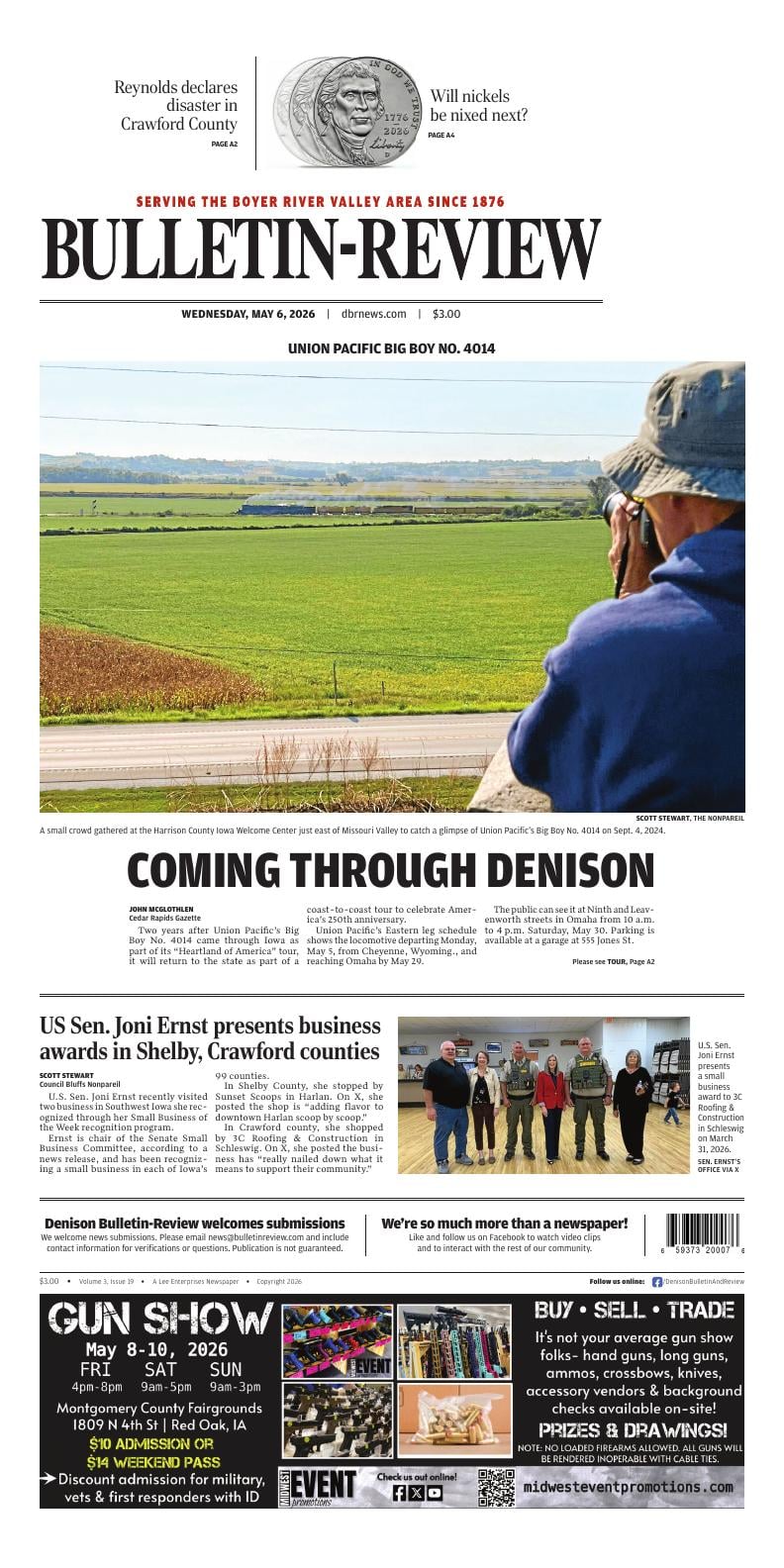
Nick Rohlman, Cedar Rapids Gazette
People look on as Union Pacific’s Big Boy 4014 steam engine
arrives in Belle Plaine on Sept. 5, 2024.
Page A2
Nick Rohlman, Cedar Rapids Gazette
People look on as Union Pacific’s Big Boy 4014 steam engine
arrives in Belle Plaine on Sept. 5, 2024.
US Sen. Chuck Grassley highlights grants President Donald Trump wants to eliminate
scott.stewart
U.S. Sen. Chuck Grassley recently called attention to the apportionment of federal Community Service Block Grant funding.
Grassley, in a post on X last week, said he raised the need to release funding with Russell Vought, director of the Office of Management and Budget, in a meeting earlier this month. Grassley posted that CSBG "supports programs that reduce poverty" and help people become self-sufficient.
Among the Iowa agencies receiving funding are West Central Community Action in Harlan, according to a news release. WCCA serves Southwest Iowa communities with outreach centers and Head Start centers across Cass, Crawford, Fremont, Harrison, Mills, Monona, Montgomery, Page, Pottawattamie and Shelby counties.
More than 270,000 Iowans are served by the agencies like WCCA supported by CSBG, Grassley said. In remarks at a hearing, Grassley called on the release of the appropriated money, telling Vought the executive agency lacks the authority to impound it.
"We are not getting any answers about why these quarterly allotments aren't given out," Grassley said in the remarks, which were flagged to the attention of The Nonpareil by a Grassley spokesperson. "... So, I want those quarterly allotments released.”
A fact sheet distributed by the White House lists the Community Service Block Grant among several "woke programs" it is seeking to eliminate as part of President Donald Trump deems the "radical gender and racial ideologies that poison the minds of Americans."
The White House asserts that CSBG funding "has been hijacked from true poverty reduction to things such as equity-building and green energy initiatives." It is recommending the elimination of the program from the federal budget.
Click and hold your mouse button on the page to select the area you wish to save or print.
You can click and drag the clipping box to move it or click and drag in the bottom right corner to resize it.
When you're happy with your selection, click the checkmark icon next to the clipping area to continue.