
Proposal to make raising Iowa income taxes harder moves closer to ballot
Iowans could get a vote this November on whether to make it harder for future lawmakers to raise state income taxes under a resolution advancing through the Legislature.
House Republicans on a three-member tax policy subcommittee Monday signed off on Senate Joint Resolution 11, a proposed constitutional amendment that would require a two-thirds majority vote in both the Iowa House and Senate to increase income taxes on individuals and corporations or create new income taxes.
The measure raises the threshold for passing individual or corporate income tax increases from a simple majority to a two-thirds supermajority.
Reps. John Wills, R-Spirit Lake, and Carter Nordman, R-Dallas Center, signed on to move the measure forward to the full House Ways and Means Committee. The panel’s lone Democrat, Rep. David Jacoby, D-Coralville, was unable to attend the subcommittee hearing.
If ultimately approved by the House this session, the measure would appear on the November general election ballot for voter approval.
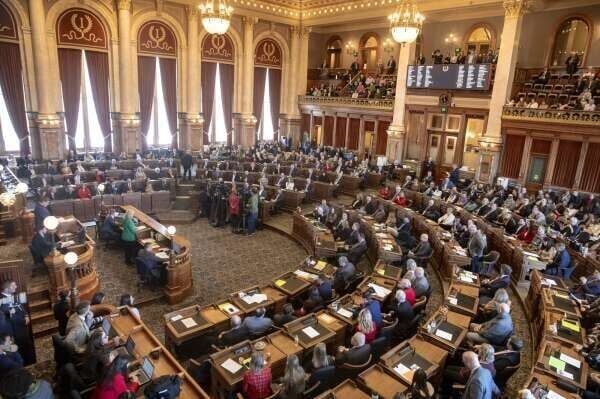
Representatives assemble in the Iowa House chamber during the first day of last year's legislative session at the Iowa State Capitol in Des Moines on Monday, Jan. 13, 2025.
Constitutional amendments must be passed in multiple years by two consecutive two-year general assemblies of the Iowa Legislature before being put to Iowa voters for approval on the next statewide general election ballot. If the amendment gains majority approval from voters, it is added to the state constitution.
Both the House and Senate passed the resolution in 2024, and the Senate passed it again in 2025. Another House passage this year would send it to the ballot.
Supporters argued the amendment would provide tax certainty and make it harder for future legislatures to raise income taxes without broad bipartisan agreement.
Andy Conlin, representing Iowans for Tax Relief, said the amendment “simply requires the Legislature to come to consensus” and would give businesses and individuals greater certainty about future tax rates. He said Iowa’s recent tax cuts “put more money in Iowans pockets.”
Tyler Raygor of Americans for Prosperity called the resolution “a prudent safeguard against reckless spending and overtaxation of Iowans,” arguing that requiring a supermajority would promote fiscal responsibility and protect families and businesses from sudden tax hikes.
“We think that this approach strikes a perfect balance between the needs of government and the budgets of Iowa families and businesses,” Raygor said. “ … And I think should a time come when we need to consider raising taxes, we can count on our legislators to come together and do the right thing, or maybe take a look at our budget and focus on cutting so that we can fund the needs and not the wants.”
Opponents, however, warned the amendment would limit lawmakers’ flexibility as Iowa faces significant budget pressures.
Iowa is projected to face a second consecutive budget shortfall exceeding $1 billion, driven largely by recent state and federal tax cuts. The state faces a nearly $1.4 billion budget deficit this fiscal year — the first full budget year with Iowa’s income tax cuts fully phased in at a single flat rate of 3.8 percent.
Next fiscal year, Iowa is expected to collect $1.2 billion less than Gov. Kim Reynolds has proposed spending, with lawmakers planning to use the state’s roughly $4 billion Taxpayer Relief Fund to cover the gap rather than cut services.
The state Revenue Estimating Conference lowered projections in March, creating a second straight year in which spending is expected to outpace revenue. Republicans say the reserve funds were intended for exactly this purpose and that revenues will eventually rebound and again exceed spending before reserves are exhausted.
Democrats, including State Auditor Rob Sand, who is running for governor, have argued the repeated use of reserves points to a structural imbalance caused by the tax cuts and reflects fiscal mismanagement.
Several groups opposing the amendment echoed those concerns during Monday’s hearing.
Margaret Buckton, representing the Urban Education Network of Iowa and Rural School Advocates of Iowa, said limiting income tax increases could push lawmakers toward raising sales or property taxes instead, both of which affect school funding.
Luke Elzinga, of the Des Moines Area Religious Council, pointed to added financial strain from H.R. 1, the federal budget reconciliation bill passed by Republicans in Congress and signed into law last year by President Donald Trump, arguing the state may need more flexibility — not less — as it responds to changes in SNAP food assistance and Medicaid funding.
“SNAP enrollment right now is at an 18-year low in the state, but we’re going to be spending more than ever to administer the program because of those changes,” Elzinga said.
He said Iowa was relying on temporary dollars this year to fill the funding gap and warned that demand for food assistance remained high, with food pantries “breaking records across the state.” He added that SNAP enrollment had fallen 9 percent since H.R. 1 was enacted and said lawmakers should preserve every available option to respond if more families needed support.
“If we see changes in our economy that leads more people to rely on public assistance programs from SNAP, it’s going to be really important that we have all tools available for the state to address those needs,” Elzinga said. “We really disagree with tying the hands of future state legislatures.”
Paige Chickering, of Save the Children Action Network, warned that requiring a supermajority for future income tax increases could limit lawmakers’ ability to fund programs serving children and families as budget pressures mount. Chickering said the organization was particularly concerned about how those constraints could affect early childhood education, child care and efforts to address food insecurity across the state.
Pam Mackey-Taylor, of the Iowa Chapter of the Sierra Club, warned the amendment could leave future lawmakers unable to respond if reserve funds ran dry.
“This constitutional amendment would tie the hands of future legislatures and how they are going to handle the state’s finances when the revenues are not meeting the expenses,” she said.
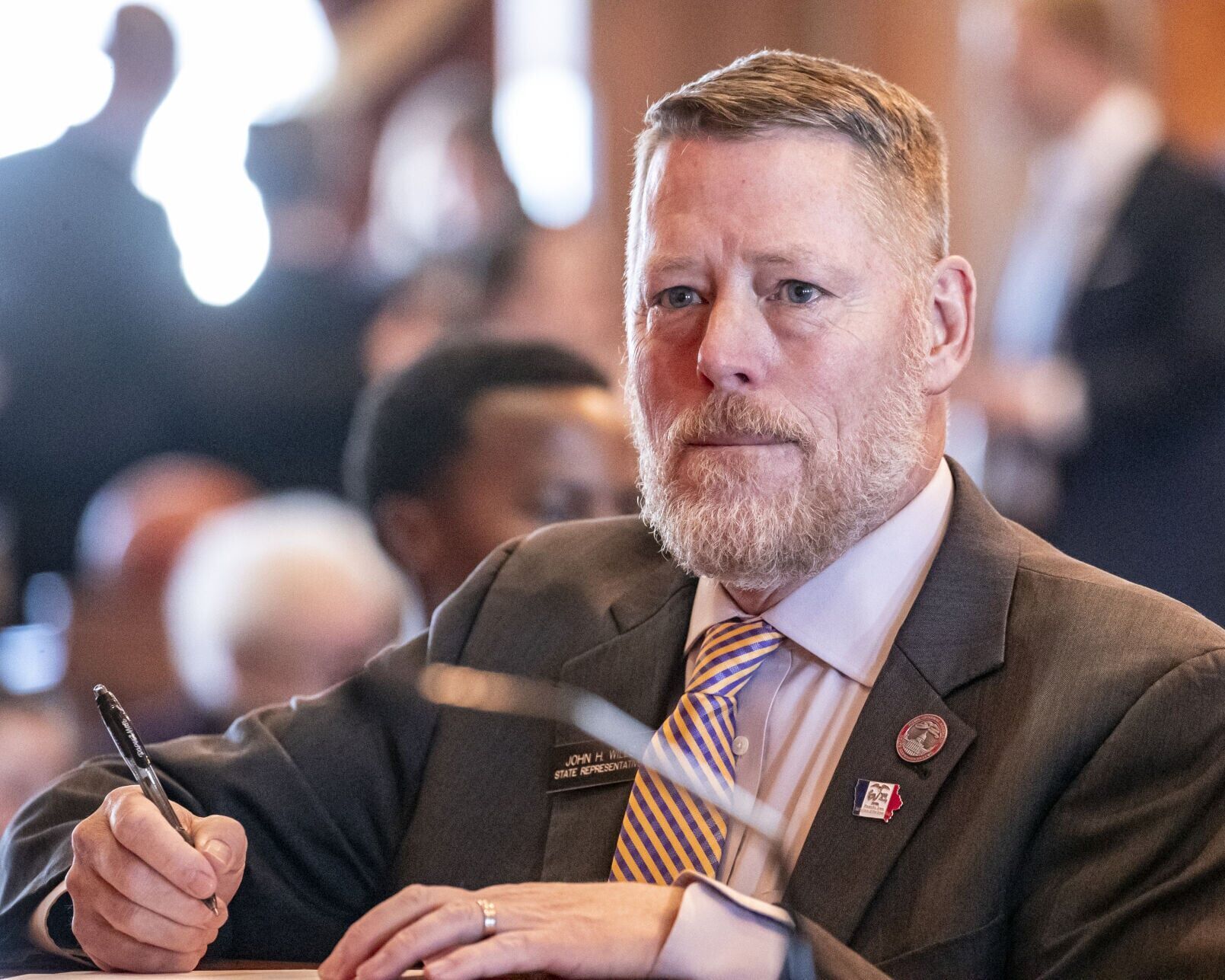
Rep. John Wills, a Republican from Spirit Lake, signs his oath of office during the first day Jan. 13 of last year’s legislative session at the Iowa Capitol in Des Moines.
Wills pushed back on criticism that the proposal came at the wrong time, saying the current shortfall was expected and planned for.
“I want to remind people that the budget shortfall that we have was planned,” Wills said. “We planned for deficit spending for a number of years, as our revenues catch up to the reduced income that we’re going to have because of a massive tax decrease.”
He emphasized that the Legislature would not be directly imposing the supermajority requirement itself.
“By affirming this resolution, what we are doing is saying that we’re going to allow Iowans to decide,” Wills said. “It simply puts it on the ballot so that Iowans can decide if they want this to become state law.”
With Wills and Nordman signing on, the resolution now advances to the full House Ways and Means Committee for further consideration.