

While sentiments over the value of a college education are fractured, 2020 provided evidence that earning a bachelor’s degree or higher provided significantly more stability during the recession than obtaining a high school diploma.
The Most Educated U.S. Cities

Photo Credit: fongbeerredhot / Shutterstock
Amid the intersection of mounting debt and rising college costs comes an honest question: Is college worth it?
The nation’s student loan debt levels were around $1.4 trillion in 2020, making it the second-biggest debt pool behind mortgages. That figure is ahead of auto loans, credit cards, and other personal loans. After adjusting for inflation, the average cost of a college education more than doubled between 1985 and 2019, while median household income only rose by28%.
The data points to a larger issue for high school graduates pondering their future. Even if college is worth it, do graduates want to carry tens of thousands of dollars in student debt for the next 10, 20, or 30 years?
Today’s high school seniors are wrestling with significant questions that have no easy answers, and this may explain why the gig economy has become popular. Freelancers often don’t have to prove their education to get hired. Rather, they can showcase their skill. Talent, in some cases, is taking workers further than a diploma could have.
But despite a seismic shift in the way college is viewed, nearly 70% of recent high school graduates enroll in college. While there are widespread doubts about the benefit of a college diploma, recent data from the Federal Reserve’s Report on the Economic Well-Being of U.S. Households indicates that the average college graduate believes that the benefits of a degree far exceed the costs.
Self-reported financial well being is correlated with educational attainment

At the national level, there’s a relatively decisive notion that a college degree’s benefits outweigh the costs. However, that decisiveness has not led to an even distribution of college, graduate, and doctoral degrees across states. Research indicates that states in the northern U.S. have significantly higher levels of education than states in the South.
Using a composite scoring system based on how many years of education a state’s over-25 population had, researchers at HireAHelper found that Massachusetts had the nation’s highest level of education, followed by Colorado, Vermont, and New Hampshire. Notably, not a single state south of Virginia ranked in the top 20.
The northern US has significantly higher levels of education

State-by-state comparisons don’t tell the whole story, as research indicates there are large variations not just in regional education levels but within states themselves. For example, California cities rank in the top five for small, medium and large cities. At the same time, the state has the three least-educated locations among small, medium and large cities. These disparities are common among several states.
To identify which cities have the highest levels of education, researchers at HireAHelper analyzed Census Bureau data and calculated a composite score (from 0 to 100) based on the average number of years of education residents completed. For example, someone who finished high school was considered to have completed 12 years of education; whereas someone who earned a bachelor’s degree was considered to have completed 16 years.
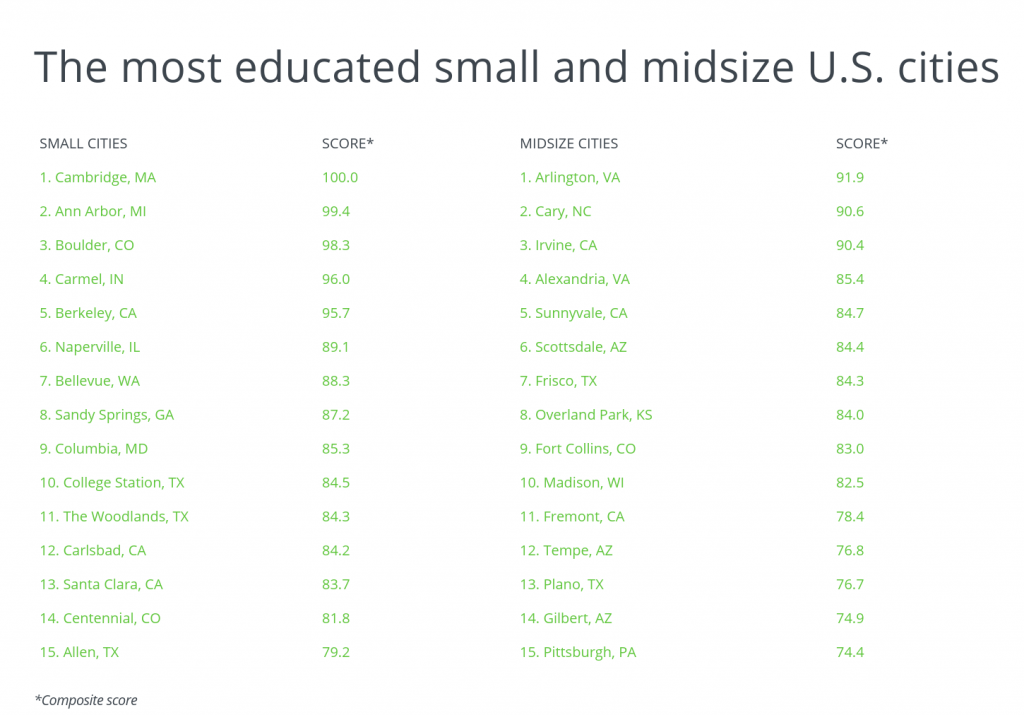
Only cities with 100,000 or more people were included in the analysis. Additionally, to improve relevance, cities were grouped into cohorts based on population size: small (100,000–149,999), midsize (150,000–349,999), and large (350,000 or more).
Here are the U.S. cities with the highest education rates.
The most educated small and midsize US citites
15. New Orleans, LA

Photo Credit: f11photo / Shutterstock
- Composite score: 65.4
- Average number of education years: 13.9
- Graduate or professional degree: 18.0%
- Bachelor’s degree only: 21.7%
- Associate degree only: 3.9%
- High school diploma only: 23.1%
- Less than a high school diploma: 12.3%
14. Nashville, TN

Photo Credit: Sean Pavone / Shutterstock
- Composite score: 67.0
- Average number of education years: 14.0
- Graduate or professional degree: 17.2%
- Bachelor’s degree only: 28.1%
- Associate degree only: 6.4%
- High school diploma only: 20.2%
- Less than a high school diploma: 10.5%
13. San Diego, CA

Photo Credit: Sean Pavone / Shutterstock
- Composite score: 67.1
- Average number of education years: 14.1
- Graduate or professional degree: 19.3%
- Bachelor’s degree only: 28.1%
- Associate degree only: 7.0%
- High school diploma only: 15.6%
- Less than a high school diploma: 10.5%
12. Boston, MA

Photo Credit: Travellaggio / Shutterstock
- Composite score: 68.5
- Average number of education years: 14.2
- Graduate or professional degree: 24.3%
- Bachelor’s degree only: 27.5%
- Associate degree only: 5.1%
- High school diploma only: 19.1%
- Less than a high school diploma: 11.4%
11. Virginia Beach, VA

Photo Credit: Jon Bilous / Shutterstock
- Composite score: 69.0
- Average number of education years: 14.2
- Graduate or professional degree: 15.3%
- Bachelor’s degree only: 22.9%
- Associate degree only: 12.2%
- High school diploma only: 18.7%
- Less than a high school diploma: 5.9%
10. Colorado Springs, CO

Photo Credit: photo.ua / Shutterstock
- Composite score: 69.2
- Average number of education years: 14.2
- Graduate or professional degree: 15.4%
- Bachelor’s degree only: 24.9%
- Associate degree only: 10.6%
- High school diploma only: 20.0%
- Less than a high school diploma: 5.6%
9. Austin, TX
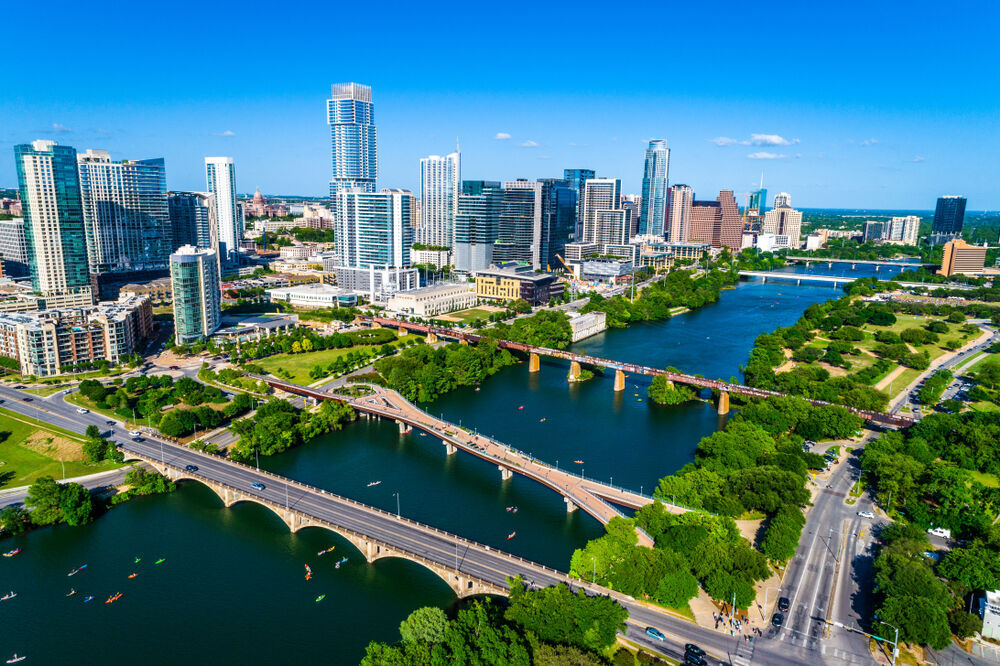
Photo Credit: Roschetzky Photography / Shutterstock
- Composite score: 70.7
- Average number of education years: 14.3
- Graduate or professional degree: 21.1%
- Bachelor’s degree only: 33.9%
- Associate degree only: 5.5%
- High school diploma only: 14.2%
- Less than a high school diploma: 10.1%
8. Minneapolis, MN

Photo Credit: Checubus / Shutterstock
- Composite score: 71.6
- Average number of education years: 14.4
- Graduate or professional degree: 20.7%
- Bachelor’s degree only: 31.5%
- Associate degree only: 7.7%
- High school diploma only: 14.6%
- Less than a high school diploma: 8.7%
7. Raleigh, NC

Photo Credit: Farid Sani / Shutterstock
- Composite score: 71.7
- Average number of education years: 14.4
- Graduate or professional degree: 18.7%
- Bachelor’s degree only: 31.6%
- Associate degree only: 7.2%
- High school diploma only: 16.8%
- Less than a high school diploma: 8.2%
6. Denver, CO

Photo Credit: Nicholas Courtney / Shutterstock
- Composite score: 71.8
- Average number of education years: 14.4
- Graduate or professional degree: 20.5%
- Bachelor’s degree only: 32.6%
- Associate degree only: 5.0%
- High school diploma only: 17.0%
- Less than a high school diploma: 8.8%
5. San Francisco, CA

Photo Credit: yhelfman / Shutterstock
- Composite score: 72.0
- Average number of education years: 14.4
- Graduate or professional degree: 24.1%
- Bachelor’s degree only: 35.1%
- Associate degree only: 4.9%
- High school diploma only: 11.9%
- Less than a high school diploma: 11.6%
4. Portland, OR

Photo Credit: Bob Pool / Shutterstock
- Composite score: 75.0
- Average number of education years: 14.7
- Graduate or professional degree: 21.4%
- Bachelor’s degree only: 31.4%
- Associate degree only: 6.5%
- High school diploma only: 15.0%
- Less than a high school diploma: 6.5%
3. Atlanta, GA

Photo Credit: ESB Professional / Shutterstock
- Composite score: 78.7
- Average number of education years: 14.9
- Graduate or professional degree: 24.3%
- Bachelor’s degree only: 32.2%
- Associate degree only: 5.3%
- High school diploma only: 17.0%
- Less than a high school diploma: 7.5%
2. Washington, DC

Photo Credit: f11photo / Shutterstock
- Composite score: 81.3
- Average number of education years: 15.1
- Graduate or professional degree: 34.0%
- Bachelor’s degree only: 25.7%
- Associate degree only: 3.3%
- High school diploma only: 15.8%
- Less than a high school diploma: 8.2%
1. Seattle, WA

Photo Credit: f11photo / Shutterstock
- Composite score: 83.5
- Average number of education years: 15.3
- Graduate or professional degree: 28.1%
- Bachelor’s degree only: 36.9%
- Associate degree only: 5.4%
- High school diploma only: 9.5%
- Less than a high school diploma: 5.3%

Here are some tips on what high school seniors should be thinking about in December and January.


