

WARREN, R.I. — A nearly 150-year-old stained-glass church window that depicts a dark-skinned Jesus Christ interacting with women in New Testament scenes has stirred up questions about race, Rhode Island's role in the slave trade and the place of women in 19th century New England society.
People are also reading…
How St. Francis created the Nativity scene, with a miraculous event in 1223
Nativity scenes have been displayed for hundreds of years

The earliest biblical descriptions do not mention the presence of any barnyard animals, that are part of Nativity displays today. Oscar Llerena/Flickr, CC BY-NC-ND
Around the Christmas season, it is common to see a display of the Nativity scene: a small manger with the baby Jesus and his family, shepherds, the three wise men believed to have visited Jesus after his birth and several barnyard animals.
Biblical descriptions offer details of birth
The earliest biblical descriptions, the Gospel of Matthew and the Gospel of Luke, written between A.D. 80 and 100, offer details of Jesus’ birth, including that he was born in Bethlehem during the reign of King Herod.
St. Francis of Assisi credited with first nativity scene
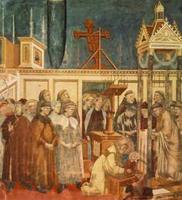
St. Francis of Assisi preparing the Christmas crib at Greccio. Basilica of Saint Francis of Assisi, Assisi, Italy
But the Nativity scene now recreated in town squares and churches worldwide was originally conceived by St. Francis of Assisi.
Much of what scholars know about Francis comes from “Life of St. Francis,” written by the 13th-century theologian and philosopher St. Bonaventure.
Nativity imagery proliferates in art

The Nativity story continued to expand within Christian devotional culture well after Francis’ death. In 1291, Pope Nicholas IV, the first Franciscan pope, ordered that a permanent Nativity scene be erected at Santa Maria Maggiore, the largest church dedicated to the Virgin Mary in Rome.
Nativity imagery dominated Renaissance art.
Nativity scenes take a political turn

Seen is a new art installation dubbed "Scar of Bethlehem" by the artist Banksy.
After the birth of Jesus, King Herod, feeling as though his power was threatened by Jesus, ordered the execution of all boys under two years old. Jesus, Mary and Joseph were forced to flee to Egypt.
In an acknowledgment that Jesus, Mary and Joseph were refugees themselves, in recent years, some churches have used their Nativity scenes as a form of political activism to comment on the need for immigrant justice. Specifically, these “protest nativities” have criticized President Donald Trump’s 2018 executive order on family separation at the U.S.-Mexico border.


