From potential lead exposure to updated maps and safety concerns, follow all our coverage of the planned detonation at the Iowa Army Ammunition Plant.
See updated lead particle dispersion maps here
The Iowa Army Ammunition Plant in Middletown, Iowa, plans to do a controlled detonation of 68 barrels of degraded lead azide, a material used in explosives.
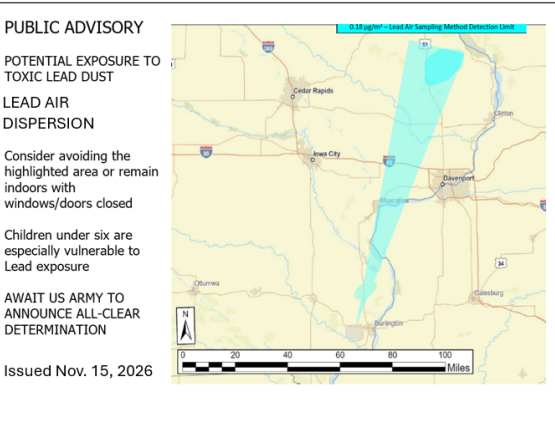
The detonation could result in lead particles dispersing into the air as much as 100 miles from the blast site and leave lead particles deposited on the ground within about a 40-mile range. Lead is toxic to humans and animals.
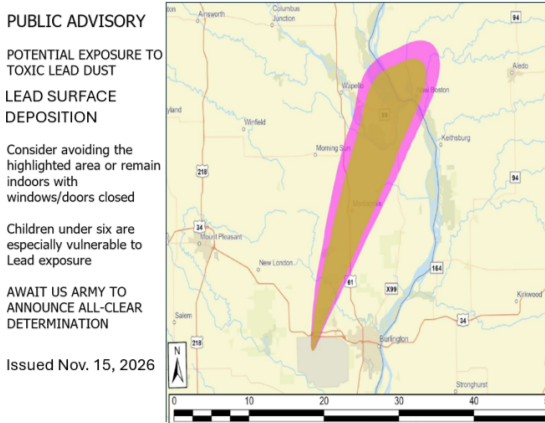
An updated map released late Wednesday of a roughly 30-mile area that could be exposed to toxic lead dust settling on surfaces from the planned detonation of lead azide on Friday.
An updated map released late Wednesday night from the U.S. Army modeling potential exposure of lead particles in the air from a detonation of lead azide on Friday.
Concerns mounted Wednesday over a planned detonation of degraded lead azide in southeast Iowa, leading to calls to delay the detonation and evaluate alternatives.
The toxic lead dust from the planned explosion of lead azide could hit parts of the Quad-Cities depending on weather factors.
Elected officials voice concerns on proposed detonation planned Friday
As the U.S. Army prepares to detonate 9,700 pounds of lead azide on Friday, elected officials took to social media to share information and concerns with residents.
Some, sounded an alarm and called for a pause to the detonation or more explanation from the U.S. Army. Others pointed to the U.S. Army's updates and guidance.
The safety of Iowans now and in the future should be government’s top concern. An unacceptable lack of communication and clarity has made Iowans understandably concerned and angry about this situation. The public deserves to know, if this is the safest option, why other options were worse. If it isn’t as safe as possible to do this tomorrow, it shouldn’t happen tomorrow. https://t.co/wGsUjYTFh2
Keeping Iowans safe is my top priority. As someone who was born with spina bifida due to my father’s exposure to Agent Orange – an airborne toxin – I am deeply concerned about Friday’s planned detonation in Middletown. I have heard from many Iowans who are worried about their health and safety due to the potential risk of lead exposure as a result of the detonation. The lack of advanced notice and clear communication and transparency from the U.S. Army, including to public officials such as Iowa Governor Kim Reynolds, is deeply troubling. Iowans deserve to know that every precaution is being taken to keep them and their families safe. As I continue to push for answers and reassurances, I am in communication with Senator Joni Ernst and we are doing all that we can to get clarity. In the meantime, I am calling for the U.S. Army to pause and delay the detonation until public officials and the public can fully understand the health impacts to Iowans and know that every safety precaution is being taken. Although this underground detonation may be required to safely neutralize the material, it should not be rushed, and instead be planned to minimize the impacts on Iowans, including on a day where the weather patterns do not increase the associated health risks. Above all, Iowans deserve to know that every safety precaution has been taken and exactly what the associated health risks are. Until those questions are answered, the detonation should not proceed. https://t.co/KvEWMZD0t8
Tomorrow, the U.S. Army plans to conduct two controlled detonations at the Iowa Army Ammunition Plant in Middletown to dispose of nearly 10,000 pounds of degraded lead azide to prevent an uncontrolled explosion. Surrounding communities were not given adequate notice. I’ve heard directly from Iowans concerned about the potential impact on air quality and their families’ health and safety. They deserve clear answers and transparent safety protocols before this moves forward. It shouldn’t happen tomorrow. We need more rigorous oversight of facilities that store hazardous materials to prevent this kind of situation from happening in Iowa or around the country. I’m working directly with the federal agencies involved for answers.
SOUTHEAST IOWA DESERVES BETTER. Tomorrow, the United States Army will conduct two controlled detonations at the Iowa Army Ammunition Plant near Middletown. Nearly 10,000 pounds of lead azide has been allowed to deteriorate to the point that the Army says it is too dangerous to move, and now the people of Southeast Iowa are being told to live with the consequences. According to EPA documents, this material was not stored in the permitted hazardous-waste management area at the plant. Now recrystallized and hyper-sensitive to friction and shock, the Army ultimately determined that moving the lead azide could trigger a large-scale explosion. Because moving the material at this point could create tremendous danger, controlled detonation may now be the safest path forward. But acknowledging that this may be the safest option today in no way, shape, or form, excuses the negligence and mismanagement that created the problem in the first place. There are serious questions that need to be answered about how we got here in the first place. How does something like this happen at a United States Army installation? Who was responsible for overseeing the storage of this material? How long was it allowed to deteriorate? What inspections were conducted, what warning signs were missed, and who is going to be held accountable? These are not unreasonable questions. They are basic questions of responsibility and accountability. And what about the environmental consequences? The Army has acknowledged that these detonations will produce a dust plume containing airborne lead particles that will settle on surrounding land and surfaces. Here is something everyone should understand: LEAD DOES NOT JUST WASH AWAY. It doesn’t biodegrade. Rain does not make it disappear. In fact, the water will just carry the contamination further into our soil and waterways. That contamination will remain in our environment for years and depending on conditions, lead can bind to soil, sediment, or become mobile again. This isn’t a “temporary dust problem”. Iowa's waterways have struggled with nitrate contamination for years. Politicians even spent much of the 2026 cycle talking about water quality and cancer rates. Instead of delivering on needed relief from nitrate pollution, thousands of Iowans will now be forced to drink both nitrates and lead. The people who live in Southeast Iowa deserve a few things from the Army and the federal government in the coming days: Accountability – Iowans deserve a thorough explanation of how this was allowed to happen. Additionally, the federal government must take responsibility for addressing the fallout for this event, because taxpayers cannot be expected to pay for their own poisoning. Transparency – Air, soil, surface water, and sediment should be tested before and after the detonations. Publish the full air-dispersion models, methodologies, and results. Residents shouldn’t have to rely on vague assurances. Change – Before plant operations resume, the Army needs to come forth with a comprehensive plan with actionable measures that ensure nothing like this will ever happen again. This is ultimately about whether the federal government takes its responsibility to the communities surrounding its installations seriously. Too often, they haven’t. The Army exists to protect our country; our land, our water, and our children are worthy of that protection. Southeast Iowa deserves answers and accountability.
Earlier this year, the Army publicly disclosed that it had discovered degraded lead azide at the Iowa Army Ammunition Plant in Middletown. Since then, the Army has been in conversation with the local community and has held open public forums in Middletown on how to handle it. Because the material cannot be relocated and no one can say when it might detonate on its own, causing an uncontrolled explosion, a controlled detonation is the safest and best option. The detonation is scheduled for Friday, November 20, at approximately noon. I encourage everyone in the area to follow the Army's advisory and check https://t.co/BtTGOMCn0K for updated maps.
We are gathering as much information as we can about the Army ammunition plant detonation. Here are links to the latest advisories: https://t.co/XzxyKwKRFx
Illinois is monitoring the planned detonation in Iowa, as it could affect Mercer County and surrounding areas. The Department of Defense is responsible for ensuring people aren't harmed by exposure — and we’re pressing for answers and more transparency. https://t.co/3A7zutF58S
When farmers have to keep cattle inside, off the water and grass, it’s clearly gone too far. We can catch a 250-ton rocket with chopsticks, but can't dispose of an explosive without 100-mile neurotoxin plume? Pause, bring in the brightest minds, find another way. https://t.co/bII1iKqCxo
Service will be suspended from 11:30 a.m. to 2 p.m. on Friday due to potential lead exposure. Service will resume normal operations when conditions are safe again.
A chemist says a controlled detonation is likely the safest option for unstable lead azide, although lead dust remains hazardous and could spread.
An updated map released late Wednesday of a roughly 30-mile area that could be exposed to toxic lead dust settling on surfaces from the planned detonation of lead azide on Friday.
Updated Map - Surface Exposure 11/18
An updated map released late Wednesday of a roughly 30-mile area that could be exposed to toxic lead dust settling on surfaces from the planned detonation of lead azide on Friday.
MuscaBus to suspend service for several hours amid planned lead azide detonation
Muscatine is reminding patrons of the Muscatine Public Transit System, or MuscaBus, that service will be suspended from 11:30 a.m. to 2 p.m. on Friday due to potential lead exposure.
Officials said the decision is based on current information and wind projections for the planned lead azide detonation at the Iowa Army Ammunition Plant in Middletown, scheduled for approximately noon on Friday.
What we know about the planned detonation of lead azide in southeast Iowa
The U.S. Army plans to conduct two controlled detonations of 68 barrels, or 9,700 pounds, of degraded lead azide at the Iowa Army Ammunition Plant in Middletown, Iowa, on Friday.
The detonation could result in lead particles dispersing into the air as much as 100 miles from the blast site and leave lead particles deposited on the ground within about a 40-mile range. Lead is toxic to humans and animals.
Augustana chemist says US Army is likely right to detonate lead azide
Gregory Domski, Augustana College's associate provost and chemist by trade, said the U.S. Army's decision to detonate lead azide is "probably correct."
On Friday at noon, the Army will be setting off two controlled detonations of lead azide, which is considered unstable and likely unmovable. Army officials said it's the safest way to dispose of it since it could lead to an uncontrolled explosion in transit.
The toxic lead dust from the planned explosion of lead azide could hit parts of the Quad-Cities depending on weather factors.
Concerns mount over planned lead azide detonation in southeast Iowa
A growing chorus of voices is calling for a delay of the planned detonation of degraded lead azide at a munitions plant in southeast Iowa on Friday.
A Republican lawmaker from Bettendorf is calling on federal and state elected leaders to urge the U.S. Army to grant a delay. Residents organized a peaceful demonstration at the ammunition plant asking for a halt to the detonation until independent environmental testing and an evaluation of risks and alternatives can be done. The Iowa Environmental Council has called for more information on the planned detonation and lead exposure.
Quad-Cities schools take precautions ahead of scheduled lead detonation by U.S. Army
Several school districts are taking precautions ahead of potential lead exposure caused by the scheduled detonation of a degraded, unstable lead stockpile on Friday.
The U.S. Army has scheduled two controlled detonations of the lead azide at the Iowa Army Ammunition Plant in Middletown at noon. It could release toxic lead particles that may land on surfaces or become airborne.
The map shows projected surface exposure to lead following a controlled detonation in Middleton, Iowa, on Friday, Nov. 20, 2026.
Could Friday's planned Army detonations affect your neighborhood? Officials have released maps projecting airborne lead exposure and dust deposits around the Middletown plant.
Southeast Iowa residents warned of loud booms, possible lead exposure during Army detonations
Residents in southeast Iowa may hear loud booms Friday as the U.S. Army conducts two controlled detonations at the Iowa Army Ammunition Plant in Middletown.
The detonations, scheduled for noon, will dispose of degraded lead azide, but could release toxic lead particles into the air that may eventually settle on the ground.