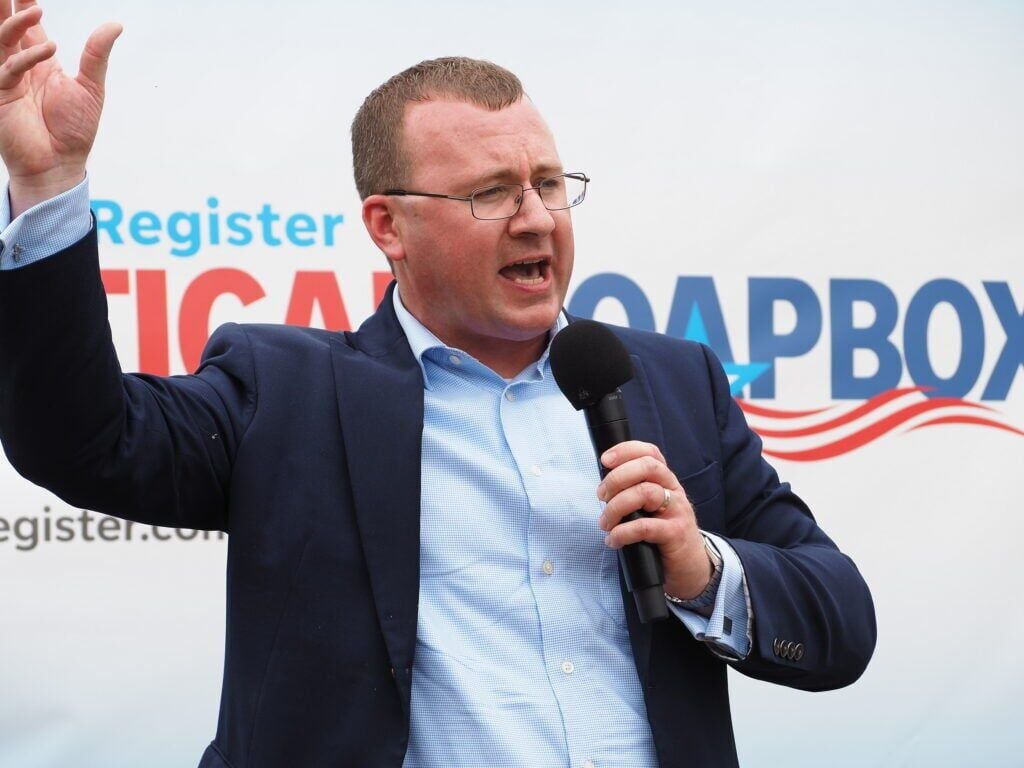
Thomas Laehn, the Libertarian running for Iowa’s U.S. Senate seat, said Saturday at the Iowa State Fair he would eliminate federal tax incentives for carbon dioxide sequestration and production of low-carbon fuels if elected.
Carbon sequestration pipeline projects have been a major point of contention in Iowa for years. They’ve also been a source of internal conflicts within the Iowa Republican Party, with conservatives voicing differing opinions at the Iowa Capitol about the use of eminent domain in building pipelines.
Laehn currently serves as the Greene County attorney. He said during his speech at the Des Moines Register Political Soapbox he was approached by Iowa House lawmakers to draft legislation to stop the use of eminent domain, particularly in response to the carbon sequestration pipeline project led by Summit Carbon Solutions.
People are also reading…
That measure, which Laehn said he helped write, made it through the Iowa House and Senate in 2025 with “a lot more provisions than my original language.” Gov. Kim Reynolds vetoed the bill. Laehn said the governor vetoed the legislation — despite polls showing a majority of Iowans oppose the use of eminent domain for the construction of hazardous liquid pipelines. Laehn pointed out Reynolds had received campaign contributions from Bruce Rastetter, the founder of Summit Agricultural Group and co-founder of Summit Carbon Solutions.
“Now, this is all happened at the state level,” Laehn said. “I’m running for the United States Senate, so why am I talking about state politics?”
He said special-interest influence is “occurring in Washington, D.C., at an even larger scale.”
Laehn brought up an article by the left-leaning outlet Iowa Starting Line stating Rastetter was “bankrolling Hinson” in the 2026 election. He linked this campaign finance information to Hinson’s support for 45Q tax credits, a tax credit incentivizing carbon sequestration which gives a credit of $85 per metric ton of CO2 to qualifying projects — a credit he said would mean billions “will be deposited into the accounts of Bruce Rastetter and his investors (of) our taxpayer money.”
“She’s also a proponent of sections 45Q and 45Z of the IRS tax code. When I’m elected to the United States Senate, one of the first pieces of legislation I will introduce will be to eliminate sections 45Q and 45Z of the IRS tax code, and then the funding for this boondoggle of a project evaporates, and the project collapses.”
Th Hinson campaign did not immediately respond to a request for comment. Rastetter has been a longtime supporter and financial backer of many Iowa Republican candidates. He has interests in several agriculture and energy industries in addition to the carbon pipeline.
Laehn also criticized 45Z tax credits for domestically produced fuels with lifecycle greenhouse gas emissions below a certain level that could also go toward some ultra-low carbon ethanol plants that would be connected to pipeline projects. Politico reported Hinson, alongside fellow Iowa Republican U.S. Rep. Mariannette Miller-Meeks, wrote a letter supporting preservation of these tax credits in 2025.
Iowa’s U.S. Senate seat is an open race this year, as U.S. Sen. Joni Ernst, who currently holds the position, is not seeking reelection. Laehn faces Hinson, the Republican candidate, and Democratic Iowa Rep. Josh Turek in the general election. Political forecasters rate the race as “leans Republican,” which election watchers say means the race is more competitive than Iowa U.S. Senate races in previous recent election cycles.
The Libertarian candidate said he was also critical of Turek because a super PAC, VoteVets, spent money to advertise on his behalf, and because the Senate Majority PAC, a Democratic organization, plans to spend $17 million in Iowa on ads focused on the U.S. Senate race.
“If Ashley is elected, she will owe her office and her allegiance to the Republican Party and the interest groups and economic elites who are funding her campaign,” Laehn said. “If Josh Turek is elected, he will owe his office and his allegiance to the Democratic Party and the economic elites who are funding his campaign. When I’m elected to the United States Senate, I will owe my office and my allegiance to all of you, to the people of the state of Iowa.”
Turek counters criticism that he is closely aligned with party insiders, arguing that he would work across party lines for Iowans’ interests. In his Soapbox speech Friday, he criticized U.S. Senate Democrats for withholding their vote on a farm bill.
Laehn was the first Libertarian to hold an elected partisan office in Iowa, according to his campaign website, winning his election to become Greene County attorney in 2018 and winning reelection in 2022. Unlike other Iowa Libertarian candidates, Laehn did not face challenges to his qualifications for ballot access in 2026.
Laehn said when he learned other Libertarian candidates faced challenges to their place on the general election ballot, his wife told him, “it shouldn’t take a law degree and a Ph.D. to figure out how to get on the ballot” — qualifications Laehn has. He also criticized the Iowa Legislature for making changes to state law that he said make it more difficult for candidates unaffiliated with major political parties to make it onto the ballot.
“What this really shows is how the two parties have entrenched themselves in Des Moines and in Washington D.C. and have erected all of these barriers and obstacles to third-party and independent candidates,” Laehn said.