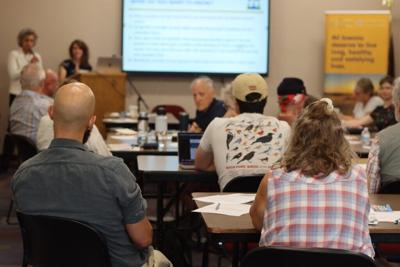
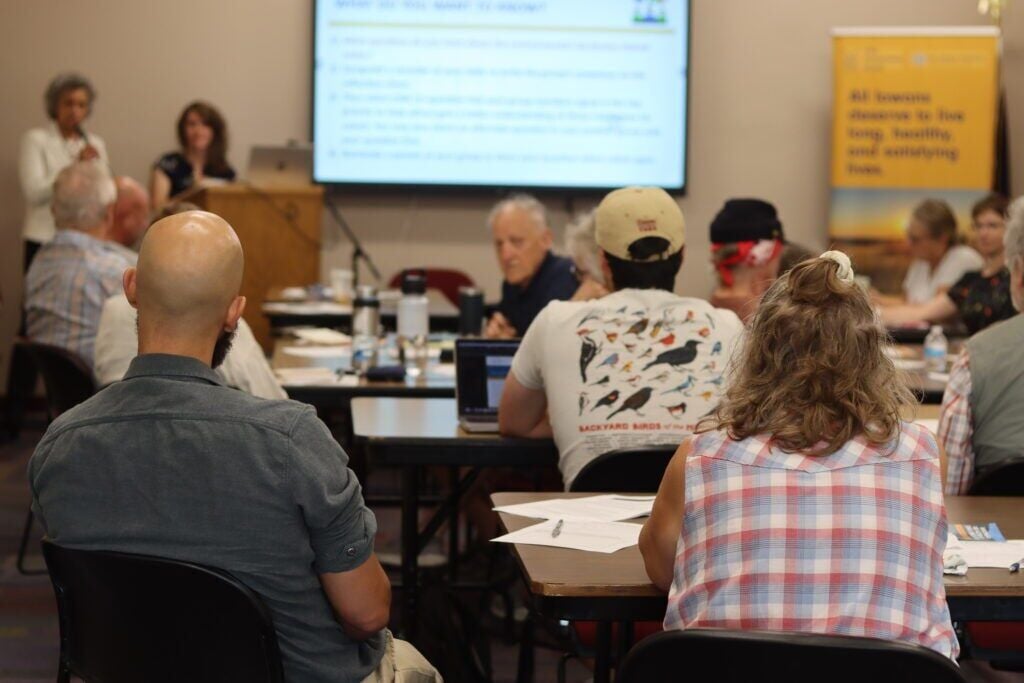
BOONE – In a conference room at the Ericson Public Library Tuesday, cancer survivors, farmers, elected officials and community activists from Boone County discussed the things they have done to reduce their exposure to carcinogens and the things they hope will change in Iowa to help lower the state’s high cancer rates.
The discussion in downtown Boone was part of a series of community conversations led by the Iowa Environmental Council about the information in the “Environmental Risk Factors and Iowa’s Cancer Crisis” report the council released in March.
Kathy Toms, a Boone County resident, said she started removing the toxins she could control from her life five years ago after a breast cancer diagnosis. Now she prioritizes foods, beverages and household products that are free of chemicals she feels might have contributed to her cancer.
People are also reading…
“I don’t want to fight again,” Toms said.
Boone County, according to figures from the Iowa Cancer Registry, has a cancer incidence rate and a cancer-related mortality rate higher than the state or national averages.
The conversation in Boone was the eighth stop for the council in its tour around the state to present the report, which analyzed more than 250 studies and included the perspectives of hundreds of Iowans that participated in public forums.
Kerri Johannsen, Iowa Environmental Council’s senior director of policy and programs, said the council is hosting the conversations in areas that have especially high cancer rates, or where the council has a local partner to help host the event.
She said that while the Tuesday event in Boone was full of folks who have been engaged with this issue, usually the room is split when presenters ask who has called their elected officials or submitted an opinion article to their local papers on the issue.
Johannsen said the council is listening to the concerns and solutions brought forward by attendees who often bring different perspectives than researchers.
“What do we all want to do together, because this is impacting everybody,” Johannsen said. “Everyone has to be at the table, or we’re not going to make progress.”
Johannsen asked the room if they knew someone who had cancer — every hand was raised in response. She was again met with a room full of raised hands after asking if those gathered felt like the state had a “long way to go” in addressing the connection between environmental issues and cancer.
Diana Wright, a Boone County resident at the event, said she wants to see more action on Iowa’s water quality issues.
“We’ve got a huge water quality issue in the state, and we’ve got a huge cancer issue,” Wright said. “I want to make sure I’m understanding the science, and then we need to advocate to do something about it because I think there’s a lot of stuff out there that could be preventable, and we need to have the will to make the changes.”
The report, which was done in collaboration with the Harkin Institute at Drake University, started as a look at water quality in Iowa and its relationship to Iowa’s cancer incidence rates. Iowa is one of two states where the rate is rising, instead of declining.
The final report looked at pesticides, per- and polyfluoroalkyl substances, known as PFAS, nitrate and radon – all of which, the report concluded, have links to the types of cancers that are higher in Iowa than in other states.
The report points to Iowa’s vast agricultural landscape, livestock industries and the application of fertilizers, which can cause elevated concentrations of nitrate in the water, and pesticides.
Toms, who raises grass-fed cattle, said she felt that the presentation focused largely on agricultural applications of fertilizers and pesticides and didn’t emphasize that the same products are used in urban areas as well.
“It’s more than just the farm families,” Toms said. “Towns have a responsibility too.”
Other environmental risks, like PFAS, can enter waterways through wastewater streams and impact humans through things like non-stick cookware, certain types of clothing, cosmetics and other products.
Radon is a naturally occurring gas that is emitted during the breakdown of soil and rock, and is the leading cause of lung cancer in nonsmokers, according to the U.S. Environmental Protection Agency. The report shows that Iowa homes have higher radon rates than other parts of the country.
The Iowa legislature passed a law this spring that requires new homes to be built with radon mitigation systems, in an effort to lower Iowa’s cancer instances.
Wright said there are policies that could be enacted to help with Iowa’s water quality, but she felt things like “power and profit” get in the way of making significant changes.
“The only ones that get traction are the ones like radon mitigation,” Wright said. “No humans caused the radon issue, so those are easier to deal with.”
Wright said she recently tested for radon and installed a radon mitigation system in her home. Another attendee, Margaret Liston from Ogden, said she installed a reverse osmosis system in her home to help limit her exposure to potential toxins in the water.
Johannsen told attendees that the goal wasn’t to memorize the powerpoint, or the statistics about environmental risk factors, but to know “with confidence” that this is an issue in Iowa. Then, she said, they can speak to friends and family members, or even push for change at a higher level.
“The most powerful thing any person can do is to talk about how this has impacted their own lives or the lives of their kids, their parents, their neighbors, etc.” Johannsen said. “Those stories are going to move policymakers.”
Future community conversations on the report can be found, at the Iowa Environmental Council’s website.