New, reduced-credit pathways to a degree are making their way to Iowa’s public universities with preliminary approval from their state governing body.
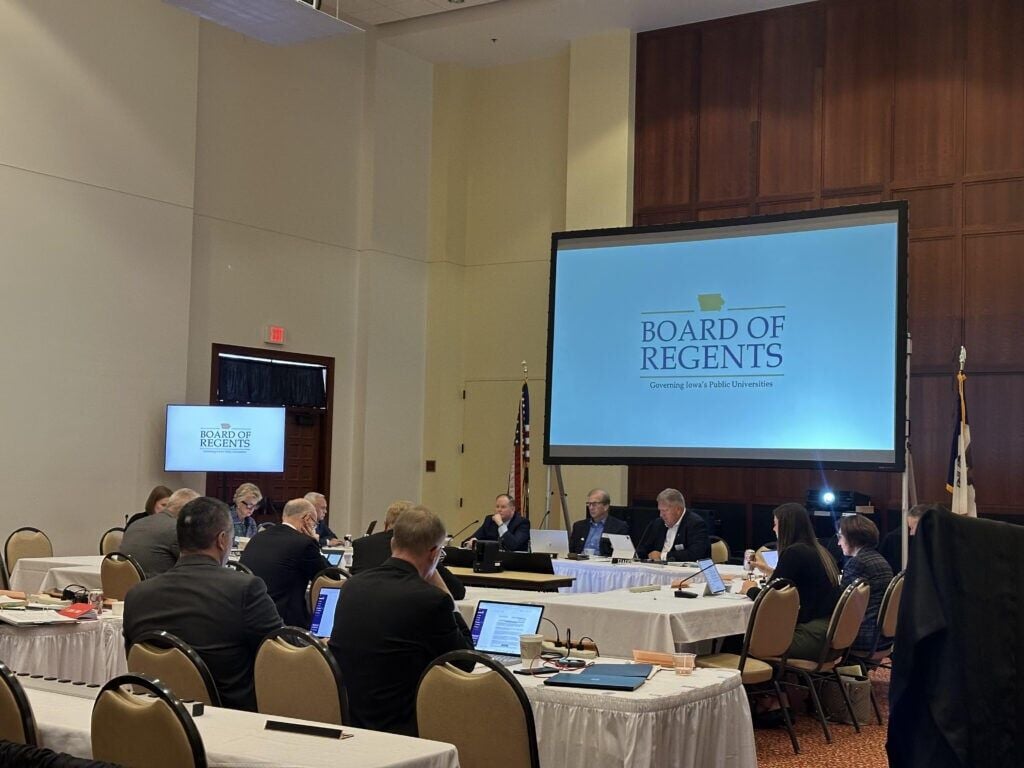
The Iowa Board of Regents Academic Affairs Committee Wednesday recommended approval for the University of Iowa and University of Northern Iowa to establish bachelor of applied professional studies degrees, developed in deference to state law and board urging, as well as program changes and eliminations.
Regent Steve Lacy said during the committee meeting universities should focus more on marketing their programs like those slated for approval Thursday, adding that “we have a marketing and communications problem” when he speaks to people who don’t know about programs like these. Regent Christine Hensley suggested marketing to the Iowa Business Council and companies with employee tuition reimbursement programs.
People are also reading…
University of Northern Iowa Provost José Herrera said officials need to be careful about marketing programs that have yet to win board approval but agreed they need to do a better job of marketing other accelerated programs.
“We’ve been doing a little bit of that with accelerated nursing and accelerated programs in communication science disorders, but I think we need to do a better job with communication,” Herrera said.
University of Iowa
The UI only brought one new degree forward for approval, and requested no program changes or eliminations.
The Bachelor of Applied Professional Studies in Applied Health Studies will be offered by the UI’s University College and represent the first of its degree type at the university, board documents stated. The mainly online, reduced-credit program will target working adults, healthcare professionals, and those with some college credit but no degree or a shorter degree or certification.
UI Associate Provost for Undergraduate Education and University College Dean Tanya Uden-Holman told board members the major “responds to workforce needs in healthcare and the demand for more flexible bachelor’s degree completion opportunities,” and separates itself from the UI’s traditional bachelor’s degree in health studies with different learning objectives and different student group targets.
Students enrolling in the degree will have two pathways to choose from — a magnetic resonance imaging (MRI) certificate, which will include in-person practicum work in Iowa City, and healthcare services. Enrollment is projected in the board document to reach 98 students in five years.
No additional funding or resources is necessary to launch the new degree, which with board approval would begin in August 2027. Uden-Holman said resources will be reallocated from University College when needed and tuition revenue will also support the program, expected to break even in its first year and bring in net revenues of around $140,000 by year five.
“The University of Iowa is particularly well positioned to offer this program, with five health sciences colleges on one campus and strong connections to a nationally recognized academic medical center,” Uden-Holman said. “The proposed major also builds on University College’s established experience serving working adults and students pursuing flexible degree options through its online BLS and BAS programs.”
University of Northern Iowa
UNI brought forward multiple proposals for new degrees, as well as program changes and eliminations.
The Cedar Falls university’s bachelor of applied professional studies focuses on professional development, communication, artificial intelligence and technology, Interim Associate Provost for Academic Affairs Deirdre Heistad said, with a 12-unit core curriculum and additional discipline-focused courses students can choose to complete the 90-credit degree.
Enrollment is expected to reach 75 students in year five of the program being offered, with targeted groups including adult learners, transfer students and working professionals. Heistad said the program will be offered entirely online through the College of Graduate Research and Online Education, and it won’t need any additional faculty, facilities or large equipment.
The new degree will expand access to higher education, support workforce needs and strengthen UNI’s commitment to these principles, Heistad said.
“Graduates will be prepared to analyze workplace challenges, communicate effectively in professional settings, and apply interdisciplinary knowledge to real-world situations,” Heistad said.
UNI also received initial approval from the committee to establish an online bachelor of arts in human services in August 2027, which Heistad said has already seen success as an exploratory program with 100 students enrolled. She said the program will prepare students to “support individuals and families, navigate service systems and understand policies governing human services.”
Interest in the program doubled between 2024 and 2025, Heistad said, and “enrollment is projected to grow to 110 majors within seven years.” No new resources are required to launch the program.
The new program would sit in the university’s department of family, aging and counseling and pull from family studies, lifespan development and social sciences to address “Iowa’s growing shortage of human and social services professionals,” she said.
For programs slated for consolidation and elimination, Heistad said they “represent a thoughtful restructuring to preserve educational opportunities while improving efficiency and alignment with student and workforce needs.”
The board committee gave preliminary approval for UNI to consolidate its family services, gerontology and long-term care administration into a renamed family and lifespan development degree. The university will also bring together geography, environmental resource management and geographic information science majors into a renamed geography and geospatial sciences degree.
“Together, these proposals streamline degree structures, improve workforce alignment, simplify student pathways, and generate approximately $89,000 in annual efficiencies while preserving student access and academic quality,” Heistad said.
UNI’s biomedical program and ecology, evolution and organismal biology degree will also be combined within the university’s biology major as concentrations.
Regent Peter Cownie asked whether the program changes will impact UNI’s gerontology clinic, which Heistad denied.
Iowa State University
ISU brought 11 programs to the board of regents for elimination Wednesday, the majority combined master’s and PhD pathways.
Provost Jason Keith told the board that each of the programs were previously identified through the university’s program vitality review as under-enrolled, and each went through university processes before being added onto a board of regents agenda.
“MS and PhD” degrees in astrophysics and applied, condensed matter, high energy, nuclear and bio-physics will be combined under an “umbrella program,” Keith said, and other graduate programs in earth science and toxicology will be eliminated. Additional programs approved for closure include a PhD in wind energy science, engineering and policy, a master of engineering in energy systems and a bachelor of arts in environmental studies as a secondary major.
“These actions are part of Iowa State’s continuous improvement effort to better streamline our curriculum for its student demand,” Keith said.
A new vitality review will take place in spring 2028, Keith said.
Board criticisms
Board members were not satisfied with all of the projected cost differences and enrollment numbers for the programs requested for elimination or establishment, with Regent Kurt Tjaden issuing challenges to university officials to take a harder look at financials and more continuous reviews of academic programs.
Tjaden said he heard words like “no incremental costs, no additional staffing” from university officials about the programs they’re trying to establish, but nothing about the new students coming to campus and the incremental tuition funding they represent. He’s “surprised the dollars aren’t higher” since costs weren’t factored in and suggested meeting again “offline” to go over everything.
“I think that the numbers that you presented for enrollment are really on the conservative side, especially once you have an effective marketing program,” Hensley said.
Universities also need to be more consistent and quick in their review steps for programs potentially up for elimination, Tjaden said, comparing it to reduction processes in business environments where there is a watchlist and ongoing process. It should be known what programs are in danger of elimination, timelines to decide upon their fate and “constant review.”
Regent Greta Rouse suggested tracking the cost savings from program changes and closures for the board’s Revenue Enhancement and Productivity Study (REAPS), to which Tjaden said they will include in their presentation to the board Thursday.
“I would challenge you to accelerate the cadence on this,” Tjaden said. “I’m not saying to terminate more programs, I’m saying have a process, be much more diligent about it.”
This story is provided by States Newsroom, a nonprofit state news network and Blox Digital content partner.