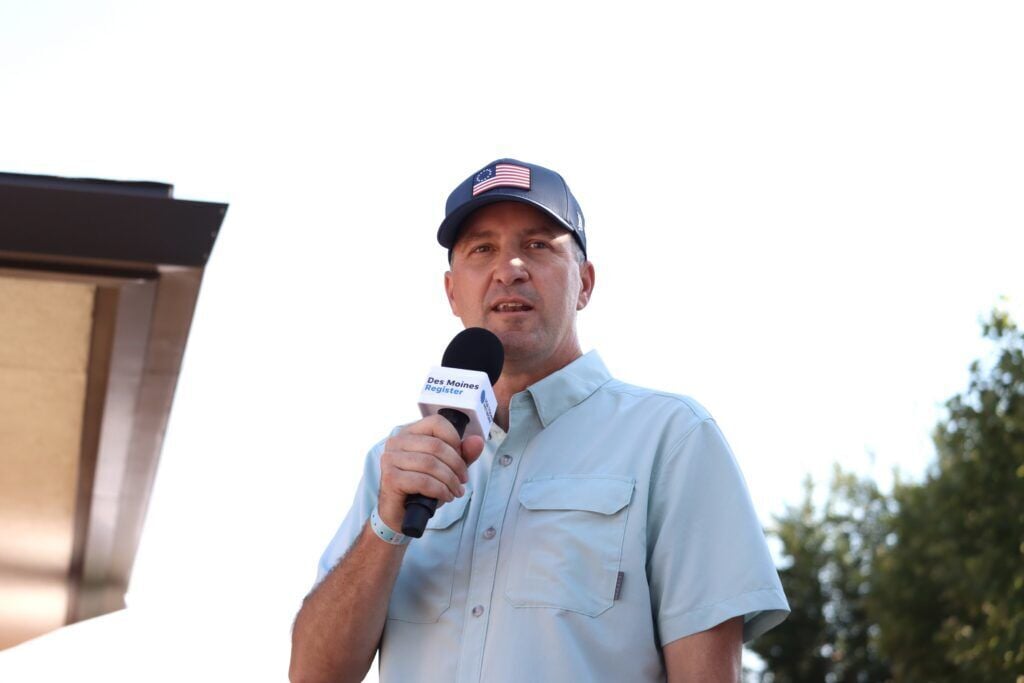
Iowa Secretary of Agriculture Mike Naig, speaking at the Des Moines Register Political Soapbox Monday, said he and his opponent have “fundamentally different” views of the office.
Naig is running against water quality researcher and advocate Chris Jones, who has the Democratic nomination for the seat. Jones has been critical of the large-scale farm model that is dependent on corn, soybeans and ethanol.
“He just has a very fundamentally different opinion about how to work on the issues that we need to work on,” Naig said.
People are also reading…
Jones has suggested policies to improve water quality by taxing or restricting things like fertilizers and animal sales and banning things like new tile drainage lines, fall tillage and chemical applications to ditches.
Naig said this approach would lead to a “smaller” and “diminished” agriculture.
“That kind of taxing and regulating drives farmers out of business, which will put our land and our farms in the hands of fewer and fewer farmers, and that is the opposite of what we need to be seeing,” Naig said. “So there is a distinct difference between him and me when it comes to this race.”
Jones called the attacks “desperate” and said Naig has been “responsible for Iowa’s declining water quality for the past decade.”
“Under Naig’s policies, the average Iowa farmer is sentenced to an endless and desperate cycle of trying to acquire more and more land, which has led to consolidation and driven the population downward in 70 of our 99 counties while hollowing out many of our small towns,” Jones said in a statement. “I think we need a new approach.”
Naig, who has held the position since 2018, said all Iowans “benefit from a strong agriculture.”
“A strong agriculture leads to strong families and strong communities, and a stronger Iowa because of it,” Naig said.
Naig said to continue supporting Iowa agriculture, the state needs to continue expanding international, national and local markets to make sure farmers can get paid for the things they grow and to secure more funding for conservation practices that improve water quality.
Iowa has continued to adopt conservation practices like cover crops, but Naig said it’s “not good enough.”
“We need to do more,” Naig said.
Cancer
Iowa’s high cancer incidence rates, which have also been tied to the state’s water quality concerns, has become a top issue in many of Iowa’s political races this year.
While speaking to reporters about the subject, Naig said, “we’re not in a good place as a state.”
“I think what we know is that this is more complex than what some want to make it, and I think you’ve got some who have decided that it’s a political issue, and I think that can be very dangerous,” Naig said.
Farmers he has spoken with, he said, told him they are frustrated at being blamed for Iowa’s cancer crisis as many reports and groups point to nitrate concentrations in the water and pesticide exposure as cancer drivers.
“It’s okay to to wonder, to ask questions, to want to know the causes, that’s where we need to go,” Naig said. “But let’s actually understand what’s going on, and then let’s address that.”