
Iowa State University researchers and partners are working to learn about how modern fires impact firefighters’ health due to toxic contaminants on their gear and to find practical solutions to keep them safe.
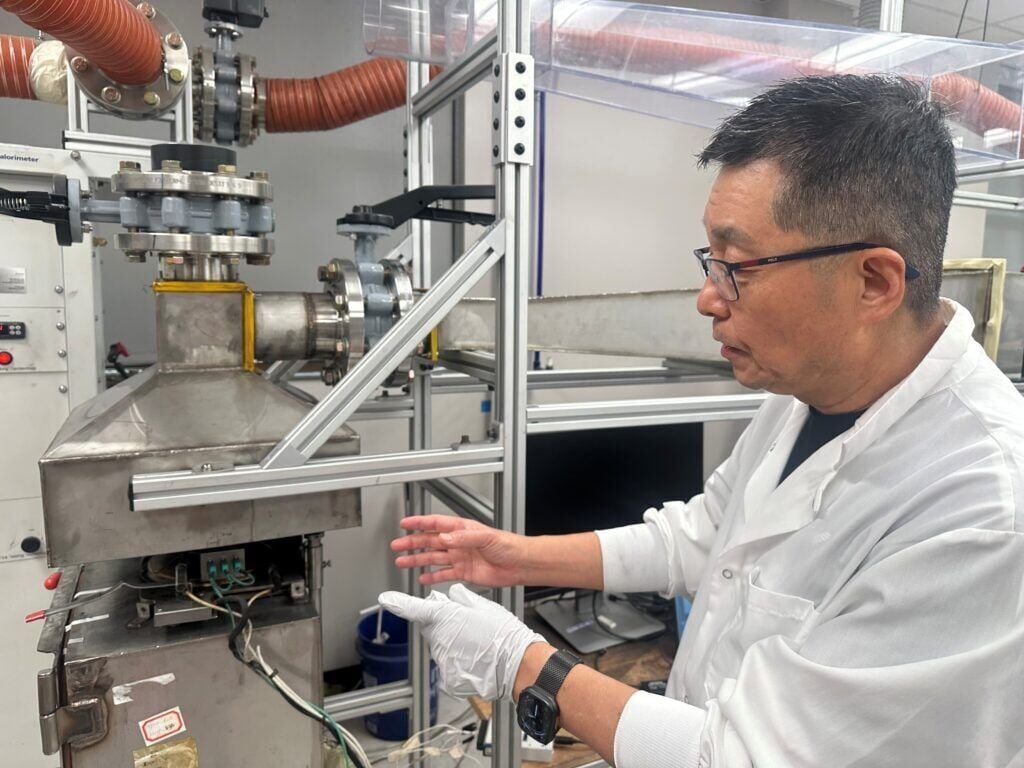
Guowen Song, an ISU professor of apparel, events and hospitality and director of the NextGen Personal Protective Technology Program, and his research team are burning materials to generate the invisible residue the fire and smoke leave on firefighters’ gear in order to study how it hangs on after the fire is put out.
They’ve already grasped the fundamental science behind carcinogens sticking on personal protective equipment, even after washing, Song said, and are trying to create a platform where their basis of knowledge can be shared and solutions for safer gear and new methods of cleaning can be disseminated.
“The current technology we call decontamination, regular washing things, does not work,” Song said. “The reason is that thing is not designed for this nature of emission, pollution, contamination, right, so there is no foundation (for) fully understanding the nature of this kind of contamination.”
People are also reading…
The team also launched the Iowa Firefighter Cancer Prevention and Exposure Reduction Program in July, with partners in the University of Iowa Holden Comprehensive Cancer Center, Iowa Cancer Consortium, Iowa State Fire Marshal Division, Iowa Fire Service Training Bureau and Iowa fire departments.
Together, they’re more deeply examining this topic and how firefighters are being impacted by the contaminants on their gear, and working on solutions to develop modernized equipment and decontamination methods.
Kent Brix, past president of the Iowa Firefighters Association, said this kind of research is “vital” for Iowa’s career and volunteer firefighters. The hazardous conditions firefighters face in the line of duty can act as a “multiplier” for their risk of cancer, he said, and it’s important that Iowa’s institutions are trying to help.
“Anything to make our firefighters safer,” Brix said.
According to the Iowa Firefighters Association, in September 2024, Iowa housed around 850 fire departments, 92% of which were volunteer departments. This is more than 20 percentage points higher than the national average, and it means that most of Iowa’s firefighters may be bringing their carcinogen-laced gear into their personal vehicles and back home after the fire is put out.
Firefighters in big cities across the U.S. are also at a greater risk but for a different reason — their structure fires can be much more complex in terms of the involved materials, leading emergency responders to become exposed to more dangerous contaminants through their clothes.

The Federal Emergency Management Agency, or FEMA, has funded Song’s work for six years, he said, because this is such a large issue. Song also leads ISU’s NextGen Personal Protective Technology program.
In that time, he and his team have developed chambers for burning materials like batteries, plastics and other synthetic materials and tested them with different parts of firefighting gear to understand how contaminants like polycyclic aromatic hydrocarbons (PAHs) stick to clothing and the effectiveness of normal cleaning measures on removing them.
PFAS, or per- and polyfluoralkyl substances, can also be a problem, researchers said, as some pieces of personal protective equipment contain PFAS-based materials due to their resistance to heat and moisture and smoke from fires can also hold the substances.
With the fundamental science of their research established, Song said the cancer prevention program partners are working to create a wearable exposure monitoring system to track exposure to contaminants at the scene of a fire, in transit, in the fire station and other areas.
“Eventually, we hope these findings from fundamental practice (help) develop a national monitoring system so we know what the true exposure could be,” Song said.
Along with greater monitoring, Song said he hopes that the work he and other partners are doing will lead to better equipment, cleaning and storage systems to keep firefighters healthy. Rui Li, co-principal investigator and a research assistant professor of apparel, events and hospitality, said their work could even lead to helping firefighters deal with insurance and other areas related to their health by tracking their personal exposure.
“We try to prevent the happening of this cancer, not like we’re developing some cure for cancer, right,” Li said. “Prevention in the first place (is) much more effective if we have enhanced understanding about how these small particles interact with the PPE system, so we can develop new material, or we can do some treatment to the PPE material to just make some improvements about the protection (to) help them with their safety and health.”