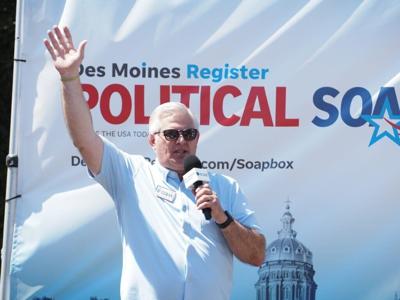

Chris McGowan, the Republican running for Iowa’s 4th Congressional District, said Monday he believes the federal government needs to be “extremely prudent” in deciding when to enter wars — though he declined to comment specifically on if the decision for the U.S. to enter into conflict with Iran met this definition.
McGowan, the Siouxland Chamber of Commerce president and a veteran, told the crowd gathered to listen to his speech at the Des Moines Register Political Soapbox that five of his six children are currently serving in the U.S. military. He said his own experience as a former member of the Iowa Air National Guard and his children’s service makes the use of military force is a “critically important concern for me,” and something he would want to weigh in on if elected to Congress.
People are also reading…
It is also a subject McGowan said he talked about with President Donald Trump after the president endorsed his campaign in February. McGowan said at the end of their conversation, he told Trump, “Sir, I believe the most seminal statement that you made in your 2024 inaugural address was the following: ‘We’re going to build the most powerful military the world has ever seen, and we’re going to judge our success not only by the wars we win, but perhaps more importantly by the wars we never get into.'”
He also reflected on his experience meeting former President Ronald Reagan when he was 17 years old.
“President Reagan had a mantra — that mantra was peace through strength,” McGowan said. “I have every intention of following President Reagan’s mantra as it relates to the very conservative use of military force, and only when diplomacy and all other avenues have failed.”
Speaking with reporters, he said he believes Congress needs to “understand the gravity of the situation” for the U.S. military to enter a conflict — while acknowledging some information must be kept classified.
“I spent some time as an intelligence officer, and I get how important it is to protect that information,” he said. “But I do believe that there has to be a substantial threat, it has to be an imminent threat, and it has to justify the use of force after all diplomacy has failed.”
Though full-scale fighting has paused, the U.S. is currently in a war with Iran. A memorandum of understanding signed by the two countries to negotiate a larger peace deal expires Monday, and there does not appear to be a clear plan to end the war that began Feb. 28.
When asked if Iran meets his definition for presenting a substantial, imminent threat, McGowan said he does not have all the information Trump and military leaders had access to when they decided to enter the war and that they’ve shared with members of Congress since.
“I’m not a member of Congress,” McGowan said. “I don’t have access to all of the information that the administration and the Department of War have that they made the decision first with Midnight Hammer and subsequently with Epic Fury. I will say this: it’s critically important that members be briefed, especially on the Senate Armed Services and the House Armed Services Committees. And I would like nothing more than to see those bodies in concert with the Department of War and the administration, when these very important decisions are executed.”
The 4th Congressional District, covering much of northwest Iowa, is currently represented by U.S. Rep. Randy Feenstra. Feenstra decided to not seek reelection in 2026, instead running as a Republican candidate for Iowa governor. Feenstra lost to candidate Zach Lahn in the GOP gubernatorial primary in June.
McGowan did not face a contested primary election to become the 4th District Republican nominee. In the general election, he faces Democrat Dave Dawson, a former state lawmaker. While several of Iowa’s congressional races are expected to be highly competitive in the midterms, the 4th District is considered a “solid Republican” seat by political forecasters.
The Republican candidate said he was committed to running a campaign “rooted in civil discourse.” He also said he plans to have a debate with Dawson ahead of the Nov. 3 general election.
“I know that my opponent and I are going to disagree on the issues, and that’s okay,” McGowan said. “But we need to do that without being disagreeable. We need to elevate the conversation and be an example and role models to others.”