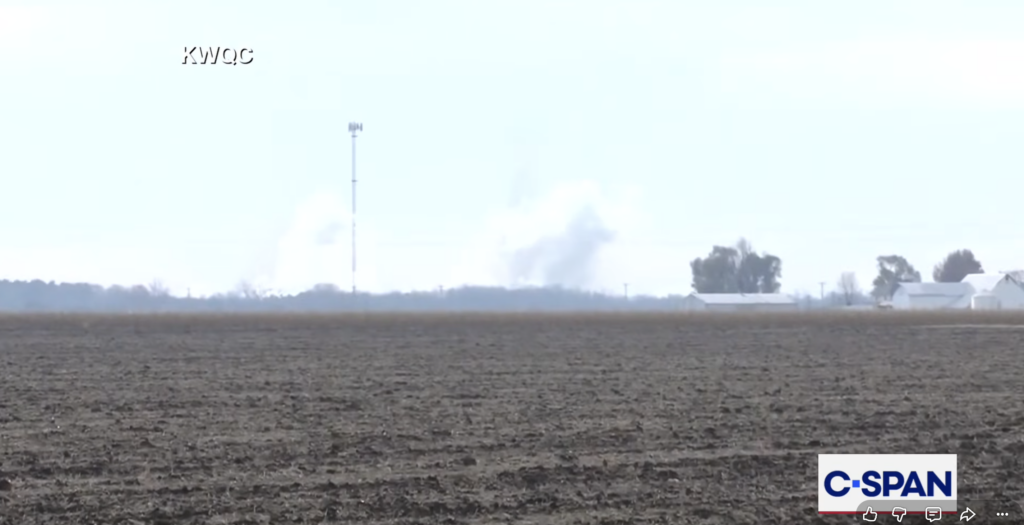
The U.S. Army intentionally detonated degraded, lead-based explosive Wednesday morning in southeast Iowa.
The operation has drawn public criticism in Iowa, and across the country, due to concerns of the spread of lead, which is toxic, from the detonation.
The Army decided to go ahead with the blast, after significantly increasing mitigation strategies and working to evacuate the area, because they determined intentional detonation was the best way to get rid of the material which was liable to detonate on its own.
The Army said it would update the public about the status of the operation by 11 a.m. at the latest.
The most recent maps from the U.S. Army showed lead particles released from the blast were likely to travel southwest of the site, as far as 100 miles over the next several hours. Dust with lead particles was expected to settle as far as 40 miles southwest of the blast site.
Folks in those areas have been advised to remain indoors, with windows and doors closed until the Army gives an all clear. Updates can be found online. The Army is also working with FEMA to distribute mobile notifications to people in the area.
The U.S. Environmental Protection Agency and the Army have been in Middletown and surrounding communities taking samples and are slated to take samples following the detonation to determine how much lead was released by the blast.
EPA has published a dashboard with air sampling and monitoring.
This story will be updated as more information is released.